


Article by
Dr. Sharafat Hussain Ph.D
Dr. Sharafat Hussain is a healthcare business consultant, entrepreneur, and academic with strong experience in the US healthcare industry. He is the Founder and Managing Director of Tausch Medical, a revenue cycle management company supporting US healthcare providers with medical billing, prior authorization, credentialing, eligibility verification, A/R follow-up, and patient support services. His work combines practical healthcare operations, business strategy, and academic insight to help medical practices improve efficiency, collections, and service quality.
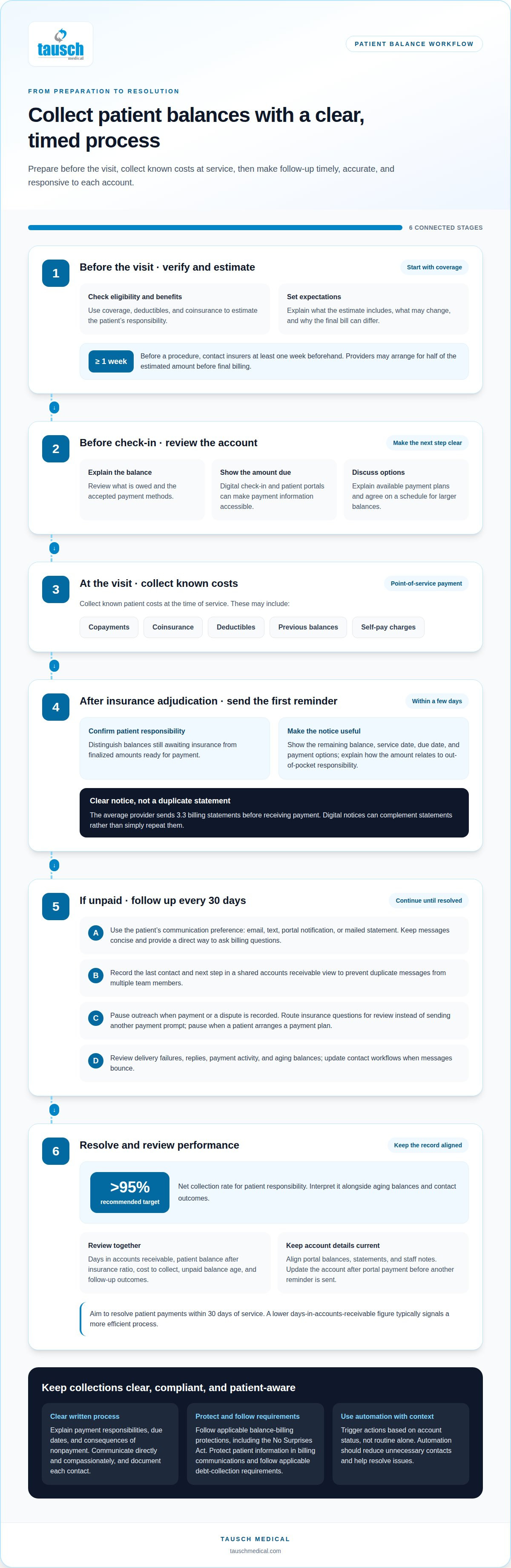
Collecting patient balances effectively starts before a visit and continues with timely, consistent follow-up. Review accounts before check-in, collect copayments and other known patient costs at the time of service, then send the first reminder within a few days after insurance adjudication and follow up every 30 days until the balance is resolved.
It’s easy to assume an invoice and a few statements are enough, but delayed or unclear communication can make an outstanding balance harder to resolve. Patients need to understand what they owe, why they owe it, and how to pay.
This article explains when to request payment, how to make reminders more useful, and how revenue cycle management can support a consistent collection process. It also covers how insurance verification, clear estimates, and organized accounts receivable follow-up help practices address balances without repeated manual outreach.
Key Takeaways
- Review patient accounts before check-in and collect known copayments or other patient costs at the time of service.
- Send the first balance reminder within a few days after insurance adjudication, then follow up every 30 days.
- Use automation to make payment instructions clear and routine outreach consistent, while focusing on resolving balances rather than sending unnecessary contacts.
- When billing and follow-up workflows need support, medical billing services and accounts receivable management can help practices manage patient balances more systematically.
1. When is the Right Time to Collect Patient Payment?
Start before the visit: verify insurance eligibility and benefits, then estimate the patient’s responsibility using coverage, deductibles, and coinsurance. Explain what the estimate includes, what may change, and why the final bill can differ. For procedures, contact insurers at least one week beforehand; providers may arrange for half of the estimated amount before final billing.
Make the next step clear through patient portals and online payment options. Before check-in, review the account and explain the balance, accepted payment methods, and any payment plan options. Digital check-in can show the amount due, while point-of-service payment can address copayments, coinsurance, deductibles, previous balances, and self-pay charges. For larger balances, agree on a payment schedule that works for the patient.
Set a written billing process that explains payment responsibilities, due dates, and the consequences of nonpayment. Staff should communicate directly and compassionately, document each contact, and explain that unpaid accounts may be referred to collections or affect continued practice participation. Aim to resolve patient payments within 30 days of service, while keeping estimates distinct from final bills.
Federal and state requirements affect what providers may bill and how they pursue payment. Follow applicable balance-billing protections, including the No Surprises Act, and bill patients only for amounts they owe under applicable law. HIPAA and the FDCPA address different concerns: protect patient information in billing communications, and follow applicable debt-collection requirements.
Track days in accounts receivable, the patient balance after insurance ratio, and cost to collect. A net collection rate above 95% is a recommended target for patient responsibility; interpret it alongside aging balances and contact outcomes.
To reduce bad debt without undermining the patient experience, provide clear estimates, convenient payment methods and plans, and consistent, discreet reminders. Once insurance adjudication is complete, send the first balance reminder promptly.
2. Automation for reminders and routine outreach
Automated outreach works best when each message reflects the account’s current status. After insurance adjudication, a practice can trigger a reminder showing the remaining balance, service date, and payment options. The average provider sends 3.3 billing statements before receiving payment, so clear digital notices can complement statements rather than simply duplicate them. Include a secure payment link and explain how the amount relates to the patient’s out-of-pocket responsibility.
Build a reminder sequence around account events: send an initial notice when the balance is finalized, follow up if it remains unpaid, and pause reminders when a payment or dispute is recorded. A shared accounts receivable view lets staff see the last contact and next step, preventing duplicate messages when multiple team members handle an account.
Use patients’ communication preferences to choose email, text, portal notifications, or mailed statements. Keep each message concise, identify the practice, and provide a direct way to ask billing questions. For example, a reminder can state the balance and due date, then direct the patient to a portal to review details or arrange payment. Clear information can improve understanding without making every notice feel like a collection demand.
Review delivery failures, patient replies, payment activity, and aging balances regularly. If a message bounces, update the contact workflow; if a patient raises an insurance question, route the account for review instead of sending another payment prompt. Practices can assess whether automated appointment communication also needs attention through patient scheduling support. These controls make automation a practical aid to account resolution, not an excuse for indiscriminate outreach.
3. Automated patient revenue management
Automation is most useful when it ties each account’s next action to its current status. A revenue cycle workflow can distinguish balances awaiting insurance adjudication from patient responsibility ready for payment. That distinction prevents premature statements and helps staff focus on accounts that need a decision, rather than another routine notice.
Set clear rules for common account events. For example, a completed insurance payment can trigger an updated patient statement, while a denied claim can enter a review queue instead of receiving a payment reminder. If an account remains unpaid, flag it as it approaches 30 days, then assign a specific follow-up action. Staff should be able to pause outreach when a patient disputes a charge or arranges a payment plan.
Keep portal balances, statements, and staff notes aligned. When a patient pays through the portal, update the account before sending another reminder. An accurate, accessible record also helps teams spot recurring billing errors, delayed insurance responses, and unresolved patient questions. Automation should reduce unnecessary contacts and help resolve issues, not send messages without regard to context.
Review performance using patient-responsibility net collection rate, days in accounts receivable, and the age of unpaid balances. A net collection rate above 95% is a recommended target for patient responsibility; a lower days-in-accounts-receivable figure typically signals a more efficient process. Compare trends by balance status and follow-up outcome, then adjust workflow rules where accounts stall. For practices seeking structured support with outstanding balances, explore accounts receivable management as a way to strengthen follow-up and resolution.
Tausch Medical: Medical Billing Services
Tausch Medical supports healthcare practices seeking more consistent billing and patient-balance follow-up. Its Medical Billing Services help organize billing workflows, while Insurance Verification and Authorization clarify coverage before care and inform estimates of patient responsibility.
For unpaid accounts that need structured follow-up, Accounts Receivable Management supports resolution. Practices that want to move billing tasks beyond their internal team can also use Medical Billing Outsourcing. These services may help when staff capacity is stretched, balances are aging, or billing tasks need clearer ownership across the revenue cycle.
To identify a useful next step, pinpoint where accounts stall, such as eligibility checks, claim processing, or follow-up after insurance adjudication. Contact Tausch Medical to discuss support for your practice’s billing and accounts receivable workflows.
Build a More Consistent Patient Payment Process
During your next workflow review, choose one improvement your team can implement, such as clarifying ownership of unresolved accounts or simplifying patient payment instructions. A focused change can make collection practices more consistent without adding unnecessary complexity.
Consider where expert operational support could help your practice maintain that progress.
Want to see how Tausch Medical can support your practice with reliable medical billing, prior authorization, eligibility verification, A/R follow-up, and RCM support? Start with our free two-week trial and experience the difference before making a commitment: free trial form
Frequently Asked Questions
How can healthcare staff collect outstanding balances?
Sort accounts by what is blocking resolution: pending insurance, a denied claim, a patient question, or an amount ready for payment. For example, route a denied claim for review rather than asking the patient to pay prematurely. Record the next action and its owner so staff can continue follow-up without duplicating work or overlooking the account.
When is the Right Time to Collect Patient Payment?
Collect known copayments during check-in, then request the remaining patient amount once insurance processing establishes the balance. If an estimate is available before a planned service, explain it upfront and clarify that the final responsibility may change. This helps patients understand why payment may be requested at different stages of the billing process.
When Should Providers Consider Third-Party Collection Support?
Consider external collection support when internal follow-up has stalled despite accurate statements, documented contact attempts, and review of billing questions or disputes. First separate unresolved insurance claims from valid patient balances, since they require different next steps. Also consider the effect on patient relationships and ensure any collection approach follows applicable requirements.
Why Is Collecting at Point-of-Service More Important?
Point-of-service collection gives staff an opportunity to explain a known charge while the patient checks in or out. A clear conversation can resolve confusion about a copayment or prior balance before it becomes a later billing question. Offering an online payment option at that point also lets patients pay without waiting for a mailed statement.
What are best practices for collecting patient balances effectively?
Make collecting patient balances effectively a workflow responsibility, not a series of disconnected reminders. Reconcile payments before contacting patients, distinguish insurance issues from patient responsibility, and document questions with a clear owner and next step. Review recurring delays to determine whether they stem from inaccurate account details, unclear statements, or inconsistent follow-up, then improve the relevant process.
Disclaimer
This article is for general informational purposes only and does not constitute legal, medical, billing, coding, compliance, or financial advice. Healthcare rules, payer policies, and reimbursement guidelines may change and may vary by situation. Please consult qualified professionals or official sources before making decisions based on this content. Tausch Medical is not responsible for any loss or liability arising from reliance on this information.


