


Article by
Dr. Sharafat Hussain Ph.D
Dr. Sharafat Hussain is a healthcare business consultant, entrepreneur, and academic with strong experience in the US healthcare industry. He is the Founder and Managing Director of Tausch Medical, a revenue cycle management company supporting US healthcare providers with medical billing, prior authorization, credentialing, eligibility verification, A/R follow-up, and patient support services. His work combines practical healthcare operations, business strategy, and academic insight to help medical practices improve efficiency, collections, and service quality.
In-house billing isn’t inherently risky; unclear ownership and limited controls are. The risks of in-house medical billing can emerge when claim follow-up depends on a few people, workflow bottlenecks go unnoticed, or recurring denials and eligibility issues lack a clear owner. Even a capable team can face these pressures as staffing and day-to-day priorities shift.
If you’re unsure whether billing processes are consistently monitored, this guide will help you assess them without assuming your in-house team is ineffective. You’ll learn which controls and performance signals to review, what questions can uncover delays or recurring issues, and how to decide whether additional billing or revenue cycle support may be worth evaluating.
Key Takeaways
- The risks of in-house medical billing can surface at handoffs across eligibility, authorization, claim submission, denial follow-up, and accounts receivable (A/R).
- Map each billing workflow, assign an owner and backup, and review exceptions to make gaps easier to identify and address.
- Track claim status, denial reasons, aging A/R, and unresolved eligibility or authorization questions to spot stalled work.
- When evaluating extra support, clarify responsibilities, reporting, access, and escalation processes so your practice retains visibility.
Risks of In-House Medical Billing: Where Workflow Gaps Can Emerge
In-house billing means the practice manages billing workflows itself, using its own staff and processes. The structure varies: one practice may assign tasks across several roles, while another may rely on a small team. The key risks of in-house medical billing arise when work is unclear, untracked, or beyond available capacity, not simply because billing is managed internally.
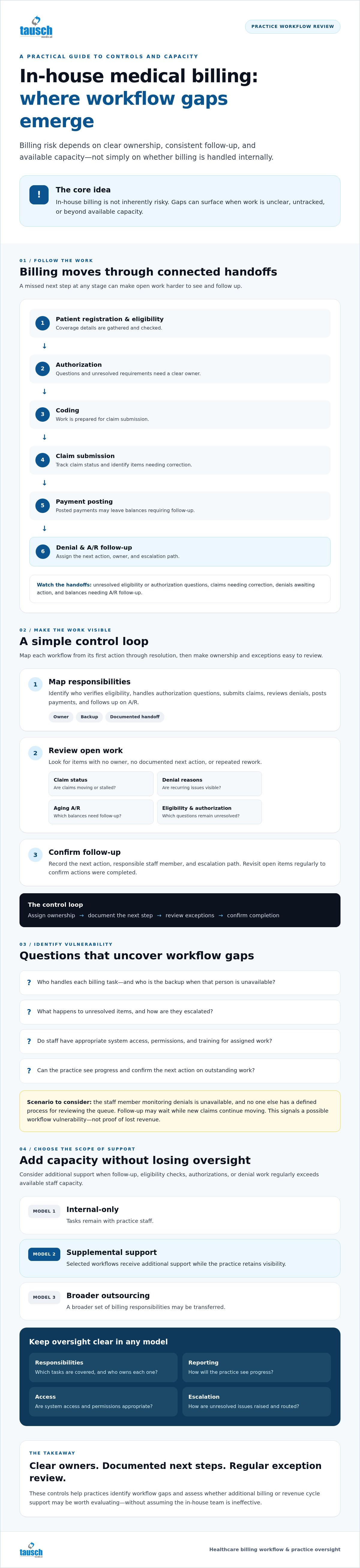
A typical medical billing process moves from patient registration and insurance eligibility checks through authorization, coding, claim submission, payment posting, and follow-up. Each handoff can create a gap. Missing or outdated coverage details may affect a claim, an authorization question may remain unresolved, or a denial may sit in a queue without an assigned owner. Practices can review Tausch Medical’s medical billing services when assessing whether additional billing capacity fits their needs.
Billing risk depends on process controls and available capacity, not location alone. Clear task ownership, documented steps, and visibility into open work help practices maintain oversight, whether billing is handled internally or with outside support.
Which billing tasks are most exposed to missed handoffs?
Consider a hypothetical absence: the staff member who monitors denials is unavailable, and no one else has a defined process for reviewing that queue. Follow-up may wait while new claims continue moving from submission to payment posting. That scenario signals a possible workflow vulnerability, not proof of lost revenue.
Review whether each stage has an owner, a backup, and a clear next step. Pay particular attention to unresolved eligibility or authorization questions, claims that need correction, denials requiring action, and posted payments that leave a balance for A/R follow-up. This helps distinguish an isolated delay from a recurring handoff problem without assuming every in-house team is ineffective.
How to Assess In-House Medical Billing Risks and Strengthen Controls
A structured review can show whether the risks of in-house medical billing stem from unclear ownership, inconsistent follow-up, or limited capacity. Start by mapping each workflow from the first action to resolution. Assign an owner and backup, document the handoffs, review exceptions, and check whether outstanding items receive a next step.
- Map responsibilities: Identify who verifies eligibility, handles authorization questions, submits claims, reviews denials, posts payments, and follows up on A/R.
- Review open work: Check claim status, denial reasons, aging A/R, and unresolved eligibility or authorization questions. Look for items with no owner, no documented next action, or repeated rework.
- Confirm follow-up: Record the next action, responsible staff member, and escalation path for unresolved items. Revisit the list regularly to confirm that actions were completed.
Documented ownership and recurring review help surface workflow exceptions before they become persistent blind spots. An internal medical billing audit can provide a framework for examining processes and controls. For related context on how front-end information affects billing workflows, read about the impact of inaccurate insurance verification.
What should a practice review before changing its billing model?
Before adjusting responsibilities, ask who handles each task, what happens during staff absences, and how unresolved items are escalated. Check whether staff have appropriate system access and permissions, and whether training supports their assigned work. Also confirm which privacy obligations apply to your practice and verify current requirements with qualified guidance. These checks help define safeguards before any workflow changes.
If you’re considering additional billing support, use the review to specify which tasks need help and what information your team needs to monitor progress. Learn about Tausch Medical’s billing support as one option to evaluate.
When to Add Medical Billing Support Without Losing Practice Oversight
Additional support may make sense when claim follow-up, eligibility checks, authorizations, or denial work regularly exceeds available staff capacity. The choice isn’t simply in-house or outsourced: an internal-only model keeps tasks with practice staff; supplemental support can take on selected workflows; and outsourcing can transfer a broader set of billing responsibilities. Compare each option by the work it covers, who owns each task, how the practice sees progress, and how unresolved issues are escalated. Explore medical billing services and outsourced medical billing services as options to evaluate.
How can outside support complement an in-house team?
Support can be scoped around specific pressure points, such as insurance verification, prior authorization, denial follow-up, or A/R management, while practice staff retain responsibility for other workflows. A knowledgeable medical biller can help keep assigned billing work organized, but responsibilities and handoffs still need to be clear. For focused context on denials, review your practice’s denial reasons and the steps used to resolve them.
Before changing a workflow, agree on which tasks the support team handles, what information and system access it needs, how progress will be reported, and who receives escalations. Set a communication cadence and define how the practice will review open items. These controls help preserve oversight and address the risks of in-house medical billing without assuming every task must leave the practice.
For practices in Houston, San Antonio, Dallas, Austin, El Paso, Arlington, Plano, New York, Boston, Philadelphia, Washington D.C., Baltimore, Miami, Orlando, Tampa, Atlanta, Raleigh, Richmond, and Jacksonville, Tausch Medical offers billing support that can include insurance verification, authorization, denial management, and A/R management.
Build a Billing Model Your Practice Can Oversee
The risks of in-house medical billing depend on how well work is assigned, monitored, and followed through, not simply on where billing happens. Clear ownership, documented workflows, and regular reviews can help your practice identify stalled claims and recurring exceptions. If capacity is the concern, supplemental or outsourced support may help address specific tasks while your practice defines reporting, access, and escalation expectations.
Tausch Medical provides medical billing and revenue cycle management support, including insurance verification, prior authorization, denial management, and A/R follow-up. Explore Tausch Medical’s services to consider whether additional support aligns with your practice’s needs.
Review your billing workflows and contact Tausch Medical to discuss medical billing support for the tasks your practice needs help managing.
A thoughtful assessment can help you strengthen oversight and choose a billing approach with greater confidence.
Frequently Asked Questions
What are the main risks of in-house medical billing?
The main risks of in-house medical billing include unclear task ownership, missed handoffs, staffing gaps, inconsistent follow-up, and limited visibility into unresolved claims. For example, eligibility questions, authorization issues, denials, or aging A/R may remain unattended if no one is assigned to monitor and escalate them. These are potential workflow vulnerabilities, not proof that an in-house team is performing poorly.
Can a medical practice reduce in-house billing risks without outsourcing?
Yes. A practice can strengthen internal billing controls by documenting each workflow, assigning a clear owner to every task, and establishing backup coverage for staff absences. Regularly review claim status, denial reasons, aging A/R, and unresolved eligibility or authorization questions. Set a consistent process for escalating stalled items, then use the review findings to update training and clarify responsibilities.
Is in-house medical billing less secure than outsourced billing?
Not necessarily. Security depends on the safeguards, access practices, and oversight in place, rather than whether billing is handled internally or externally. Practices should review who can access billing information, how system permissions are managed, how staff or vendors handle sensitive data, and what procedures apply when access changes. Before outsourcing, clarify responsibilities, reporting, and communication with the provider.
When should a practice consider outside medical billing support?
Consider additional support if billing tasks repeatedly exceed staff capacity, follow-up queues remain unresolved, or key workflows depend on one person without backup. Practices in Houston, San Antonio, Dallas, Austin, El Paso, Arlington, Plano, New York, Boston, Philadelphia, Washington D.C., Baltimore, Miami, Orlando, Tampa, Atlanta, Raleigh, Richmond, and Jacksonville can evaluate Tausch Medical’s billing and revenue cycle management support, including insurance verification, authorization, denial management, and A/R follow-up.
Disclaimer
This article is for general informational purposes only and does not constitute legal, medical, billing, coding, compliance, or financial advice. Healthcare rules, payer policies, and reimbursement guidelines may change and may vary by situation. Please consult qualified professionals or official sources before making decisions based on this content. Tausch Medical is not responsible for any loss or liability arising from reliance on this information.


