


Article by
Dr. Sharafat Hussain Ph.D
Dr. Sharafat Hussain is a healthcare business consultant, entrepreneur, and academic with strong experience in the US healthcare industry. He is the Founder and Managing Director of Tausch Medical, a revenue cycle management company supporting US healthcare providers with medical billing, prior authorization, credentialing, eligibility verification, A/R follow-up, and patient support services. His work combines practical healthcare operations, business strategy, and academic insight to help medical practices improve efficiency, collections, and service quality.
High patient volume doesn’t guarantee a healthy practice. Cash flow can still stall when claims are denied, receivables age, or billing performance is hard to see. The key performance indicators for medical billing turn these symptoms into measurable signals, helping you pinpoint where revenue is delayed or lost.
If collections aren’t keeping pace with the care you provide, look beyond claim volume. Persistent denials and limited visibility into billing operations can make it difficult to identify what needs attention and whether performance is improving.
This reference explains what key billing metrics reveal and how to use them to guide revenue cycle improvements. Learn how to assess days in A/R, clean claim and denial rates, net collections, and aging receivables, then use those findings to set practical priorities.
Key Takeaways
- Use key performance indicators for medical billing to assess financial health and identify where revenue cycle performance needs attention.
- Distinguish gross collection rate from net collection rate to understand how effectively your practice collects what it is owed.
- Track denial trends and first-pass claim accuracy to uncover workflow issues and strengthen revenue integrity.
- Turn monthly KPI reviews into specific process changes, and use cost to collect to evaluate the resources your billing operation requires.
Essential Financial KPIs: Key Performance Indicators for Medical Billing
Financial performance needs to be measured, not inferred from appointment volume or billed charges. The key performance indicators for medical billing show whether services are translating into collectible revenue, where cash is getting delayed, and which processes may need attention. These are vital signs within the broader Revenue Cycle Management (RCM) process, connecting administrative work to financial outcomes.
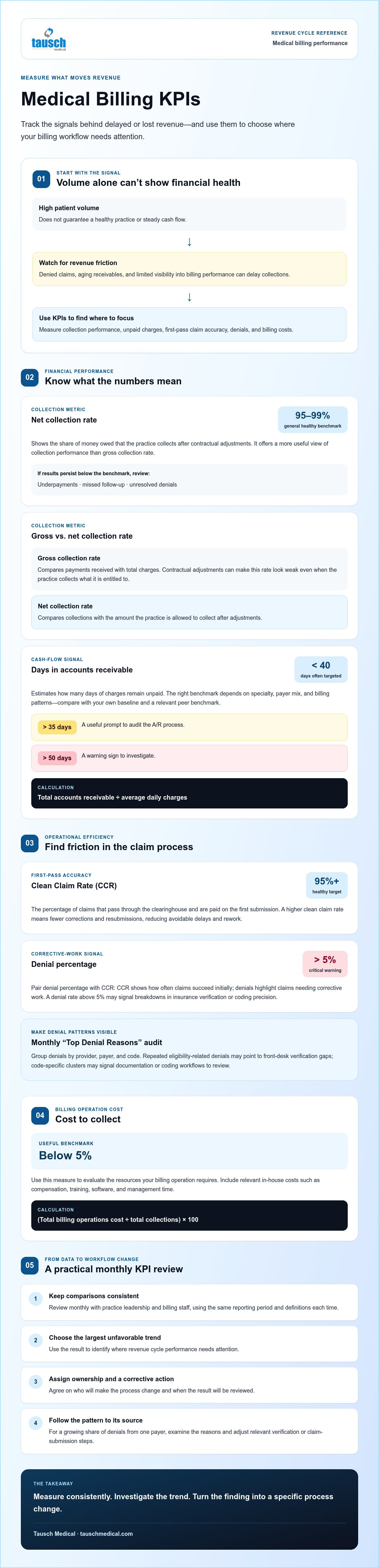
Gross collection rate compares payments received with total charges. Because contractual adjustments affect the calculation, this rate can look weak even when the practice collects what it is entitled to. Net collection rate offers a more useful view of collection performance: it compares collections with the amount the practice is allowed to collect after adjustments. A healthy benchmark is generally 95% to 99%. Persistent results below that range warrant a closer look at underpayments, missed follow-up, and unresolved denials.
Net Collection Rate and Days in Accounts Receivable (A/R)
Net collection rate is the percentage of money owed to a practice that it actually collects after contractual adjustments. To calculate days in A/R, divide total accounts receivable by average daily charges. The result estimates how many days of charges remain unpaid.
As a general reference, practices often target fewer than 40 A/R days, but the right benchmark depends on specialty, payer mix, and billing patterns. A surgical specialty, for example, may have different payment timing from a primary care practice. Compare your results with your own baseline and a relevant peer benchmark. More than 50 days is a warning sign, while exceeding 35 days is a useful prompt to audit the A/R process. Review aging, payer delays, and follow-up consistency, then assess whether your medical billing operations support timely, accurate reimbursement.
Operational Efficiency Metrics: Analyzing Denial Trends and Claim Accuracy
Billing supports revenue integrity when a practice tracks not only what was submitted, but where preventable errors enter the claim process. Among the key performance indicators for medical billing, first-pass performance is especially useful. A high Clean Claim Rate (CCR) means fewer claims need correction and resubmission, reducing avoidable delays and rework. Northwest Career College’s guide to Essential Medical Billing KPIs also explains how operational measures can help practices assess performance.
Clean Claim Rate (CCR) and Denial Percentage
Clean Claim Rate is the percentage of claims that pass through the clearinghouse and are paid on the first submission. A healthy target is generally 95% or higher. Pair CCR with denial percentage: the first shows how often claims succeed initially, while the second highlights claims that need corrective work. A denial rate above 5% should be treated as a critical warning of possible breakdowns in insurance verification or coding precision.
Use a monthly “Top Denial Reasons” audit to identify patterns instead of treating each rejection as an isolated issue. Group denials by provider, payer, and code. Repeated eligibility-related denials may point to front-desk verification gaps, while code-specific clusters may indicate documentation or coding workflows that need review. This connects front-end accuracy to back-end collections and makes follow-up more targeted.
Track findings alongside payer responses and corrective actions, then consult this guide to medical claim denial management for recovery tactics. Practices seeking additional support can explore medical billing and denial management services as part of a more consistent revenue integrity process.
Transforming KPI Data into Revenue Growth Strategies
Metrics create value only when they lead to a workflow change. Hold a monthly review with practice leadership and billing staff, using the same reporting period and definitions each time. Start with the HFMA MAP Keys as a reference. Select the largest unfavorable trend, assign an owner, and agree on a corrective action and date to review the result. For example, if one payer accounts for a growing share of denials, examine the reasons and adjust the relevant verification or claim submission steps.
Identifying When to Transition to Professional RCM Support
Calculate cost to collect by dividing the total cost of billing operations by total collections, then multiplying by 100. Include relevant in-house expenses such as compensation, training, software, and management time. A rate below 5% is a useful benchmark. Compare it with the scope of work and results before deciding whether your current model is sustainable.
Consider professional support when denial rates remain elevated, A/R days keep rising, or your team lacks the capacity to investigate recurring issues and follow up consistently. These are signals to assess, not automatic proof that outsourcing is the right choice. Compare internal performance with services that cover the same functions, and ask prospective partners what their reporting shows, how often it is updated, and how exceptions are escalated. Tausch Medical serves providers in Dallas, Houston, New York, and other major cities. Practices can review its medical billing services as one comparison point.
Use your monthly review to record the baseline, action taken, and subsequent KPI movement. For additional evaluation criteria, see this guide to outsourcing revenue cycle management. Tracking key performance indicators for medical billing this way turns reporting into a disciplined improvement cycle. Clear reports also help practices assess whether internal or external support is providing the visibility they need.
Turn Billing Insights into Sustainable Growth
Key performance indicators for medical billing help turn revenue cycle data into practical decisions. Use monthly reviews to see whether process changes are improving collections, claim accuracy, and denial trends, then assign clear ownership for next steps. Consistent follow-through helps your practice respond to reimbursement challenges with greater clarity.
When internal visibility or capacity limits progress, an RCM partner can support A/R recovery and denial management while your team focuses on patient care. Tausch Medical serves providers across markets including Houston, Dallas, and New York.
Contact Tausch Medical to discuss medical billing, insurance verification and authorization, A/R management, denial management, patient scheduling, and provider credentialing for your practice.
Frequently Asked Questions
What is the most important KPI for medical billing?
Net collection rate is often the clearest overall measure of how effectively a practice collects the reimbursement it is entitled to receive after contractual adjustments. A healthy benchmark is generally 95% to 99%. It should not stand alone, though. Pair it with Clean Claim Rate and denial trends to see whether collection results reflect accurate first-pass billing or extensive rework and follow-up.
How much should it cost a medical practice to collect its revenue?
A commonly used benchmark is to keep cost to collect below 5% of total revenue collected. Calculate it by dividing the costs of billing operations by collections, then multiplying by 100. Include relevant expenses such as staff compensation, training, software, and management time. Compare results over time and against the scope of work, since definitions and included costs can vary between practices.
What is a good benchmark for Days in A/R in 2026?
A practical general target is fewer than 40 Days in A/R, with 30 to 40 days considered a strong range for many practices. MGMA’s reported 2026 median for physician groups is 42 to 47 days, while more than 50 days is a warning sign. Interpret your results in the context of specialty, payer mix, and your own historical trend.
How can I reduce my practice’s claim denial rate quickly?
Start by reviewing recent denials and grouping them by payer, provider, and code to identify recurring causes. Correct front-end eligibility or authorization gaps and address coding or documentation patterns, then monitor whether those denial categories decline. Tausch Medical supports providers in Houston, San Antonio, Dallas, Austin, El Paso, Arlington, Plano, New York, Boston, Philadelphia, Washington, D.C., Baltimore, Miami, Orlando, Tampa, Atlanta, Raleigh, Richmond, and Jacksonville with medical billing, verification and authorization, A/R management, and denial management.
Disclaimer
This article is for general informational purposes only and does not constitute legal, medical, billing, coding, compliance, or financial advice. Healthcare rules, payer policies, and reimbursement guidelines may change and may vary by situation. Please consult qualified professionals or official sources before making decisions based on this content. Tausch Medical is not responsible for any loss or liability arising from reliance on this information.


