


Article by
Dr. Sharafat Hussain Ph.D
Dr. Sharafat Hussain is a healthcare business consultant, entrepreneur, and academic with strong experience in the US healthcare industry. He is the Founder and Managing Director of Tausch Medical, a revenue cycle management company supporting US healthcare providers with medical billing, prior authorization, credentialing, eligibility verification, A/R follow-up, and patient support services. His work combines practical healthcare operations, business strategy, and academic insight to help medical practices improve efficiency, collections, and service quality.
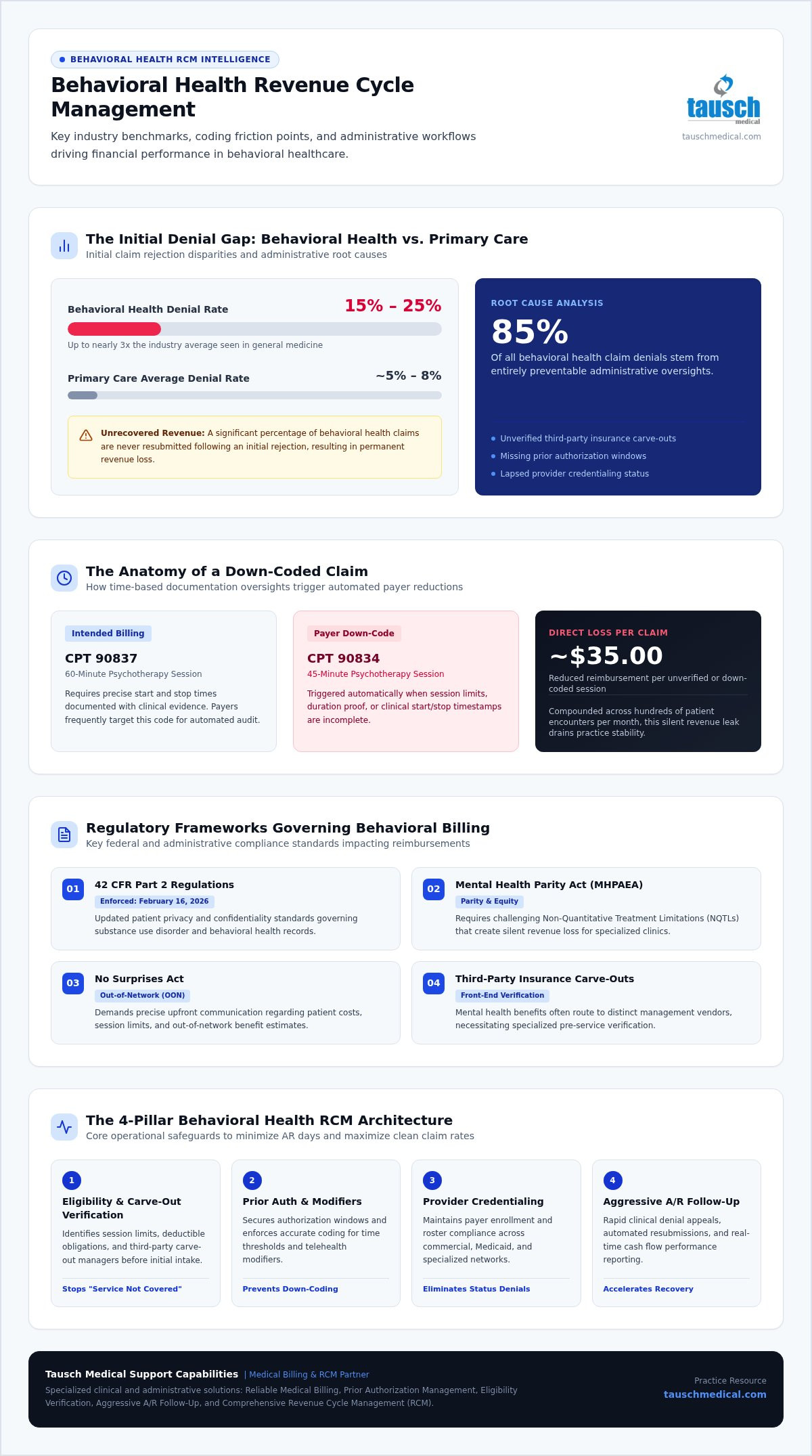
Did you know that behavioral health practices face initial claim denial rates between 15% and 25%; a figure that is nearly triple the average seen in primary care? It's a taxing reality for providers who wish to prioritize clinical excellence but find themselves tethered to exhausting administrative hurdles. You likely understand the frustration of managing third-party carve-outs, tracking session limits, and navigating the complexities of time-based CPT documentation. This administrative burden doesn't just drain your energy; it actively compromises your practice's financial health and long-term stability.
Our guide demonstrates how specialized mental health billing services can transform these challenges into a streamlined, high-performance revenue cycle. We'll explore the strategic advantages of expert management, from mastering telehealth modifiers to optimizing prior authorization workflows. By the end of this article, you'll discover how to achieve lower AR days and improved clean claim rates, ultimately securing the clinical precision and premium support your practice deserves.
Key Takeaways
- Understand the critical differences between general medical coding and behavioral health requirements, including session time thresholds and specific insurance carve-outs.
- Recognize the essential features of a high-performance partner, such as aggressive accounts receivable follow-up and clinical expertise in denial management.
- Discover how specialized mental health billing services can eliminate administrative friction by managing prior authorizations and complex eligibility verification processes.
- Learn how to optimize your practice’s financial health through the seamless integration of patient scheduling and comprehensive revenue cycle management.
Navigating the Complexities of Mental Health Billing Services
Mental health billing services represent a specialized discipline within the broader healthcare landscape, focused specifically on the submission and reconciliation of behavioral health claims. Unlike general medicine, where procedures are often finite, mental health billing relies on the nuances of time-based encounters and session-specific limitations. Effective revenue cycle management in this field requires a deep understanding of how payers treat mental health differently, often through complex third-party carve-outs that lead to initial denial rates reaching 25%. It's a landscape where administrative precision directly dictates financial stability.
Behavioral health practices face unique economic pressures, such as managing Out-of-Network (OON) benefits and maintaining compliance with the No Surprises Act. These regulations demand precise communication regarding patient costs. For many providers, outsourcing revenue cycle management has evolved from a simple administrative choice into a critical growth strategy. It allows clinicians to reclaim time for patient care while ensuring technical compliance with updated standards like the 42 CFR Part 2 regulations enforced as of February 16, 2026.
Why Behavioral Health Billing Requires Specialized Expertise
Precision in coding is paramount for mental health billing services. Payers frequently target 60-minute sessions (CPT 90837) for automated down-coding to 45-minute sessions (CPT 90834) if start and stop times aren't documented with clinical evidence. This single error can reduce reimbursement by approximately $35 per claim. Proactive insurance verification serves as the first line of defense, identifying session limits and prior authorization windows before treatment begins. Without this front-end rigor, practices risk the 85% of denials that stem from entirely preventable administrative oversights.
Key Features of a High-Performance Mental Health Billing Partner
A high-performance partner for mental health billing services must offer more than just submission software; they must provide clinical advocacy. This involves deep expertise in the Mental Health Parity and Addiction Equity Act to challenge non-quantitative treatment limitations that often lead to silent revenue loss. Transparency is equally vital, ensuring providers have clear visibility into their financial data through real-time reporting. For independent practices scaling in major hubs like Houston or Dallas, these insights are crucial for monitoring cash flow and identifying bottlenecks before they impact daily operations.
Aggressive A/R follow-up and dedicated medical claim denial management are the primary drivers of revenue recovery in behavioral health. Since a high percentage of claims are never resubmitted after an initial rejection, having a partner that pursues every dollar is a necessity for long-term health. Many clinicians find that they can finally expand their patient capacity and reduce administrative overhead when they choose to outsource medical billing services to a specialized expert who understands the nuances of therapy-specific workflows.
The Role of Provider Credentialing and Insurance Verification
Successful billing begins long before the first session. Comprehensive provider credentialing services ensure you're correctly enrolled with the right payers, preventing rejections based on provider status. When paired with rigorous eligibility verification, this foundation stops "service not covered" denials before a patient even enters your office. By confirming carve-outs and authorization windows upfront, you secure your revenue stream from the start. You can optimize your recovery process with our specialized support, ensuring your practice remains financially resilient through every stage of the billing cycle.
Optimizing Your Behavioral Health Revenue with Tausch Medical
Tausch Medical understands that mental health billing services require more than just technical data entry; they demand a clinical perspective rooted in evidence-based management. By offering dedicated AR denial services, we ensure that no claim is abandoned due to the administrative complexity typical of behavioral health. Our team operates with a focus on clinical precision, providing premium support for specialized practices in major hubs like New York and Atlanta. We position ourselves as the strategic partner that resolves administrative chaos, allowing you to dedicate your full attention to clinical outcomes.
Operational efficiency is only achieved when front-end and back-end systems work in perfect harmony. Our patient scheduling and phone answering services integrate directly with our billing workflows to create a seamless, end-to-end experience. This high-level integration ensures that every patient encounter within our mental health billing services adheres to the latest psychotherapy coding guidelines from the initial intake call. By verifying insurance and obtaining authorizations at the point of scheduling, we eliminate the friction that often leads to costly downstream denials.
Transitioning to Outsourced Billing: A Risk-Free Approach
Many practitioners hesitate to switch billing companies because they fear data migration issues or temporary cash flow interruptions. Tausch Medical addresses these concerns with a sophisticated transition framework that prioritizes security and continuity. We believe that mastering revenue cycle management is the cornerstone of long-term sustainability for modern practices. To demonstrate our commitment, we offer a risk-free introductory period. It's a professional path that allows skeptical practitioners to experience our rigor and see the tangible impact on their clean claim rate before making a formal commitment.
Elevating Your Practice Through Strategic RCM Partnership
The evolution of behavioral health care demands a billing infrastructure that is as precise as the clinical work it supports. Throughout this guide, we have examined how the strategic alignment of credentialing, proactive verification, and specialized denial management protects a practice's most vital resources. By leveraging professional mental health billing services, you ensure that complex payer rules and algorithmic down-coding no longer dictate your clinical schedule. This partnership provides the transparency and technical rigor necessary to navigate the modern regulatory environment in hubs ranging from Austin to Philadelphia, allowing your team to focus exclusively on delivering world-class care.
Want to see how Tausch Medical can support your practice with reliable medical billing, prior authorization, eligibility verification, A/R follow-up, and RCM support? Start with our free two-week trial and experience the difference before making a commitment: free trial form
Frequently Asked Questions
What is the difference between general medical billing and mental health billing services?
Mental health billing services are distinct because they manage non-quantitative treatment limitations and complex insurance carve-outs that don't exist in general medicine. Unlike procedural billing, behavioral health relies on precise session-time documentation and cumulative visit limits. Practices in San Antonio and Plano require this level of specialty knowledge to prevent automated down-coding and ensure consistent revenue flow.
How do specialized billing services handle mental health claim denials?
Specialized partners like Tausch Medical analyze denial patterns specific to behavioral health, such as mismatched telehealth modifiers or expired authorizations. Instead of accepting initial rejections, we perform clinical reviews to align claims with current 2026 CMS guidelines. This aggressive approach is essential for providers in Austin or Jacksonville who face initial denial rates significantly higher than the national medical average.
Can outsourcing mental health billing help with provider credentialing?
Outsourcing ensures that provider credentialing services are integrated directly into the billing lifecycle. This prevents unrecognized provider denials by ensuring all clinicians in Baltimore or Arlington are correctly enrolled with relevant payers before treatment begins. By managing the complexities of primary source verification, we allow your practice to expand without the administrative delays typical of manual enrollment processes.
Disclaimer
This article is for general informational purposes only and does not constitute legal, medical, billing, coding, compliance, or financial advice. Healthcare rules, payer policies, and reimbursement guidelines may change and may vary by situation. Please consult qualified professionals or official sources before making decisions based on this content. Tausch Medical is not responsible for any loss or liability arising from reliance on this information.


