


Article by
Dr. Sharafat Hussain Ph.D
Dr. Sharafat Hussain is a healthcare business consultant, entrepreneur, and academic with strong experience in the US healthcare industry. He is the Founder and Managing Director of Tausch Medical, a revenue cycle management company supporting US healthcare providers with medical billing, prior authorization, credentialing, eligibility verification, A/R follow-up, and patient support services. His work combines practical healthcare operations, business strategy, and academic insight to help medical practices improve efficiency, collections, and service quality.
How much revenue did your practice lose this morning because a provider's status remains "pending" in a payer's outdated database? Most clinical leaders view the cost of medical credentialing services as an administrative fee, yet the true price of inefficiency is often hidden in the form of out-of-network denials and months of delayed reimbursements. You're likely tired of the administrative burnout that comes with navigating complex application cycles that seem designed to fail. We believe that clinical precision should extend to your business operations.
This guide will help you analyze the financial impact of provider enrollment and teach you how to evaluate credentialing partners to ensure your revenue remains protected. We'll explore strategic ways to achieve zero-error submissions and predictable operational costs for your practice in 2026. By aligning your enrollment strategy with your revenue cycle, you'll secure a faster time-to-reimbursement and maintain a premium standard.
Key Takeaways
- Distinguish between upfront service fees and the hidden revenue leakage of out-of-network status to calculate the comprehensive cost of medical credentialing services.
- Verify a partner’s Primary Source Verification (PSV) accuracy and reporting transparency to prevent administrative delays and ensure NCQA compliance.
- Align your credentialing strategy with professional medical billing outsourcing to minimize front-end claim rejections and accelerate your revenue cycle.
- Transition from reactive enrollment to a proactive strategy that ensures predictable operational costs and a faster time-to-reimbursement for every provider.
Understanding the True Cost of Medical Credentialing Services
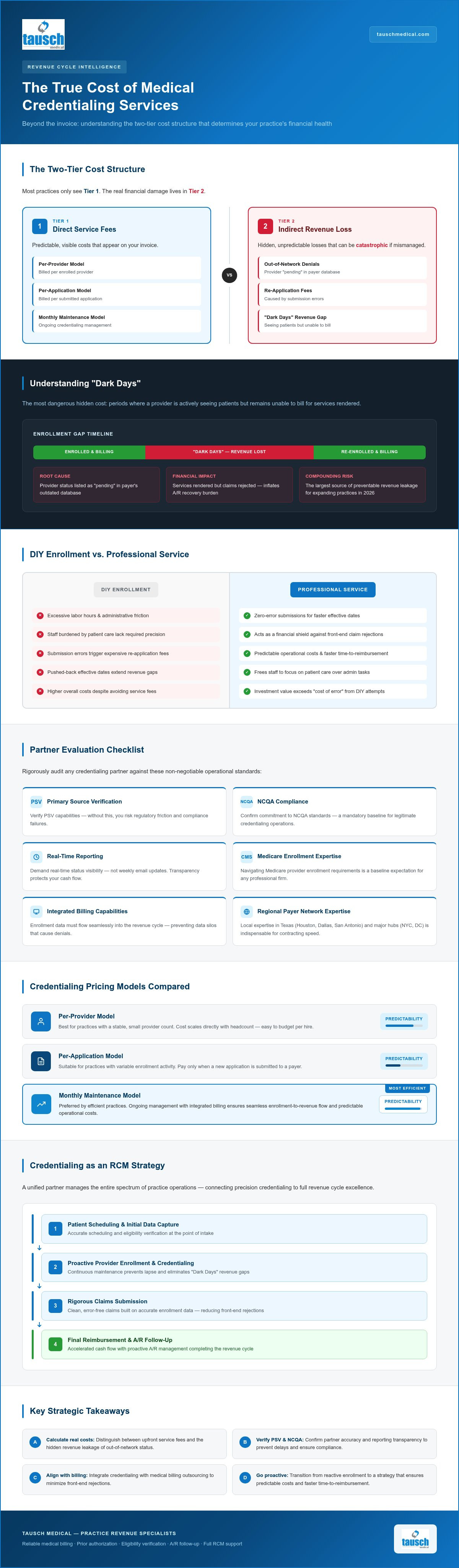
Analyzing the cost of medical credentialing services requires looking beyond the initial invoice. Most practices make the mistake of viewing this as a simple line-item expense. In reality, a two-tier cost structure exists: direct service fees and indirect revenue loss. While direct fees are predictable, indirect losses from mismanagement can be catastrophic. Professional provider credentialing services act as a financial shield; they prevent front-end claim rejections that otherwise stall your cash flow immediately.
In 2026, the administrative landscape is more fragmented than ever. Attempting DIY enrollment often results in higher costs due to excessive labor hours and administrative friction. The foundational process of medical credentialing now demands a level of clinical precision that internal staff, already burdened by patient care, rarely possess. Errors in these submissions lead to expensive re-application fees and pushed-back effective dates. This "cost of error" often far outweighs the investment in professional service rates.
The Hidden Costs of Physician Credentialing Delays
Delays create what industry experts call "Dark Days." These are periods where a provider is actively seeing patients but remains unable to bill for services rendered. These gaps directly inflate your medical accounts receivable recovery efforts later. Revenue leakage is no longer a minor nuisance; it's a systemic risk to practice stability. Precision in the initial application is the only way to protect your bottom line from these invisible drains. Industry analysts suggest that the compounding effect of enrollment delays represents the single largest source of preventable revenue leakage for expanding practices in 2026.
How to Evaluate and Select a Credentialing Partner
Selecting a partner requires a rigorous audit of their operational standards. You must first verify their Primary Source Verification (PSV) capabilities and commitment to NCQA compliance. Without these, you risk regulatory friction. Real-time reporting transparency is equally vital; you shouldn't have to wait for weekly emails to see an application status. Navigating Medicare provider enrollment requirements is a baseline expectation for any professional firm.
When you compare the cost of medical credentialing services, look beyond the surface price. Providers often choose between per-provider, per-application, or monthly maintenance models. The most efficient practices opt for partners with integrated medical billing capabilities. This synergy ensures that enrollment data flows seamlessly into the revenue cycle, preventing the data silos that often cause claim denials.
Navigating Regional Payer Networks in Texas and Major Hubs
Local expertise in Texas hubs like Houston, Dallas, and San Antonio is indispensable. Texas payer contracts often involve unique nuances that differ significantly from East Coast networks in NYC or DC. A partner who understands these regional variations can accelerate the contracting phase. This expertise naturally leads to more accurate insurance eligibility verification, which is a critical byproduct of clean credentialing. If you're looking to scale your practice across these competitive markets, partnering with a specialist who understands these local dynamics is a strategic necessity.
Integrating Credentialing into Your Revenue Cycle Strategy
Integrating credentialing into your revenue cycle isn't just an administrative choice; it's a financial imperative. Successful medical billing outsourcing depends entirely on the precision of your initial provider enrollment. If the foundation is cracked, your billing efforts will inevitably lead to denials. Precision is foundational. By prioritizing enrollment, you remove the friction that often plagues front-desk staff, allowing them to focus on patient care rather than resolving avoidable insurance discrepancies.
Understanding the cost of medical credentialing services as a strategic investment rather than a burden is the first step toward RCM excellence. A unified partner manages the entire spectrum of practice operations, including:
- Accurate patient scheduling and initial data capture.
- Proactive provider enrollment and continuous credentialing maintenance.
- Rigorous claims submission and final reimbursement follow-up.
In 2026, the ROI of a Credentialing-First approach is evident in the reduction of Dark Days. When you analyze the cost of medical credentialing services, consider the long-term stability it provides. Claims stay clean.
The Tausch Advantage: Strategic Partnership Over Transactions
Tausch Medical views enrollment as the heartbeat of your practice's financial health. We don't treat these processes as isolated tasks. Our uncompromising integrated approach is designed specifically to reduce A/R days and minimize denial rates by ensuring that every provider is correctly positioned within payer networks. This clinical precision in management allows you to scale with confidence. We invite you to experience this synergy firsthand through our risk-free trial, which serves as the definitive way to evaluate our service quality and commitment to your success.
Securing Your Practice's Financial Future in 2026
Managing the long-term cost of medical credentialing services requires a fundamental shift from reactive administrative tasks to a proactive revenue strategy. We've explored how identifying hidden revenue leakage and integrating enrollment with your broader revenue cycle can eliminate the "Dark Days" that stall practice growth. Selecting a partner with clinical precision ensures that your provider data remains a catalyst for reimbursement rather than a barrier to care. By prioritizing transparency and regional expertise, you protect your bottom line and reduce the administrative burden on your team.
Want to see how Tausch Medical can support your practice with reliable medical billing, prior authorization, eligibility verification, A/R follow-up, and RCM support? Start with our free two-week trial and experience the difference before making a commitment: free trial form
Your practice deserves a partner committed to clinical excellence and sustainable growth.
Frequently Asked Questions
What is the average turnaround time for medical credentialing in 2026?
Turnaround times for 2026 generally range between 90 and 120 days depending on the specific payer and region. While digital automation has improved some phases, manual verification remains a significant bottleneck. In high-demand hubs like Houston or San Antonio, administrative backlogs at major insurance carriers can extend this window. Maintaining a complete and accurate CAQH profile is the most effective way to prevent unnecessary delays.
Do medical credentialing companies charge per provider or per application?
Most companies offer flexible fee structures tailored to practice size and growth goals. Common models include flat per-application fees for one-time enrollments or per-provider rates for comprehensive management. When evaluating the cost of medical credentialing services, it's vital to check if maintenance and re-credentialing are included. Practices in competitive markets like New York or Miami often prefer monthly maintenance to ensure continuous compliance.
What is the difference between provider enrollment and medical credentialing?
Credentialing is the rigorous process of verifying a provider's qualifications, including education, licenses, and clinical history. Enrollment is the subsequent step of contracting with a payer to receive reimbursement for services. You cannot have one without the other. For providers in Dallas or Atlanta, this distinction is critical because clinical credentialing must be finalized before the payer will even consider the enrollment application.
How does credentialing impact my medical billing denial rate?
Credentialing precision directly influences your front-end denial rate. Inaccurate or expired enrollment data is a primary cause of "provider not found" or "out-of-network" rejections. By integrating these services with expert denial management, practices in cities like Austin or Boston can significantly reduce revenue leakage. Managing the cost of medical credentialing services effectively prevents the expensive administrative burden of re-filing claims that were rejected due to enrollment errors.
Disclaimer
This article is for general informational purposes only and does not constitute legal, medical, billing, coding, compliance, or financial advice. Healthcare rules, payer policies, and reimbursement guidelines may change and may vary by situation. Please consult qualified professionals or official sources before making decisions based on this content. Tausch Medical is not responsible for any loss or liability arising from reliance on this information.


