


Article by
Dr. Sharafat Hussain Ph.D
Dr. Sharafat Hussain is a healthcare business consultant, entrepreneur, and academic with strong experience in the US healthcare industry. He is the Founder and Managing Director of Tausch Medical, a revenue cycle management company supporting US healthcare providers with medical billing, prior authorization, credentialing, eligibility verification, A/R follow-up, and patient support services. His work combines practical healthcare operations, business strategy, and academic insight to help medical practices improve efficiency, collections, and service quality.
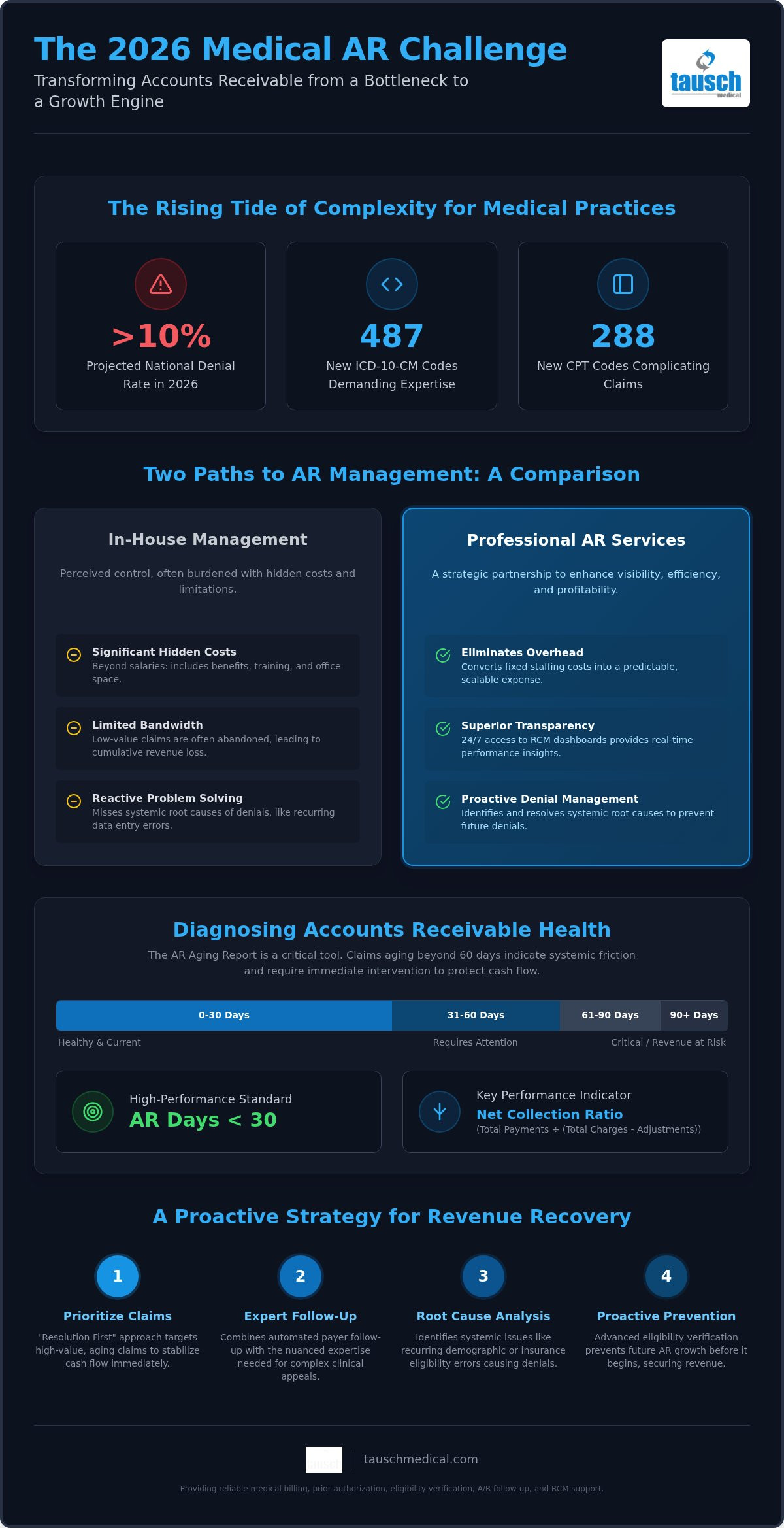
With national denial rates exceeding 10% in 2026, the financial stability of a premium healthcare practice requires the same precision as your clinical procedures. You've likely felt the weight of stagnant cash flow from aging insurance claims and the administrative friction of staff turnover. Integrating professional medical accounts receivable services is no longer an elective strategy; it's a necessity for those seeking to overcome these obstacles to long-term growth.
Navigating the 487 new ICD-10-CM codes and complex 2026 payer requirements demands expertise that internal teams often struggle to sustain. This guide explores how specialized management transforms these bottlenecks into predictable cash flow. We'll outline the strategic frameworks necessary to reduce the burden on your clinical staff and achieve industry-leading AR metrics of under 30 days, ensuring your practice remains a model of both medical and operational excellence.
Key Takeaways
- Learn why modern medical accounts receivable services are essential for navigating 2026 payer complexities and maintaining consistent practice liquidity.
- Identify the hidden administrative costs and revenue leaks associated with managing aging claims through internal billing departments.
- Discover how specialized denial management identifies systemic root causes to recover revenue that internal teams often overlook.
- Understand the transition process for integrating professional AR recovery into your broader growth goals without disrupting patient care.
The Strategic Role of Medical Accounts Receivable Services in 2026
In the sophisticated financial architecture of a premium healthcare practice, Accounts receivable represents the vital link between clinical excellence and fiscal sustainability. High-performing medical accounts receivable services distinguish between insurance payer debt and patient responsibilities, ensuring that every service rendered translates into liquid capital. Without this distinction, practices often find their cash flow trapped in administrative cycles rather than fueling clinical innovation. It's the lifeblood of liquidity that allows for continuous investment in world-class technology.
Stagnation often stems from the increasing complexity of 2026 payer requirements, where even minor medical billing errors costing revenue can trigger immediate denials. As national denial rates climb toward 10%, maintaining a healthy baseline through expert medical accounts receivable services is critical. We define a high-performance standard as keeping AR days under 30 to 40 days. This metric reflects a practice’s operational precision and technological superiority, serving as a benchmark for long-term stability.
Key Metrics: Tracking AR Days and Collection Ratios
AR Days measures the average time it takes for your practice to receive payment after a claim has been submitted to a payer. Analyzing an AR Aging Report requires a granular focus on specific time buckets: 0-30, 31-60, 61-90, and 90+ days. Claims moving beyond the 60-day mark typically indicate systemic friction or unresolved denials that require immediate intervention.
To assess the effectiveness of your medical billing services, calculate the Net Collection Ratio. Divide total payments received by total charges minus contractual adjustments. It's a clear indicator of captured revenue and overall practice health.
Solving the Cash Flow Crisis: Professional AR vs. In-House Management
Practices often assume in-house management offers better control, but the hidden financial drain is significant. Beyond base salaries, the burden includes benefits, office space, and continuous training on the 288 new CPT codes released for 2026. Internal teams frequently abandon low-value claims because they lack the bandwidth to chase every dollar, leading to substantial cumulative losses. Professional medical accounts receivable services eliminate these overheads while providing superior transparency through 24/7 RCM reporting. You aren't losing control; you're gaining real-time visibility into your practice's financial performance through sophisticated dashboards.
The CDC provides data on families having problems paying medical bills, highlighting the delicate nature of patient-side collections and debt management. Specialized medical claim denial management identifies systemic root causes, such as recurring demographic errors or insurance eligibility issues, that internal teams often overlook. By shifting to an expert model, you ensure that every denial receives the clinical precision required for a successful appeal. If you're ready to secure your practice's financial future, consider seeking professional AR support to optimize your recovery rates.
Denial Management and Revenue Recovery Strategies
A "Resolution First" approach to AR denial services prioritizes high-value aging claims to stabilize cash flow immediately. This strategy combines automated payer follow-up with the nuanced expertise needed for complex clinical appeals. By integrating advanced eligibility verification and authorization handling, professional teams prevent future AR growth before it begins. Implementing these medical accounts receivable services allows your clinical staff to focus entirely on patient care while we secure the revenue you've earned.
Implementation and ROI: Partnering with Tausch Medical for Growth
Transitioning to specialized medical accounts receivable services requires a strategic partner capable of managing complex migrations without compromising patient care. Whether your practice operates in Houston, Dallas, or Atlanta, our team ensures a seamless integration with your existing EHR workflows. This transition's essential for achieving broader revenue cycle management goals. By choosing to outsource medical billing services to a high-performance partner, you resolve the persistent challenges in accounts receivable management that often hinder clinical growth. We don't just collect debt; we rebuild the financial foundation of your practice through clinical precision and technological superiority.
The Tausch Medical Approach: Precision and Support
Our methodology prioritizes getting it right the first time. This begins with comprehensive provider credentialing services, ensuring your claims are payable from the moment of service. We also recognize that front-end accuracy's the most effective form of denial prevention. By supporting your team with patient scheduling and eligibility verification, we'll eliminate the demographic errors that typically fuel AR aging. Our deep expertise in Texas and East Coast markets allows us to navigate regional payer networks with an insider’s perspective. This local knowledge, combined with our global technological reach, provides a premium partner experience that transforms your medical accounts receivable services into an engine for expansion. We focus on the administrative details so you can remain dedicated to your patients' health.
Securing Your Practice’s Financial Future in a Complex Payer Market
Optimizing your financial health in 2026 requires moving beyond reactive billing toward proactive revenue recovery. By implementing specialized medical accounts receivable services, you bridge the gap between clinical precision and fiscal sustainability. You've seen how professional oversight reduces the administrative friction of denied claims while providing the transparency needed to maintain full control over your operations. Whether you're based in Houston, New York, or Dallas, the transition to an expert RCM model ensures that your focus remains on patient outcomes. Precision matters. Your practice deserves a partner that values growth as much as you do.
Want to see how Tausch Medical can support your practice with reliable medical billing, prior authorization, eligibility verification, A/R follow-up, and RCM support? Start with our free two-week trial and experience the difference before making a commitment: free trial form
Frequently Asked Questions
What is the ideal benchmark for AR days in a medical practice?
The industry standard for a healthy revenue cycle is maintaining AR days below 30 to 40 days. Achieving this benchmark indicates that your practice effectively processes claims and captures revenue with minimal friction. For providers in competitive markets like Houston or New York, staying within this range is essential for maintaining the liquidity needed to invest in advanced clinical technology and premium patient care.
How do medical accounts receivable services handle denied claims?
Professional medical accounts receivable services utilize a "Resolution First" strategy that prioritizes high-value aging claims for immediate recovery. We identify systemic root causes, such as recurring 2026 CPT coding errors or insurance eligibility issues, to prevent future denials. This specialized oversight ensures every claim receives the clinical precision required for a successful appeal, transforming stagnant debt into consistent, predictable cash flow for your practice.
Is it cost-effective for a small practice to outsource AR management?
Outsourcing is highly cost-effective for smaller practices because it eliminates the significant overhead of internal billing departments. You avoid expenses related to staff benefits, office space, and the continuous training required for evolving 2026 compliance standards. By leveraging our medical accounts receivable services, small practices in cities like Dallas or Atlanta gain access to enterprise-level expertise and technology without the high fixed costs of a full-time team.
How does Tausch Medical ensure HIPAA compliance during AR recovery?
Tausch Medical maintains clinical-grade security through encrypted data transmission and strictly controlled access protocols. We adhere to the latest 2026 HIPAA standards, including the updated 15-day patient record access timeline and revised Notice of Privacy Practices. Our team undergoes rigorous ongoing training to ensure that every stage of the AR recovery process protects patient confidentiality while maintaining the highest levels of professional integrity and regulatory compliance.
Disclaimer
This article is for general informational purposes only and does not constitute legal, medical, billing, coding, compliance, or financial advice. Healthcare rules, payer policies, and reimbursement guidelines may change and may vary by situation. Please consult qualified professionals or official sources before making decisions based on this content. Tausch Medical is not responsible for any loss or liability arising from reliance on this information.


