


Article by
Dr. Sharafat Hussain Ph.D
Dr. Sharafat Hussain is a healthcare business consultant, entrepreneur, and academic with strong experience in the US healthcare industry. He is the Founder and Managing Director of Tausch Medical, a revenue cycle management company supporting US healthcare providers with medical billing, prior authorization, credentialing, eligibility verification, A/R follow-up, and patient support services. His work combines practical healthcare operations, business strategy, and academic insight to help medical practices improve efficiency, collections, and service quality.
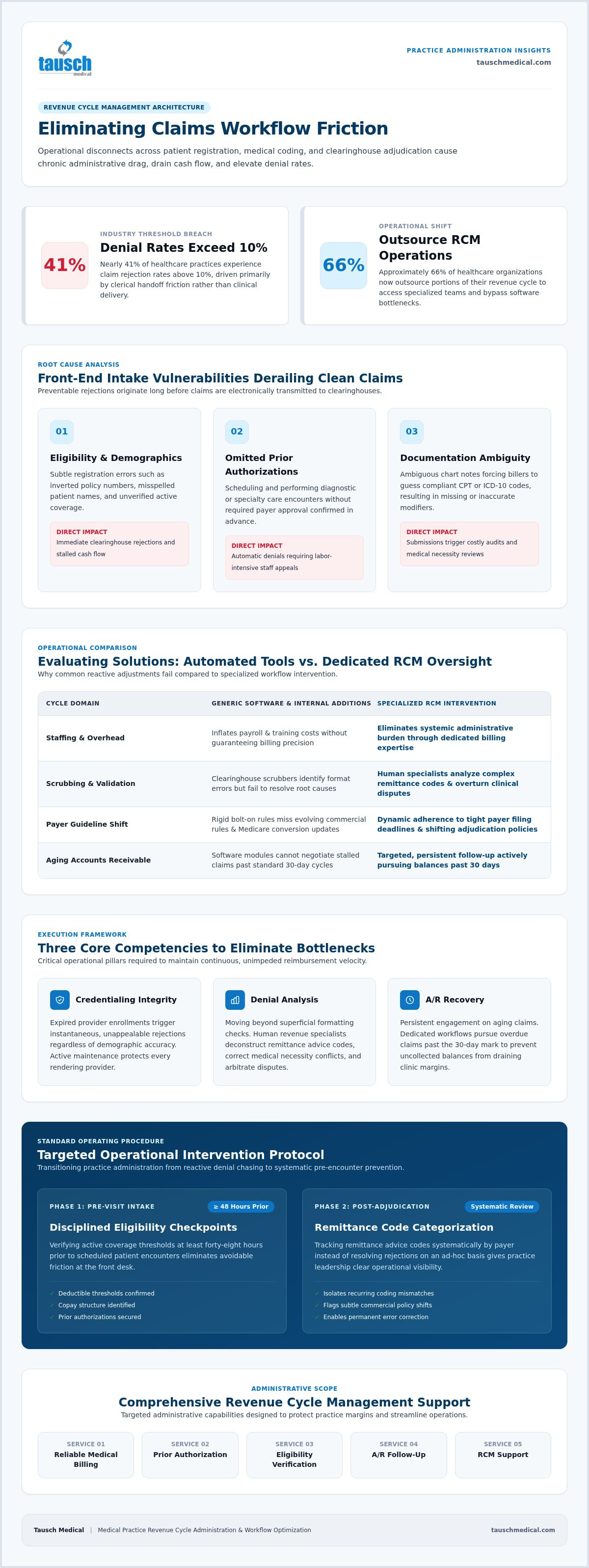
Nearly 41% of healthcare practices now see claim denial rates exceed 10%, yet the underlying culprit doesn't stem from clinical care. You already know the daily strain of watching avoidable clerical errors trigger rejections, while mounting days in accounts receivable slowly drain operational cash flow. When front-desk staff must balance complex payer rules with patient intake, critical handoffs falter. This chronic claims workflow friction stalls revenue, inflates overhead, and pulls your team away from their primary focus.
Discover how to identify, evaluate, and eliminate claims workflow friction to accelerate reimbursement and protect practice revenue. This guide details where operational disconnects occur across the billing lifecycle, reveals proven ways to achieve high first-pass clean claims rates, and shows you how to relieve your staff from exhausting administrative burdens.
Key Takeaways
- Pinpoint the operational disconnects across front-end intake, coding, and payer submissions that generate costly claims workflow friction.
- Discover why disconnected practice software often worsens manual errors, and how synchronized revenue cycle oversight eliminates systemic gaps.
- Compare standalone billing software against specialized revenue cycle management outsourcing to protect cash flow and credentialing compliance.
- Learn structured intake and denial tracking protocols designed to boost first-pass clean claims and lift the burden from front-office teams.
Identifying the Root Drivers of Claims Workflow Friction
Operational breakdowns rarely occur in isolation; they compound across the entire billing pipeline. In medical practice administration, claims workflow friction represents the structural drag caused by systemic disconnects across patient registration, medical coding, and clearinghouse adjudication. When clinic management platforms fail to synchronize with electronic records, administrative teams resort to repetitive, manual data re-entry. These redundant touchpoints multiply clerical mistakes, trap substantial revenue in aged accounts receivable, and drain operational cash flow. Maintaining healthy margins through professional revenue cycle management (RCM) requires identifying and correcting these handoff failures before submissions leave the facility.
Front-End Intake Vulnerabilities That Derail Clean Claims
A substantial portion of preventable rejections originates during initial patient intake, long before a biller transmits an electronic claim. Front-office teams frequently manage competing priorities, balancing in-person reception with complex payer rules. Under this daily pressure, subtle administrative oversights quickly cascade into severe cash flow delays:
- Eligibility and demographic mismatches: Inverted policy numbers, misspelled names, or unverified coverage trigger immediate clearinghouse rejections and stall reimbursement.
- Omitted prior authorizations: Performing diagnostic or specialty procedures without verified payer approval leads to automatic denials that require exhaustive staff appeals.
- Clinical documentation gaps: Ambiguous chart notes leave billing staff guessing on compliant CPT or ICD-10 codes, resulting in incorrect modifiers and payer audits.
Targeting claims workflow friction at the point of scheduling and intake establishes clean data governance, directly elevating first-pass acceptance rates and preserving practice revenue.
Evaluating Solutions to Eliminate Revenue Cycle Bottlenecks
When revenue stalls, practices often default to hiring more administrative staff or purchasing software add-ons. Neither approach fixes the root problem. Adding in-house personnel inflates payroll and training overhead without ensuring billing accuracy, while generic software relies on rigid rules that miss subtle policy updates. Approximately 66% of healthcare organizations now outsource portions of their revenue cycle, relying on specialized teams to eliminate systemic claims workflow friction.
Resolving persistent bottlenecks requires evaluating operational capacity across three core competencies:
- Credentialing integrity: Expired provider enrollments cause immediate, unappealable claim rejections regardless of how clean the initial data was.
- Denial management: Automated scrubbers flag surface formatting errors, but human specialists must analyze remittance codes, overturn complex clinical denials, and manage payer disputes.
- Persistent payer follow-up: Software cannot negotiate slow adjudications; dedicated teams are necessary to pursue aged receivables past standard 30-day thresholds.
Specialized Billing Outsourcing vs. Generic Practice Automation Tools
Automated clearinghouse scrubbers provide essential baseline filtering, but they cannot adapt dynamically to shifting commercial guidelines or evolving Medicare conversion factors. Independent clinics frequently discover that EHR bolt-on modules flag errors without resolving them, leaving internal personnel to decipher cryptic rejections. Active human oversight bridges this gap. Medical billing specialists intervene directly when commercial payers enforce restrictive filing deadlines, tracking every submission through final adjudication. Rather than managing complex payer rules alone, practices can partner with medical billing services to streamline submissions, systematically manage rejections, and eradicate chronic claims workflow friction across their entire operation.
Streamlining Practice Operations Through Targeted Workflow Intervention
Transforming practice revenue performance demands replacing reactive billing habits with proactive administrative safeguards. Practices systematically reduce claims workflow friction by establishing disciplined eligibility checkpoints at least forty-eight hours prior to scheduled patient encounters. Verifying active deductible thresholds, copay structures, and prior authorization requirements before clinical visits stops avoidable denials before they manifest. When clinical teams don't have to chase individual denials reactively, they can categorize remittance advice codes by payer. This systematic tracking reveals whether rejections stem from recurring coding mismatches or subtle policy shifts, allowing leadership to correct operational errors permanently.
Achieving Seamless Claims Adjudication with Specialized Operational Support
Submission speed directly impacts reimbursement velocity. Establishing daily clearinghouse audits ensures billing specialists catch and resolve technical rejections within twenty-four hours, keeping claims well ahead of restrictive commercial timely filing deadlines. Operational resilience thrives when front-desk scheduling aligns seamlessly with experienced back-end recovery units, preventing critical registration details from falling through administrative cracks.
Relying on specialized accounts receivable denial services provides the continuous oversight needed to contest slow adjudications and overturn complex appeal rejections. This integrated approach eradicates claims workflow friction across every phase of the revenue cycle, sustaining dependable cash flow while relieving in-house medical teams from overwhelming administrative burdens.
Reclaim Practice Momentum and Protect Operational Revenue
Eliminating chronic claims workflow friction requires more than quick software patches; it demands synchronizing patient intake, coding precision, and persistent denial recovery into a unified operational standard. By establishing front-end eligibility safeguards, analyzing payer rejection trends, and deploying dedicated follow-up specialists, your clinic secures predictable cash flow while shielding clinical staff from administrative burnout. Sustained financial health isn't accidental; it begins with structured, end-to-end execution.
Want to see how Tausch Medical can support your practice with reliable medical billing, prior authorization, eligibility verification, A/R follow-up, and RCM support? Start with our free two-week trial and experience the difference before making a commitment: free trial form
Frequently Asked Questions
What is claims workflow friction in healthcare practices?
Claims workflow friction refers to operational bottlenecks and misalignments across patient registration, coding, clearinghouse scrubbing, and payer adjudication. These disruptions stall claim progression, cause recurring clerical errors, and delay practice reimbursement. When administrative handoffs lack structure, staff waste valuable hours investigating rejections instead of focusing on proactive revenue cycle tasks and patient service.
How do front-desk administrative errors contribute to claims workflow friction?
Front-desk administrative oversights directly generate claims workflow friction by introducing flawed patient demographic data, unverified coverage details, or missing prior authorizations during intake. When staff face high patient volumes, small typos in subscriber IDs or overlooked payer pre-certification rules slip through. These initial oversights lead to automatic clearinghouse rejections, requiring extensive rework long after patient encounters conclude.
Can outsourcing medical billing eliminate revenue cycle friction for specialty clinics?
Yes, outsourcing medical billing removes chronic friction by placing end-to-end revenue cycle management with dedicated specialists. External billing teams handle rigorous eligibility verification, pre-authorizations, coding accuracy checks, and timely denial appeals. This specialized oversight lifts the administrative burden from internal clinic staff, prevents submission delays, and accelerates cash flow across complex payer networks in competitive markets like Houston.
How does friction in claims processing directly impact accounts receivable days?
Friction in claims processing directly inflates accounts receivable days by trapping unpaid claims in prolonged correction cycles. Each clearinghouse rejection or payer denial forces staff to research errors, adjust codes, and submit formal appeals. This repetitive back-and-forth pushes payment aging past standard 30-, 60-, or 90-day intervals, stalling practice cash flow and compromising financial stability.
Disclaimer
This article is for general informational purposes only and does not constitute legal, medical, billing, coding, compliance, or financial advice. Healthcare rules, payer policies, and reimbursement guidelines may change and may vary by situation. Please consult qualified professionals or official sources before making decisions based on this content. Tausch Medical is not responsible for any loss or liability arising from reliance on this information.


