


Article by
Dr. Sharafat Hussain Ph.D
Dr. Sharafat Hussain is a healthcare business consultant, entrepreneur, and academic with strong experience in the US healthcare industry. He is the Founder and Managing Director of Tausch Medical, a revenue cycle management company supporting US healthcare providers with medical billing, prior authorization, credentialing, eligibility verification, A/R follow-up, and patient support services. His work combines practical healthcare operations, business strategy, and academic insight to help medical practices improve efficiency, collections, and service quality.
What if the main challenge with patient scheduling isn’t filling open slots, but making sure each appointment moves smoothly through your practice? Calls, cancellations, rescheduling, and follow-up can absorb staff time, especially when it is unclear who owns each handoff. Patient scheduling services can provide support, but their scope and fit depend on how the work connects with your existing processes.
A useful service should support a consistent patient experience rather than create another administrative disconnect. This guide explains what patient scheduling services may cover, where their role may end, and how to assess a provider’s workflows and communication practices. It also shows how to map scheduling to eligibility verification, authorization, and billing, so you can decide what support your practice needs and how to coordinate it with other administrative work.
Key Takeaways
- List the appointment tasks you want handled, and distinguish staff support from software or broader administrative assistance.
- Before choosing a provider, define task ownership, communication methods, and procedures for handing work back to your team.
- Ask how scheduling support will work with your existing systems, and verify integration capabilities rather than assuming compatibility.
- Map scheduling handoffs to eligibility checks, authorization, billing, and follow-up, then document who is responsible for each function.
What Patient Scheduling Services Can Handle for a Medical Practice
Patient scheduling services support the administrative work of coordinating appointments, from receiving requests to managing changes and communicating next steps. The exact scope varies by provider, so don’t assume every service covers the full process. Clarify which tasks are handled, which stay with your staff, and how information moves between the two.
It also helps to distinguish a managed service from software. Medical practice management software provides tools for appointment scheduling, while a scheduling service involves people carrying out agreed administrative tasks. General administrative assistance may cover calendars or calls without being designed around your practice’s specific processes. Tausch Medical lists patient scheduling and phone answering services among its offerings.
Which Scheduling Tasks Should a Practice Clarify Up Front?
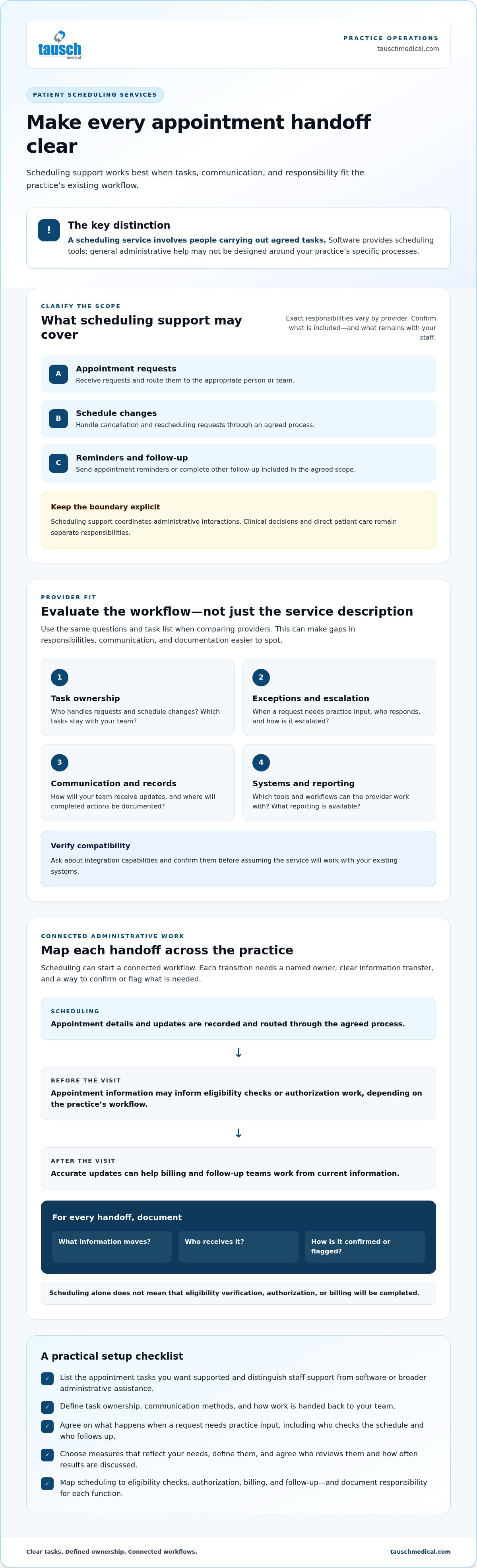
Start by listing the work you want supported, then name the person or team responsible for each patient communication. Ask whether the proposed scope includes:
- Receiving and routing appointment requests.
- Handling cancellations and rescheduling requests.
- Sending appointment reminders or completing other follow-up.
For each task, agree on what happens when a request needs practice input, who responds, and where the outcome is recorded. For example, if a patient asks to change an appointment but the available options are unclear, the workflow should specify who checks the schedule and who follows up. Clear ownership helps prevent messages from being missed or duplicated. Keep boundaries explicit, too: scheduling support coordinates administrative interactions, while clinical decisions and direct patient care remain separate responsibilities. This scope check gives you a practical basis for comparing providers and setting up a consistent workflow.
How to Evaluate Patient Scheduling Services for Your Practice
Assess fit in sequence: identify where your team needs support, confirm which tasks the provider will handle, agree on communication and escalation, then map each handoff. This helps reveal gaps that may be hidden by a broad service description. A written task list can make comparisons more useful: check each provider against the same requests, schedule changes, follow-up, documentation, and escalation needs.
What Should You Ask Before Choosing a Scheduling Provider?
Ask who handles appointment requests and schedule changes, how unresolved issues are escalated, and where completed actions are documented. Confirm how the provider’s staff will coordinate with your team, what reporting is available, and who is responsible when a request needs practice input. For example, establish whether your staff should receive a message, review a shared record, or use another agreed process for exceptions. For systems, ask which tools and workflows the service can work with, and verify integration capabilities before assuming compatibility.
Choose a small set of measures that reflects your needs, such as whether requests are handled according to the agreed workflow, whether changes are recorded accurately, and how unresolved requests are flagged. Define what each measure means, who reviews it, and how often you will discuss results. The American Medical Association’s guidance on ways to improve scheduling in your outpatient practice can help your team identify process considerations when setting expectations.
For a deeper discussion of potential benefits, see 5 Strategic Benefits of Outsourcing Patient Scheduling in 2026. If you’re comparing support models, review Tausch Medical’s patient scheduling services alongside your documented workflow needs.
How Patient Scheduling Services Fit into Broader Practice Support
Scheduling can be the first step in a connected administrative workflow, rather than a task that ends when an appointment is added to the calendar. Appointment details may inform later eligibility checks or authorization work, while accurate updates can help staff handling billing and follow-up work from current information. These handoffs depend on the practice’s agreed process. Scheduling alone does not mean that a verification, authorization, or billing task will be completed.
Where Can Scheduling Connect with Billing and Administrative Work?
Map each transition: identify what information moves from scheduling, who receives it, and how the receiving team confirms or flags what is needed. For example, a scheduled visit may prompt an eligibility check or authorization review, depending on the practice’s workflow. After the visit, billing and accounts receivable follow-up may rely on accurate appointment and administrative records. Include cancellations and schedule changes in the map so the relevant teams know how updates are communicated and recorded.
Before combining services, confirm exactly which functions a provider offers and how responsibilities are documented. Tausch Medical lists patient scheduling alongside medical billing, insurance verification and authorization, accounts receivable management, and denial management. Practices can review its patient scheduling and phone-answering services and clarify how scheduling fits with their own administrative handoffs.
When reviewing a combined support model, trace one appointment through the workflow: from the initial request, to any eligibility or authorization handoff, to billing and follow-up. Note where staff need to review information and how a change or exception is returned to the right person. Tausch Medical provides medical billing and outsourcing services, including insurance verification, authorization, accounts receivable management, and patient scheduling. Confirm the scope of each function and how it would connect with your practice’s processes.
Build a More Connected Scheduling Workflow
Patient scheduling services work best when task ownership is clear and appointment information can move smoothly into related administrative workflows. Before choosing support, define what the provider handles, how changes are communicated, and where scheduling connects with eligibility verification, authorization, billing, and follow-up. Tausch Medical lists patient scheduling alongside medical billing and revenue-cycle support, giving practices services to consider together while confirming the scope of each function.
To explore Tausch Medical’s practice support, review its services. You can also use https://tauschmedical.com/free-trial-form to start a conversation about your practice’s scheduling and billing support needs.
Frequently Asked Questions
What are patient scheduling services?
Patient scheduling services help a medical practice coordinate administrative work around appointments. Depending on the provider’s agreed scope, this may include receiving requests, recording cancellations or rescheduling, and handling follow-up communications. Before choosing support, confirm which tasks are included, who contacts patients, how exceptions are escalated, and which responsibilities remain with in-house staff. That clarity helps prevent gaps or duplicate communication.
Are patient scheduling services the same as scheduling software?
No. Scheduling software is a tool practice staff use to manage appointments, while a scheduling service provides people or operational support for defined tasks. For example, organizations such as Contesto provide dedicated operational support and out-of-hours management to assist care providers with ongoing administrative workflows. A provider may use software as part of its process, but that doesn’t make the service itself a software product. Ask which systems are involved, what integrations are available, and who remains responsible for each workflow.
Can a medical practice outsource patient scheduling without changing its existing systems?
Possibly, but compatibility depends on the practice’s systems and the provider’s workflows. Before work begins, ask how appointment information will be accessed, documented, and transferred, and verify any integration claims directly. Agree on communication channels, permissions, escalation procedures, and responsibility for exceptions. These discussions help identify whether the service can fit your current setup or whether workflow adjustments may be needed.
How can a practice measure patient scheduling service quality?
Measure performance against the agreed tasks: review how requests are handled, whether schedule changes are documented accurately, and how unresolved issues are escalated. Establish a baseline and review results with the provider, considering your specialty, staffing, and workflow rather than relying on one metric. Tausch Medical serves practices in Houston, San Antonio, Dallas, Austin, El Paso, Arlington, Plano, New York, Boston, Philadelphia, Washington, D.C., Baltimore, Miami, Orlando, Tampa, Atlanta, Raleigh, Richmond, and Jacksonville. To discuss patient scheduling and related billing support for your practice, contact Tausch Medical through its website.
Disclaimer
This article is for general informational purposes only and does not constitute legal, medical, billing, coding, compliance, or financial advice. Healthcare rules, payer policies, and reimbursement guidelines may change and may vary by situation. Please consult qualified professionals or official sources before making decisions based on this content. Tausch Medical is not responsible for any loss or liability arising from reliance on this information.


