


Article by
Dr. Sharafat Hussain Ph.D
Dr. Sharafat Hussain is a healthcare business consultant, entrepreneur, and academic with strong experience in the US healthcare industry. He is the Founder and Managing Director of Tausch Medical, a revenue cycle management company supporting US healthcare providers with medical billing, prior authorization, credentialing, eligibility verification, A/R follow-up, and patient support services. His work combines practical healthcare operations, business strategy, and academic insight to help medical practices improve efficiency, collections, and service quality.
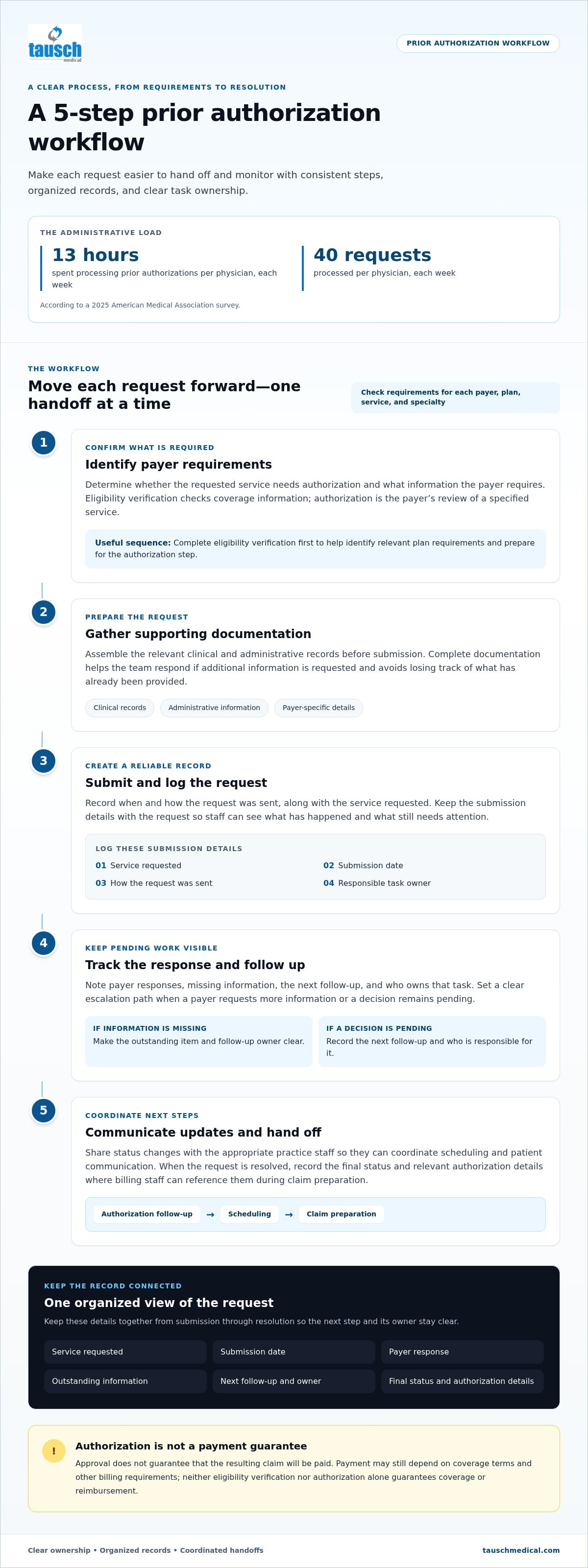
Medical practices spend an average of 13 hours a week processing 40 prior authorization requests per physician, according to a 2025 American Medical Association survey. That time can quickly add up across payer forms, status checks, and follow-up, especially when incomplete documentation leads to rework. Prior authorization services can help organize these steps, but reliable management takes more than submitting a request and waiting for a decision.
It’s understandable that authorization delays can complicate scheduling and make patient communication harder. A consistent workflow can help staff track requests, keep documentation organized, and share timely status updates without losing sight of billing and follow-up. This guide explains how prior authorization works, where delays and denials can arise, and how practices can build a clear, repeatable process. You’ll also see how coordinated authorization support fits into the broader revenue cycle, helping reduce administrative strain while keeping your team informed.
Key Takeaways
- Prior authorization is a payer review that may be required before care, but approval alone doesn’t guarantee claim payment.
- Use a repeatable sequence to identify payer requirements, gather supporting records, submit the request, and track its status.
- Prior authorization services work best when request ownership and follow-up are clear, so pending decisions don’t disappear between tasks.
- Connect authorization updates with scheduling, claim preparation, and escalation pathways to help your practice coordinate next steps.
What Prior Authorization Services Do for a Medical Practice
Before certain services or treatments, a health plan may require a review of the request and supporting information. This is prior authorization: a payer’s review before care, not a guarantee that the resulting claim will be paid. Payment may still depend on coverage terms and other billing requirements. The Prior Authorization Overview offers additional background on how the process is used across healthcare.
For a practice, the work involves more than sending a form. Missing documentation can prompt requests for additional information, while unclear task ownership can leave a request waiting without follow-up. Delays can then complicate scheduling and patient updates. Organized records and clear responsibility for tracking each request help staff see what has been submitted, what remains pending, and what needs attention.
How authorization differs from eligibility verification
Eligibility verification checks a patient’s coverage information, while authorization addresses whether a payer requires and reviews approval for a specified service. Completing verification first can help staff identify relevant plan requirements and prepare for the next step. Neither process, by itself, guarantees that a service will be covered or that a claim will be reimbursed.
Well-coordinated prior authorization services connect verification, documentation, submission, and follow-up, giving staff a clearer view of outstanding work. Tausch Medical supports practices with insurance verification and authorization alongside broader revenue-cycle work. Practices can also explore medical billing outsourcing support as part of coordinating administrative workflows.
How to Build a Reliable Prior Authorization Workflow
A repeatable workflow makes each request easier to hand off and monitor. Requirements and documentation can vary by payer, plan, service, and specialty, so staff should use a consistent process while checking the relevant requirements for each request.
- Identify requirements: Determine whether the requested service needs authorization and what information the payer requires.
- Gather documentation: Assemble the relevant clinical and administrative records before submission.
- Submit and log: Record when and how the request was sent, along with the service requested.
- Track and follow up: Note payer responses, missing information, the next follow-up, and who owns that task.
- Communicate updates: Share status changes with the appropriate practice staff so they can coordinate scheduling and patient communication.
Clear ownership prevents pending requests from becoming everyone’s responsibility and no one’s task. A shared, organized record gives staff a reliable place to see what has happened and what needs attention; the AMA Research on Prior Authorization Impact provides broader context on the administrative burden and delays practices may face.
What to track from submission through resolution
For each request, keep the service, submission date, payer response, outstanding information, and next follow-up together. Timely status updates help staff make informed scheduling decisions and communicate clearly with patients. Once resolved, record the final status and relevant authorization details where billing staff can reference them during claim preparation. This connected approach helps coordinate practice revenue-cycle support without treating authorization status as a promise of payment.
Consistent prior authorization services rely on practical task ownership and complete records, not just submission. A defined handoff from authorization follow-up to scheduling and billing can make the next step clear for the team.
When Prior Authorization Support Should Connect With Your RCM
Authorization status affects more than one administrative task. Scheduling staff may need an update before coordinating a service, while billing staff need the final status and relevant authorization details when preparing a claim. Connecting these handoffs helps the practice respond to pending requests and identify unresolved issues without treating authorization as a guarantee of reimbursement.
Set a clear pathway for escalation when a payer requests additional information or a decision remains pending. The responsible team member should know what needs follow-up, who needs to be informed, and how status changes reach scheduling and billing. This keeps open requests visible and gives staff a consistent way to communicate with patients about next steps.
How coordinated support can fit specialty-practice operations
Specialty clinics often coordinate service-specific documentation with payer and plan requirements. Linking eligibility verification and authorization records with billing follow-up can give staff a more complete operational picture, from checking coverage information to recording the outcome for claim preparation. Tausch Medical provides connected authorization, verification, medical billing, A/R follow-up, and broader RCM support for practices in markets including Houston, Dallas, and Austin.
With prior authorization services integrated into revenue-cycle workflows, teams can route unresolved requests for follow-up and keep relevant staff informed, while avoiding assumptions about coverage or payment. Coordination supports a clear process; it doesn’t determine a payer’s decision.
Want to see how Tausch Medical can support your practice with reliable medical billing, prior authorization, eligibility verification, A/R follow-up, and RCM support? Start with our free two-week trial and experience the difference before making a commitment.
Build a More Connected Authorization Workflow
Prior authorization is most manageable when it’s treated as an ongoing workflow, with clear ownership, organized documentation, and timely status updates. Connecting authorization with eligibility verification, scheduling, billing, and follow-up helps staff coordinate next steps, while remembering that approval alone doesn’t guarantee claim payment. Tausch Medical supports practices with prior authorization and insurance verification, alongside medical billing, A/R management, denial management, and broader RCM support.
Want to see how Tausch Medical can support your practice with reliable medical billing, prior authorization, eligibility verification, A/R follow-up, and RCM support? Start with our free two-week trial and experience the difference before making a commitment: free trial form
Explore Tausch Medical’s practice support and take a practical next step toward a clearer, more coordinated approach to prior authorization services.
Frequently Asked Questions
What are prior authorization services?
Prior authorization services help a medical practice manage payer review requests before certain services or treatments. Support may include identifying applicable requirements, coordinating documentation, submitting requests, tracking status, and communicating updates. Because processes vary by payer, plan, service, and specialty, maintain organized records and check current requirements for each request. This makes handoffs clearer without implying approval or payment.
Does prior authorization guarantee that an insurance claim will be paid?
No. An authorization decision isn’t a guarantee that an insurance claim will be paid. Payment may depend on applicable coverage, eligibility, documentation, coding, and other payer requirements. Record authorization details and continue the practice’s usual verification and billing processes. Treating approval as confirmation of reimbursement can lead to mistaken assumptions during claim preparation and follow-up.
How can a practice reduce prior authorization delays?
Use a consistent workflow that checks current payer requirements, gathers complete documentation, assigns ownership, and tracks each request through resolution. Record any outstanding information and the next follow-up so staff can see what needs attention. Clear communication about status changes also helps relevant team members coordinate scheduling and patient updates without relying on assumptions about the payer’s decision.
Disclaimer
This article is for general informational purposes only and does not constitute legal, medical, billing, coding, compliance, or financial advice. Healthcare rules, payer policies, and reimbursement guidelines may change and may vary by situation. Please consult qualified professionals or official sources before making decisions based on this content. Tausch Medical is not responsible for any loss or liability arising from reliance on this information.


