


Article by
Dr. Sharafat Hussain Ph.D
Dr. Sharafat Hussain is a healthcare business consultant, entrepreneur, and academic with strong experience in the US healthcare industry. He is the Founder and Managing Director of Tausch Medical, a revenue cycle management company supporting US healthcare providers with medical billing, prior authorization, credentialing, eligibility verification, A/R follow-up, and patient support services. His work combines practical healthcare operations, business strategy, and academic insight to help medical practices improve efficiency, collections, and service quality.
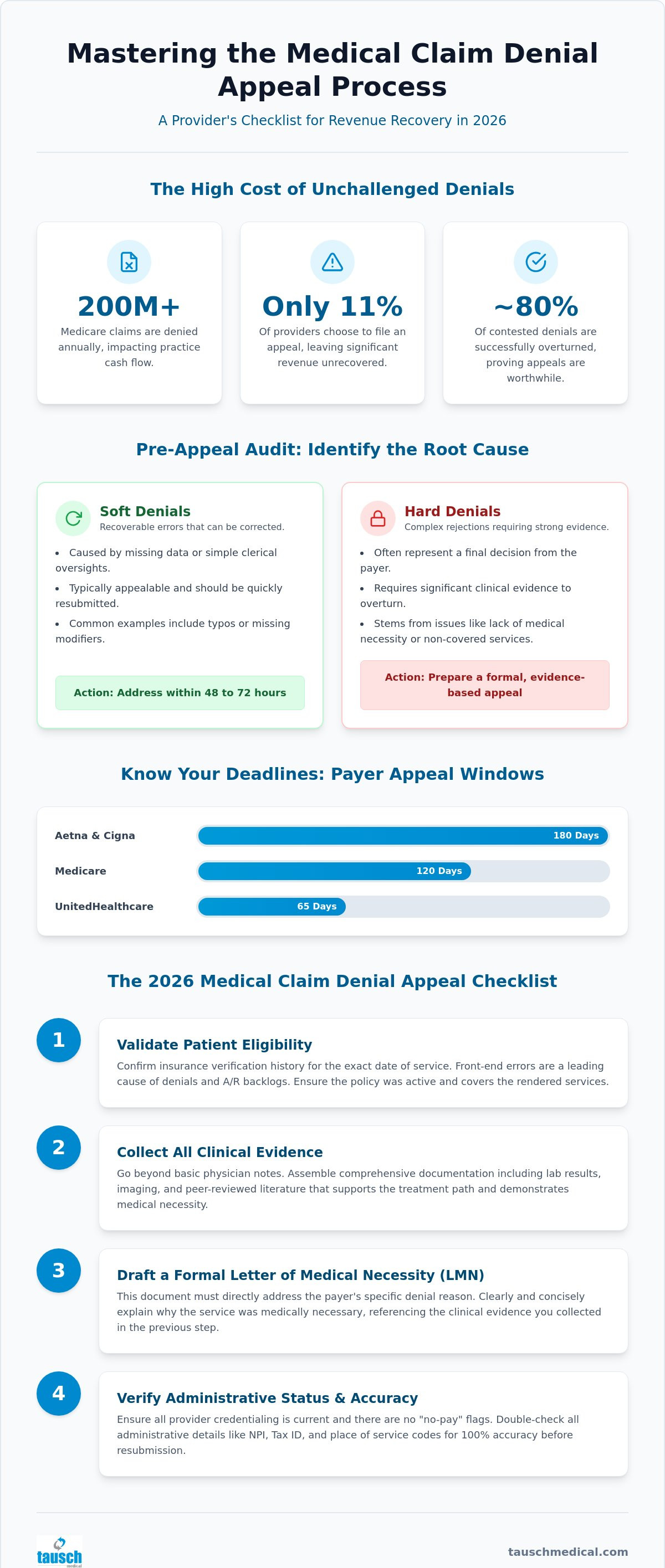
Did you know that over 200 million Medicare claims are denied annually, yet only 11% of providers choose to file an appeal? It's a startling statistic for any practice leader, particularly since roughly 80% of those who contest these denials eventually secure a win. You likely recognize the drain that manual appeals and stagnant cash flow place on your operations, especially as payers introduce increasingly complex "medical necessity" logic to justify rejections. It's a burden that compromises clinical focus and stalls the growth of your medical portfolio.
This article provides the expert clarity you need to master the medical claim denial appeal process through a structured 2026 provider checklist. By aligning clinical evidence with precise payer requirements, you'll learn to recover lost revenue and significantly reduce your A/R days. We'll preview the critical 2026 regulatory shifts, including the new CMS-0057-F prior authorization timelines, and offer a repeatable framework to optimize your practice's clean claim rates and long term financial stability.
Key Takeaways
- Identify the root causes of rejections by analyzing EOB and RA codes to distinguish between uncollectible hard denials and recoverable soft denials.
- Master the medical claim denial appeal process using a structured 2026 framework that ensures every clinical justification is backed by peer-reviewed evidence.
- Reduce your A/R days by validating patient eligibility and insurance history before services are rendered, preventing common front-end errors.
- Optimize long-term practice cash flow by shifting from reactive rebuttal to a proactive, automated denial management strategy.
The Pre-Appeal Audit: Identifying Root Causes in 2026
Success in the medical claim denial appeal process begins long before a rebuttal letter is drafted. It starts with a clinical level of precision during the audit phase. Before taking action, your team must dissect the Explanation of Benefits (EOB) and Remittance Advice (RA) to pinpoint specific denial codes. These documents contain the diagnostic DNA of why revenue was withheld. Sometimes, a payer's restrictive policy or lack of response creates a de facto denial of service, where a claim isn't technically rejected but remains unpaid in practical terms. Identifying these nuances is the first step toward recovery.
Denial Management is the strategic process of identifying, analyzing, and resolving denied claims to maximize reimbursement. To execute this effectively, you must distinguish between "hard denials" and "soft denials." Soft denials, often resulting from missing data or simple clerical oversights, are typically appealable and should be addressed within 48 to 72 hours. Hard denials are more complex, often representing a final decision that requires significant clinical evidence to overturn. Many practices discover that these rejections frequently stem from failures in prior authorization services or minor eligibility lapses that occurred before the patient even entered the exam room.
Common 2026 Denial Triggers
In 2026, payers have intensified their scrutiny of clinical documentation. Lack of medical necessity is now the leading cause of high-value rejections. It's no longer enough to provide standard physician notes; you must align your documentation with specific payer logic and peer-reviewed literature. Coding errors, particularly ICD-10 and CPT mismatches, continue to impact the bottom line of premium practices. For a deeper look at these systemic issues, read our companion piece on Medical Claim Denial Management: The 2026 Guide to Revenue Recovery.
Payer-Specific Nuances
Understanding appeal windows is critical for timely filing. While Medicare allows 120 days for a Level 1 Redetermination, commercial payers like UnitedHealthcare have much tighter windows, often requiring action within 65 days. Other major carriers like Aetna and Cigna generally offer 180 days. You must also navigate the distinction between internal reviews, conducted by the payer, and external reviews, where an independent third party makes a binding decision. Mastering these timelines ensures your practice remains a leader in financial performance and patient care.
The 2026 Medical Claim Denial Appeal Checklist
Executing a successful medical claim denial appeal process requires more than just clinical expertise; it demands administrative perfection. Once your audit has identified the root cause of a rejection, you must follow a structured rebuttal path to ensure your claim is irrefutable. High performance practices treat every appeal as a legal and clinical brief, leaving no room for payer ambiguity.
- Step 1: Validate patient eligibility. You must confirm the insurance verification history for the exact date of service. Errors at this stage often lead to the costly ripple effect that destabilizes practice revenue and creates unnecessary A/R backlogs.
- Step 2: Collect clinical evidence. This goes beyond basic physician notes. You should include lab results, imaging, and peer-reviewed literature that supports the chosen treatment path.
- Step 3: Draft a formal Letter of Medical Necessity (LMN). This document should directly address the payer's specific denial reason. Under federal guidelines, you have your right to an internal appeal, which serves as your primary tool to force a clinical reconsideration.
- Step 4: Verify administrative status. Ensure all provider credentialing services are current. An expired credential can trigger a "no-pay" status that no amount of clinical evidence can resolve.
Clinical Documentation Requirements
Administrative Accuracy Check
Precision in the small details often determines the outcome of an appeal. You must double-check the NPI, Tax ID, and place of service codes for 100% accuracy before submission. You also need to confirm that you haven't exceeded timely filing limits. For instance, Medicare Level 1 appeals have a 120-day window, while UnitedHealthcare requires action within 65 days. If managing these intricate steps feels overwhelming, professional denial management can streamline your recovery efforts and protect your cash flow.
Optimizing Your Denial Management Strategy for Long-Term Recovery
Mastering the medical claim denial appeal process is a vital skill, but the most successful practices treat the appeal as a last resort rather than a primary tactic. Shifting your focus from reactive rebuttal to proactive prevention is the hallmark of elite practice management. By optimizing front-end Revenue Cycle Management (RCM), you address errors at the point of patient registration. This precision significantly improves your clean claim rate and stabilizes your financial foundation before a single service is even coded.
A proactive approach also involves helping patients manage out-of-pocket costs to avoid future billing friction; for more on affordable coverage options, check out TELEFONETICA HEALTH RX.
Automation plays a decisive role in modern recovery. Implementing automated A/R follow-up ensures that every claim is tracked in real time, preventing high-value appeals from falling through the cracks due to simple administrative oversight. This technological edge directly influences your EBITDA. When you recover revenue that was previously written off, you aren't just improving cash flow; you're increasing the overall valuation of your medical portfolio. For many practice leaders, the clear ROI of this efficiency leads them to outsource medical billing services to experts who possess the dedicated bandwidth for rigorous, daily follow-up.
Leveraging Technology and Outsourcing
Professional AR & denial services utilize advanced data analytics to identify trends before they become systemic failures. These specialists understand that payer behavior varies significantly by region. Navigating the local payer landscapes in major hubs like Houston, Dallas, or New York requires specific knowledge of regional policy shifts and local Medicare Administrative Contractor preferences. This level of granularity ensures your practice remains resilient against shifting insurance requirements and increasingly strict medical necessity audits.
Final Steps for Practice Revenue Optimization
Establishing an internal Denial Task Force is a powerful way to monitor recurring error patterns across your organization. This group should analyze the outcomes of every medical claim denial appeal process to identify where front-desk protocols need adjustment. Closing the loop is essential for long-term health. If a specific insurance verification error leads to a denial, the solution must be integrated back into the patient intake workflow to prevent a repeat occurrence. This continuous improvement cycle secures your practice's prosperity and allows you to focus on clinical excellence.
Want to see how Tausch Medical can support your practice with reliable medical billing, prior authorization, eligibility verification, A/R follow-up, and RCM support? Start with our free two-week trial and experience the difference before making a commitment: https://tauschmedical.com/free-trial-form
Securing Your Practice's Financial Future in 2026
Mastering the complexities of payer logic requires a decisive shift from reactive habits toward clinical precision. By implementing a rigorous audit phase and aligning your documentation with the latest 2026 regulatory standards, you transform your revenue cycle into a resilient practice asset. Success in the medical claim denial appeal process isn't just about persistence; it's about leveraging data analytics and specialized expertise in A/R recovery to prevent rejections before they ever occur. This structured approach protects your clinical time and ensures that every service provided is fairly compensated.
Transitioning to a proactive strategy ensures that your clinical focus remains on patient care while your EBITDA reflects the true value of your medical portfolio. With comprehensive Revenue Cycle Management support, you can close the loop on recurring errors and stabilize cash flow for long term growth. It's time to move beyond the frustration of manual appeals and embrace a system built for modern healthcare challenges.
Want to see how Tausch Medical can support your practice with reliable medical billing, prior authorization, eligibility verification, A/R follow-up, and RCM support? Start with our free two-week trial and experience the difference before making a commitment: free trial form
Your practice deserves a partner who values precision as much as you do. Let's build a more secure and profitable future together.
Frequently Asked Questions
How long does the medical claim denial appeal process typically take in 2026?
The timeline varies by payer and appeal level, but a standard first level Medicare redetermination typically requires 60 days for a response. While 2026 CMS regulations have accelerated prior authorization decisions to 7 calendar days, the full medical claim denial appeal process can still extend over several months if it escalates to a Qualified Independent Contractor. Commercial payers often maintain similar 60 day windows for their internal review phases.
What is the difference between a first level and second level appeal?
A first level appeal is a redetermination performed by the original payer to identify clerical errors or simple omissions. If the denial is upheld, a second level appeal involves a reconsideration by an independent third party. For Medicare, this is a Qualified Independent Contractor. This second stage is more rigorous; it requires comprehensive clinical evidence and peer reviewed documentation to successfully overturn the initial adverse decision.
Can I appeal a denial if the prior authorization was never obtained?
You can technically appeal these rejections, but they are categorized as hard denials and are exceptionally difficult to overturn. Success usually depends on proving the service was an emergency or that a systemic technical error occurred during the initial verification. Most premium practices focus on preventing these through robust front end RCM rather than relying on the retrospective medical claim denial appeal process after the service is rendered.
What are the most common reasons for medical claim denials in independent practices?
The most frequent triggers in 2026 include a lack of documented medical necessity, coding mismatches between ICD-10 and CPT codes, and patient eligibility lapses. Payers have significantly increased their scrutiny of clinical narratives, making precise documentation a non negotiable requirement for reimbursement. Minor administrative errors, such as incorrect NPI or Tax ID numbers, also continue to be a leading cause of avoidable revenue loss for independent providers.
Disclaimer
This article is for general informational purposes only and does not constitute legal, medical, billing, coding, compliance, or financial advice. Healthcare rules, payer policies, and reimbursement guidelines may change and may vary by situation. Please consult qualified professionals or official sources before making decisions based on this content. Tausch Medical is not responsible for any loss or liability arising from reliance on this information.


