


Article by
Dr. Sharafat Hussain Ph.D
Dr. Sharafat Hussain is a healthcare business consultant, entrepreneur, and academic with strong experience in the US healthcare industry. He is the Founder and Managing Director of Tausch Medical, a revenue cycle management company supporting US healthcare providers with medical billing, prior authorization, credentialing, eligibility verification, A/R follow-up, and patient support services. His work combines practical healthcare operations, business strategy, and academic insight to help medical practices improve efficiency, collections, and service quality.
Did you know that in 2026, an estimated 27% of all healthcare claims are mispriced, effectively trapping billions of dollars in administrative gridlock? For most practices, these figures aren't just industry statistics; they represent the daily reality of cash flow stagnation as claims age beyond the critical 90-day threshold. It's exhausting to watch your internal staff burn out while attempting to decipher evolving payer CAS codes or navigate the complexities of the No Surprises Act. We understand that maintaining clinical excellence requires a financial foundation built on precision, not guesswork. This is why a proactive strategy for medical accounts receivable recovery is no longer optional for those seeking long-term stability and premium operational standards.
You can reclaim control over your revenue cycle by shifting from reactive collections to a forensic audit mindset. This article shows you how specialized recovery techniques transform aged debt into liquid capital through systematic workflow optimization and expert denial management. We'll examine a proven framework designed to recover over 90% of your aged claims and significantly reduce your AR days. By implementing these sustainable prevention strategies, you'll ensure your practice remains both profitable and resilient in an increasingly complex regulatory environment.
Key Takeaways
- Understand the critical distinction between routine billing and specialized recovery efforts to unlock capital trapped in aged healthcare claims.
- Implement a forensic methodology for medical accounts receivable recovery that leverages deep analysis of payer codes to identify and rectify systemic rejection patterns.
- Discover strategies to bypass modern payer obstacles, such as automated gatekeepers, while addressing the specialized skill gap within your internal team.
- Evaluate how a performance-based partnership model integrates with your existing EHR system to restore liquidity without increasing administrative overhead.
- Analyze a case study where a multi-specialty organization successfully recovered over $1 million in aged receivables through systematic forensic intervention.
What is Medical Accounts Receivable Recovery in the 2026 Healthcare Landscape?
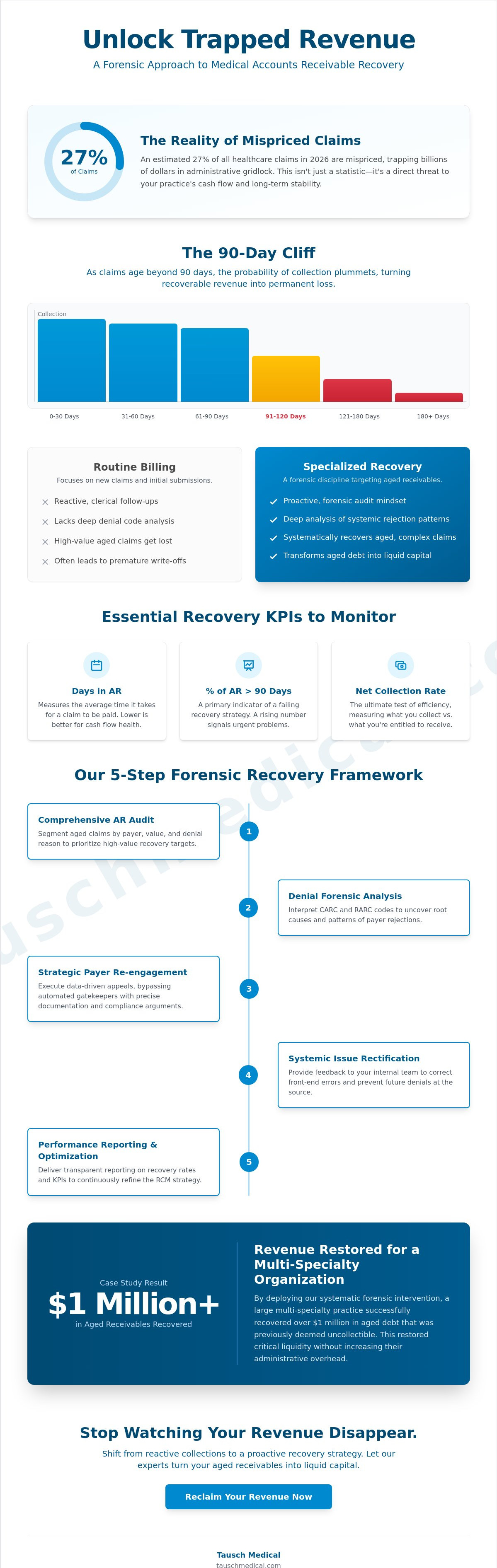
Medical accounts receivable recovery represents the systematic process of identifying, appealing, and collecting on healthcare claims that have stalled within the payment pipeline. While standard billing focuses on the initial submission and routine adjudication of fresh claims, specialized recovery is a forensic discipline. It targets the aged receivables that often fall through the cracks of a standard workflow. In the current environment, where an estimated 27% of claims are mispriced annually according to 2026 industry data, this distinction is vital for maintaining practice solvency. It isn't just about sending reminders; it's about a deep dive into why a payer hasn't fulfilled their obligation.
Effective recovery is a cornerstone of a high performing revenue cycle management strategy. Without a dedicated focus on these aged balances, the entire Revenue Cycle Management (RCM) process becomes congested, leading to what many administrators call the 90-day cliff. In 2026, this cliff is steeper than ever. Payers have implemented more aggressive AI-driven claim reviews and stricter documentation rules, significantly shortening timely filing limits for appeals. If a claim isn't successfully recovered within this narrowing window, it often becomes a permanent loss.
The Financial Impact of Aged Receivables
Uncollected claims do more than just sit on a balance sheet. They drain practice liquidity and inflate administrative overhead through repetitive, unsuccessful follow ups. There's a hidden cost of staff distraction that often goes unmeasured. When internal teams ignore current billing to chase complex, year-old denials, the new revenue cycle begins to lag, creating a self-perpetuating loop of financial instability. Write-off trends indicate that 2026 practices are losing more to preventable denials than in previous years, often because they lack the forensic tools to interpret evolving payer algorithms.
Key Performance Indicators (KPIs) to Watch
To measure the health of your medical accounts receivable recovery efforts, you must look beyond total revenue. We recommend monitoring these three specific metrics:
- Days in AR: This measures how long it takes, on average, for a claim to be paid. While benchmarks vary by specialty, staying below the 2026 national averages is essential for cash flow health.
- Percentage of AR over 90 days: This is the primary indicator of a failing recovery strategy. If this number climbs, it suggests your internal processes aren't equipped to handle complex denials.
- Net Collection Rate: This metric measures your efficiency by showing what you actually collect versus what you're legally entitled to receive. It's the ultimate test of your recovery team's effectiveness.
By treating recovery as a specialized clinical audit rather than a clerical task, providers can protect their margins. It's about ensuring that every service rendered is a service paid, regardless of how complex the insurance barrier may seem.
The Forensic Methodology for Successful Medical AR Recovery
Successful medical accounts receivable recovery isn't about aggressive phone calls; it's about clinical and financial precision. It requires a five step framework that treats every claim as a unique case file. By moving beyond standard collections and adopting a forensic mindset, practices can identify the structural weaknesses in their revenue cycle that allow capital to leak away. This methodology ensures that every effort is focused on high yield results rather than administrative busywork.
The process begins with a Comprehensive AR Audit. We segment aged claims by payer, value, and denial reason to prevent high value claims from being buried under high volume, low value rejections. Following the audit, we perform a Denial Forensic Analysis, interpreting Claim Adjustment Reason Codes (CARCs) and Remittance Advice Remark Codes (RARCs) to find the true root cause of the rejection. We then move to Strategic Prioritization. To maximize immediate cash flow, we focus on high value, high probability claims first. Many payment-related problems in healthcare are exacerbated when practices chase uncollectable debt while ignoring recoverable assets.
The final stages involve Systematic Appeal Execution and Root Cause Eradication. Our specialists utilize clinical evidence and payer specific policy knowledge to overturn rejections. We don't just fix the individual claim; we establish feedback loops to ensure the same errors don't recur. This cleans the revenue stream at its source and prevents future stagnation. A tailored approach to Accounts Receivable Management can help your team transition from reactive billing to proactive revenue restoration.
Advanced Denial Forensics
Denial Forensics is the clinical-financial audit of claim rejections to ensure 100% compliance. This process goes beyond simple CAS codes to identify hidden payer patterns that lead to mass rejections. Integrating robust medical claim denial management into your recovery process ensures that every appeal is backed by data and clinical necessity. By uncovering these patterns, we can address systemic issues that a standard billing team might overlook.
Leveraging Technology: EFTs and ERAs
Modern technology is the engine behind efficient medical accounts receivable recovery. Electronic Remittance Advice (ERA) allows for faster data posting and more accurate tracking of payer responses. When combined with Electronic Funds Transfer (EFT), it significantly reduces the lag time between recovery and actual liquidity. Modern 2026 RCM software uses automated worklists to flag aged claims for immediate human intervention, ensuring no claim remains stagnant or expires due to timely filing limits.
Common Challenges in Healthcare AR Recovery and How to Overcome Them
The path to successful medical accounts receivable recovery is often obstructed by increasingly sophisticated barriers. In 2026, the primary challenge is the rise of "automated gatekeepers." Payers now use advanced AI algorithms to filter and deny claims based on minute technicalities, often before a human ever reviews the file. Navigating these digital walls requires more than persistence; it requires a technical understanding of how these algorithms operate. When your team faces a wall of automated rejections, the traditional method of simply resubmitting the same data is no longer effective.
Payer policy volatility adds another layer of difficulty. Authorization rules and credentialing requirements can change monthly, making it nearly impossible for a general billing department to stay current. This volatility often leads to data silos where clinical documentation, while medically sound, fails to meet the specific, shifting requirements of the insurance carrier. This misalignment creates a gap that payers are happy to exploit, leaving valid claims unpaid for months.
Solving the Staffing Bottleneck
Most practices fall into a burnout cycle because they expect their best billers to handle medical accounts receivable recovery alongside daily billing tasks. These are two distinct disciplines. General billers are trained for speed and volume, while recovery requires a forensic, investigative mindset. The ROI of utilizing specialized recovery teams is significantly higher than relying on general staff who are already overwhelmed. Many organizations find that medical billing outsourcing provides the necessary access to high level expertise without the overhead of hiring and training internal specialists.
Bridging the Documentation Gap
Recovery often fails because the clinical documentation isn't "appeal-ready." We solve this by training clinical staff to understand the specific keywords and data points that trigger automated denials. Additionally, robust provider credentialing services are essential to prevent the eligibility-based AR buildup that often goes unnoticed until it's too late. By implementing real-time insurance verification at the front desk, you can stop potential AR issues before the patient even enters the exam room, ensuring that the recovery team can focus on complex forensic audits rather than simple administrative errors.
Implementation: Transitioning to a Professional AR Recovery Partner
Transitioning your medical accounts receivable recovery to a professional partner is a strategic evolution that replaces administrative burden with clinical precision. Many providers hesitate because they fear operational disruption, yet the modern integration process is remarkably fluid. A professional partner connects directly to your existing Electronic Health Record (EHR) or Practice Management System (PMS) via secure APIs. This allows recovery specialists to work within your current environment without requiring your staff to learn new software or alter their daily routines. The transition is designed to be seamless, ensuring that your patient care remains the central focus while the recovery team operates in the background to restore financial health.
We recommend evaluating partners based on a contingency-based model. Performance-based pricing ensures that incentives are perfectly aligned; the partner only succeeds when your practice realizes actual revenue restoration. In the 2026 regulatory environment, data security is paramount. Your partner must demonstrate rigorous HIPAA compliance and an understanding of the latest Fair Credit Reporting Act (FCRA) updates. For instance, as of April 28, 2026, medical debts cannot be reported to credit bureaus until 365 days after the date of service. A sophisticated partner manages these timelines precisely, protecting your practice from compliance risks while maximizing recovery efforts within the legal window.
Selecting the Right Partner
When selecting a recovery specialist, look beyond basic billing experience. You need a team with the technology stack to handle automated payer gatekeepers and the national expertise to navigate diverse insurance landscapes. Transparency in reporting is non-negotiable; you should have real-time access to recovery milestones and denial trends. The ideal AR partner provides both immediate recovery and long-term denial prevention. This dual focus ensures that while you're recapturing lost capital, you're also hardening your revenue cycle against future rejections through systematic feedback and workflow adjustments.
The First 90 Days of Recovery
The initial phase of a partnership is often characterized by an intensive "workdown" of the existing backlog. During the first 90 days, the focus shifts to segmenting and attacking claims that have aged beyond 120 days. These are the claims most likely to be written off by internal teams, but they often hold significant recoverable value. You should expect to see a measurable acceleration in cash flow as these stagnant assets are converted back into liquid capital. Success is measured not just by the total dollar amount recovered, but by the steady reduction in your overall AR days and a significant increase in your net collection rate. If your practice is ready to eliminate the 90-day cliff and restore financial health, exploring professional Accounts Receivable Management is the next logical step toward sustainable growth.
Case Study: Restoring Revenue for a Multi-Specialty Organization
A prominent multi-specialty organization recently faced a financial crisis that mirrors the struggles of many modern practices. With $1.2 million in receivables stagnant for over 90 days and a denial rate peaking at 45%, their internal billing team was overwhelmed. The stagnation wasn't due to a lack of effort but a lack of the specialized forensic tools required to navigate the 2026 payer landscape. This organization needed more than a collection agency; they required a partner capable of executing a sophisticated medical accounts receivable recovery strategy that addressed both historical losses and future prevention.
Tausch Medical initiated a forensic intervention by first segmenting the $1.2 million backlog by payer and denial complexity. We identified that a significant portion of the 45% denial rate stemmed from subtle shifts in payer authorization rules that the organization's staff hadn't been trained to recognize. By implementing our forensic recovery workflow, we moved beyond simple resubmissions. We engaged in high level appeals backed by clinical evidence and specific policy interpretations. Simultaneously, we integrated an advanced insurance verification process at the front desk to ensure that new claims entered the cycle with a much higher probability of immediate approval.
The impact of this dual track approach was immediate and transformative. Within just 120 days of implementation, the organization realized a 25% increase in monthly revenue. This wasn't new business; it was the restoration of capital they'd already earned but couldn't access. This systematic workdown also reduced their total AR days by 35%, bringing their financial metrics back in line with premium industry benchmarks. The organization's leadership could finally pivot from crisis management to strategic growth.
Quantifiable Success Metrics
The recovery effort didn't just restore cash flow; it optimized the entire revenue ecosystem. By focusing on root cause eradication, we ensured that the improvements were permanent rather than temporary fixes.
- Clean Claim Rate: Post intervention, the organization’s clean claim rate rose from 55% to 89% as a result of the forensic audit and workflow adjustments.
- Internal Efficiency: Staff burnout plummeted as administrative teams were freed from the "denial treadmill," allowing them to focus on patient experience and current billing.
- Cost Effectiveness: The contingency based model ensured that the cost of recovery was always a fraction of the capital restored, providing a clear and immediate ROI.
The Path Forward
Maintaining a low AR environment requires more than a one time cleanup. This organization now operates with a proactive mindset, utilizing Tausch Medical as a strategic knowledge center to stay ahead of payer policy shifts. A long term revenue cycle partnership ensures that clinical excellence is always supported by financial stability. If your practice is currently burdened by aged claims and high denial rates, it's time to transition to a forensic recovery model. Schedule your free AR recovery assessment with Tausch Medical today.
Securing Your Financial Future Through Revenue Restoration
We've analyzed how a forensic approach to medical accounts receivable recovery transforms stagnant debt into liquid capital. By moving beyond routine billing and addressing the systemic root causes of rejections, your practice can bypass modern automated payer gatekeepers and restore its cash flow. This strategy ensures that clinical excellence is always supported by a resilient financial foundation, allowing you to maintain your focus on patient outcomes rather than administrative hurdles.
Implementing these specialized workflows allows your team to focus on patient care while experts manage the complexities of 2026 regulatory shifts. Our forensic denial management expertise, combined with a 90%+ recovery rate on aged claims, provides the precision necessary to reclaim your earned revenue. Because we utilize a contingency-based pricing model, our success is directly tied to yours, making this a strategic and low-risk investment for your organization. It's time to stop accepting preventable losses and start optimizing your revenue stream with professional support.
Recover your aged revenue with a Tausch Medical AR Assessment. Let's work together to eliminate the 90-day cliff and secure the long-term growth your practice deserves.
Frequently Asked Questions
What is the difference between medical billing and medical AR recovery?
Medical billing focuses on the initial submission and routine processing of fresh healthcare claims, whereas medical accounts receivable recovery is a specialized forensic audit of unpaid or denied claims. While billing manages the daily flow of revenue, recovery targets stagnant capital that has stalled due to complex insurance barriers. It requires deeper investigative expertise to resolve the root causes of non-payment and restore liquidity.
At what point should a claim be considered "aged" and moved to a recovery specialist?
A claim is generally considered "aged" once it surpasses the 90-day mark without successful adjudication. In the 2026 landscape of stricter timely filing limits, we recommend initiating recovery efforts as early as 60 days for high-value claims. Moving claims to a specialist at this stage prevents them from becoming permanent losses due to payer-imposed expiration dates that are increasingly difficult to appeal later.
How does Tausch Medical handle complex insurance denials that internal teams have failed to appeal?
We utilize a forensic methodology that interprets complex Claim Adjustment Reason Codes to uncover the actual reason for rejection. Our team prepares appeals backed by clinical evidence and payer-specific policy knowledge that internal staff might not have the time or specialized training to research. This clinical-financial audit approach ensures that even the most stubborn rejections are overturned through precise, data-driven communication with payers.
Is it cost-effective to outsource AR recovery for smaller balances?
Outsourcing is highly cost-effective for smaller balances because our contingency-based pricing model ensures you only pay for actual revenue recovered. We use automated workflows to group and resolve these smaller claims efficiently, preventing them from accumulating into a significant financial drain. This allows your practice to recapture every dollar without increasing your internal administrative overhead or distracting your staff from more critical tasks.
How long does it typically take to see results from a medical AR recovery project?
You can typically expect to see a measurable acceleration in cash flow within the first 30 to 90 days of a medical accounts receivable recovery project. The initial workdown phase focuses on the most recoverable aged assets to provide immediate liquidity. Full optimization of the revenue cycle and a significant, sustainable reduction in your overall AR days are usually achieved within 120 days of implementation.
Will outsourcing my AR recovery affect the way my internal staff works?
Professional recovery services are designed to reduce the administrative burden on your internal staff, not disrupt their existing routines. Specialists work in the background, often integrating directly with your EHR or PMS through secure connections. This allows your best billers to focus on current revenue and patient care while we handle the time-consuming forensic work of chasing aged receivables and interpreting complex denials.
What security measures are in place to protect patient data during the recovery process?
We maintain rigorous security protocols, including full HIPAA compliance and encrypted data transfers, to protect all patient health information. Our systems are updated to meet 2026 cybersecurity standards, ensuring that data integration via secure APIs remains protected against evolving threats. We prioritize the confidentiality of your clinical records as much as we do the restoration of your revenue, ensuring a secure partnership.
Can Tausch Medical recover claims that are more than a year old?
We can often recover claims that are more than a year old, provided they fall within the payer’s specific timely filing limits and state-specific collection laws. While older claims are more challenging, our forensic audit process identifies those with a high probability of recovery. It is always worth a professional assessment to determine if these aged assets can still be converted back into liquid capital.
Disclaimer
This article is for general informational purposes only and does not constitute legal, medical, billing, coding, compliance, or financial advice. Healthcare rules, payer policies, and reimbursement guidelines may change and may vary by situation. Please consult qualified professionals or official sources before making decisions based on this content. Tausch Medical is not responsible for any loss or liability arising from reliance on this information.


