


Article by
Dr. Sharafat Hussain Ph.D
Dr. Sharafat Hussain is a healthcare business consultant, entrepreneur, and academic with strong experience in the US healthcare industry. He is the Founder and Managing Director of Tausch Medical, a revenue cycle management company supporting US healthcare providers with medical billing, prior authorization, credentialing, eligibility verification, A/R follow-up, and patient support services. His work combines practical healthcare operations, business strategy, and academic insight to help medical practices improve efficiency, collections, and service quality.
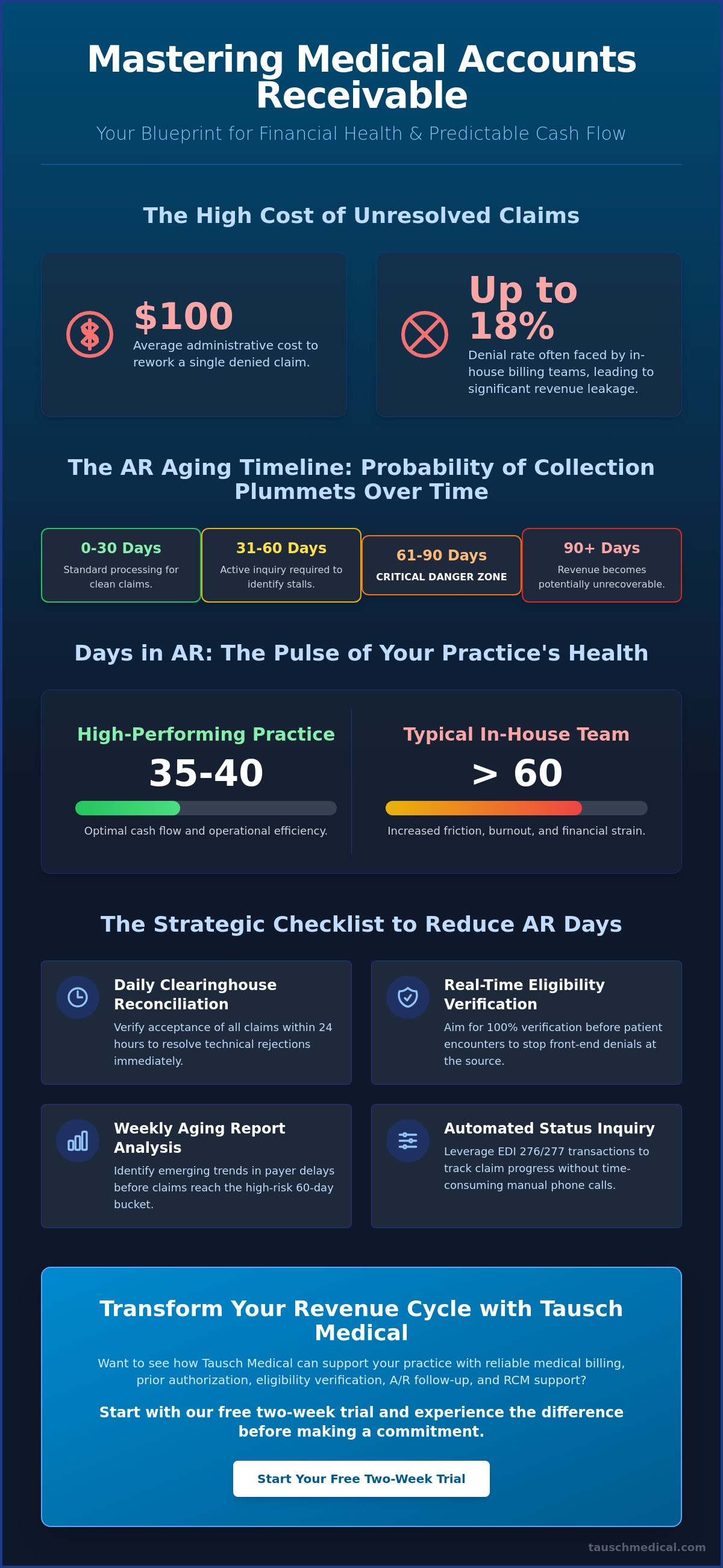
Did you know that the cost of reworking a single denied claim can reach $100 in administrative labor, while in-house billing teams often struggle with denial rates as high as 18%? You likely recognize the mounting pressure as unpaid claims drift past the critical 60-day mark, knowing that the probability of collection diminishes significantly with every passing week. It's a systemic drain on your practice's vitality that demands a more sophisticated medical accounts receivable follow up process. This isn't just about persistence; it's about applying clinical precision to your financial operations to prevent revenue leakage and staff burnout.
We'll show you how to implement a high-performance workflow that adheres to the strict 2026 Medicare 12-month timely filing mandate and leverages new state-level prompt payment protections. You'll learn the exact steps to optimize your revenue cycle, achieving the predictable cash flow and reduced administrative burden your practice deserves. This guide provides the strategic blueprint needed to lower your aging accounts and ensure your financial health reflects the premium quality of your clinical care. By aligning your billing operations with these advanced standards, you can secure the long-term business success your expertise warrants.
Key Takeaways
- Master the integration of a systematic medical accounts receivable follow up process within your RCM framework to ensure every claim reaches its full collection potential.
- Execute daily clearinghouse reconciliations and real-time eligibility checks to secure your revenue stream against common front-end errors and administrative delays.
- Utilize advanced CARC and RARC code analysis to resolve complex denials and implement high-value escalation protocols for claims aging beyond 60 days.
- Discover how transitioning to a specialized RCM partner can provide your practice with the technological superiority and clinical precision required for 2026 financial success.
What is the Medical Accounts Receivable Follow-Up Process?
The medical accounts receivable follow up process is the rigorous, systematic pursuit of claims that remain unpaid or underpaid after submission. It represents the critical final phase within the broader Revenue Cycle Management (RCM) framework. While front-end tasks like eligibility verification set the stage, the follow-up process ensures that insurance carriers fulfill their contractual obligations. In 2026, the distinction between reactive "claim chasing" and proactive "AR management" has become a defining factor for financial stability. Modern practices utilize automated triggers to flag delays before they become denials, replacing manual effort with technological precision.
Stagnant accounts receivable represent more than just delayed income; they are a direct threat to a practice's viability. When claims remain unresolved, the administrative burden on your staff increases exponentially. This cycle often leads to burnout and oversight, which only worsens the problem. Implementing a sophisticated medical accounts receivable follow up process allows your team to transition from a defensive posture to a strategic one, focusing on high-value recoveries rather than repetitive administrative tasks.
The Impact of "Days in AR" on Practice Health
The "Days in AR" metric serves as the pulse of your clinical operations, measuring the average time it takes to receive payment for services. High AR days create a cascade of operational friction, limiting your ability to fund payroll, invest in innovative medical technology, or expand patient services. High-performing practices aim for 35 to 40 days, whereas in-house teams often see cycles stretching beyond 60 days. Achieving a low AR count depends heavily on a high "Clean Claim Rate," which minimizes the need for extensive follow-up by ensuring accuracy at the point of submission.
Understanding AR Aging Buckets (30/60/90+ Days)
Financial health is categorized into aging buckets that dictate the urgency of intervention. The 0-30 day window is the standard processing period for clean claims. Once a claim enters the 31-60 day bucket, active inquiry is required to identify processing stalls. The 61-90 day window is the critical "Danger Zone." Industry data indicates that the likelihood of collecting on a claim drops significantly after 90 days; professional A/R management prioritizes these aging balances to prevent revenue from becoming unrecoverable debt, ensuring the practice's cash flow remains predictable and robust.
The 2026 Strategic Checklist to Reduce Accounts Receivable Days
Transforming your financial outcomes requires moving beyond manual effort toward a structured, technologically driven framework. A high-performance medical accounts receivable follow up process relies on a rigorous checklist that eliminates guesswork and ensures every dollar is accounted for. By applying clinical precision to your financial data, you can stop revenue leakage before it compromises your practice's growth.
Follow this 2026 strategic checklist to maintain operational momentum:
- Daily Clearinghouse Reconciliation: You must verify the acceptance of all submitted claims within 24 hours to resolve technical rejections immediately.
- Real-time Eligibility Verification: Aim for 100% verification before the patient encounter to stop front-end denials at the source.
- Weekly Aging Report Analysis: Identify emerging trends in payer delays before claims reach the high-risk 60-day aging bucket.
- Automated Status Inquiry: Leverage EDI 276/277 transactions to track claim progress without the need for time-consuming manual phone calls.
Front-End Accuracy: The Best Way to Reduce AR Days
Operational excellence begins at the registration desk. Your staff should maintain a strict protocol that includes high-resolution ID scans, current insurance card copies, and detailed prior authorization logs. Integrating professional insurance verification into your workflow acts as your primary defense against the buildup of unpaid claims. Remember: "A clean claim is the shortest path to a zero-day AR cycle." If your team is struggling to keep pace, exploring expert Accounts Receivable Management can provide the necessary relief and precision.
Payer-Specific Follow-Up Protocols
Different payers demand tailored strategies. For Medicare and Medicaid, your medical accounts receivable follow up process must account for regional variations, such as the specific timelines enforced by Novitas in Texas compared to the distinct requirements for New York payers. Commercial entities like Blue Cross Blue Shield, UnitedHealthcare, and Aetna each operate under unique contractual obligations and timely filing limits. Mastering these nuances allows your practice to navigate the 2026 landscape with professional confidence and clinical precision.
Advanced Denial Management: Resolving Claims Beyond 60 Days
When claims migrate into the 61 to 90 day bucket, your medical accounts receivable follow up process must evolve from routine monitoring to aggressive resolution. At this stage, generic inquiries are insufficient. You must decode the specific CARC (Claim Adjustment Reason Codes) and RARC (Remittance Advice Remark Codes) to uncover the clinical or administrative reason for non-payment. This data-driven approach allows you to address the root cause rather than merely treating the symptom of a stalled claim. If your internal team is overwhelmed by the complexity of these aging accounts, our Denial Management services can restore your practice's financial equilibrium.
Establishing a formal escalation workflow is paramount for high-value claims, particularly those languishing under "Payer Review" with regional carriers like Novitas in Texas or major East Coast insurers. Maintaining a detailed "Denial Log" enables you to identify if specific CPT codes or providers are triggering recurring issues, allowing for systemic corrections. For a deeper analysis of these tactics, consult our Medical Claim Denial Management Guide. Systematic tracking ensures that patterns of insurer behavior are documented, providing the leverage needed for successful appeals.
Effective Communication: Payer Call Best Practices
Success in payer communications requires clinical preparation. Before initiating a call, ensure your staff has the NPI, Tax ID, Claim ID, and patient demographics immediately accessible. Your goal is "One-Call Resolution." This means securing a firm processing date or, if a representative cannot provide a clear path to payment, requesting an immediate escalation to a supervisor. Documenting the representative's name and call reference number is a non-negotiable requirement for professional A/R follow-up.
Appeals and Underpayment Recovery
Filing a Level 1 appeal requires precision. You must adhere to strict payer deadlines and include all necessary clinical documentation to support the claim's necessity. Beyond total denials, you should also monitor for underpayments where the payer ignored your contracted fee schedule. Identifying these discrepancies requires a sophisticated understanding of your payer contracts and a willingness to challenge insurers who fail to meet their financial obligations to your practice.
Scaling RCM Success: Why Outsourcing AR Management Works
Scaling a medical practice requires more than just clinical excellence; it demands a financial infrastructure capable of handling increasing complexity. For many providers, the cost-benefit analysis of maintaining internal staff versus engaging a specialized RCM partner favors the latter. In major medical hubs like Dallas or Atlanta, the overhead for recruiting and training skilled billing personnel continues to rise. Outsourcing provides immediate access to advanced analytics and 2026 billing technology that would be cost-prohibitive to implement in-house. This transition allows your practice to benefit from a global standard of precision while maintaining a focus on patient care.
The "Tausch Advantage" lies in our supportive, expert partnership. We treat your revenue with the same clinical precision you apply to your patients. By integrating a professional revenue cycle management strategy, we ensure your medical accounts receivable follow up process is seamless and data-driven. This isn't just about clearing old debt; it's about building a predictable cash flow that supports long-term technological investment and practice growth.
Choosing the Right AR Follow-Up Partner
Selecting a partner requires a focus on transparency and specialized expertise. You should look for a firm that offers real-time reporting and maintains uncompromising HIPAA compliance. Local market knowledge is equally vital. Understanding the specific payer nuances in Texas, for instance, can be the difference between a swift payment and a protracted denial. Your partner must understand your specific specialty's coding requirements to ensure the medical accounts receivable follow up process remains accurate and efficient.
Transitioning to an Outsourced Model
Moving to an outsourced model doesn't have to disrupt your daily clinical operations. A professional transition focuses on a phased integration, where existing workflows are optimized rather than overhauled. This low-risk approach allows you to see immediate improvements in your collections without sacrificing administrative stability. By aligning with a dedicated team, you can finally move away from the burden of chasing payers and return your focus to clinical outcomes.
Want to see how Tausch Medical can support your practice with reliable medical billing, prior authorization, eligibility verification, A/R follow-up, and RCM support? Start with our free two-week trial and experience the difference before making a commitment: https://tauschmedical.com/free-trial-form
Optimizing Your Revenue Potential for 2026 and Beyond
Mastering the financial health of your practice requires a departure from outdated, manual methods. By implementing a sophisticated medical accounts receivable follow up process, you transition from reactive claim chasing to proactive revenue management. We've explored how daily reconciliations, precise denial analysis using CARC codes, and strategic outsourcing can reduce aging buckets and protect your cash flow from the volatility of the current regulatory landscape. These steps aren't just administrative tasks; they're the foundation of a premium, sustainable medical business that prioritizes clinical outcomes without sacrificing financial stability.
Achieving this level of operational excellence doesn't have to be a solitary burden for your team. Partnering with experts who understand the nuances of regional payer networks provides your practice with the technological superiority and clinical precision needed to thrive. It's time to reclaim your staff's focus and ensure your practice's growth reflects the high quality of care you provide. By aligning your billing operations with these advanced standards, you can secure the long-term success your expertise warrants.
Want to see how Tausch Medical can support your practice with reliable medical billing, prior authorization, eligibility verification, A/R follow-up, and RCM support? Start with our free two-week trial and experience the difference before making a commitment: free trial form
Frequently Asked Questions
How many days is considered a "good" AR for a medical practice?
High-performing medical practices aim for an average of 35 to 40 days in accounts receivable. If your cycle consistently exceeds 50 or 60 days, it's a clear indicator of systemic inefficiencies that require immediate strategic intervention. maintaining a lean AR cycle ensures your practice has the liquid capital necessary for premium technology investments and operational growth.
What is the difference between AR follow-up and denial management?
AR follow-up is the comprehensive pursuit of all outstanding insurance balances, whereas denial management is a specialized subset focusing on claims rejected by the payer. While your medical accounts receivable follow up process addresses stalled or pending claims, denial management requires a forensic deep dive into CARC and RARC codes to resolve specific clinical or administrative errors. Both are essential for a healthy revenue cycle.
How often should my staff perform AR follow-up?
Your staff should perform reconciliation daily to catch clearinghouse rejections, while comprehensive aging analysis should occur at least weekly. Waiting for a monthly billing cycle is an outdated approach that allows claims to drift into high-risk aging buckets. Consistent, frequent monitoring ensures that processing stalls are identified and resolved before they impact your practice's predictable cash flow.
Can I automate the medical accounts receivable follow-up process?
You can and should automate the status inquiry phase of your medical accounts receivable follow up process using EDI 276/277 transactions. Modern 2026 billing technology allows systems to communicate directly with payers, flagging claims that require human intervention without the need for manual phone calls. This innovation allows your team to focus their expertise on complex appeals rather than repetitive administrative tracking.
What are the most common reasons for claims staying in the 90+ day bucket?
Claims typically languish in the 90+ day bucket due to unresolved credentialing gaps, missing prior authorizations, or complex "Payer Review" stalls. These high-risk accounts often require supervisor-level escalation and intensive clinical documentation to secure payment. Without a structured recovery strategy, these claims represent significant revenue leakage that can compromise your practice's long-term financial stability and professional growth.
Disclaimer
This article is for general informational purposes only and does not constitute legal, medical, billing, coding, compliance, or financial advice. Healthcare rules, payer policies, and reimbursement guidelines may change and may vary by situation. Please consult qualified professionals or official sources before making decisions based on this content. Tausch Medical is not responsible for any loss or liability arising from reliance on this information.


