


Article by
Dr. Sharafat Hussain Ph.D
Dr. Sharafat Hussain is a healthcare business consultant, entrepreneur, and academic with strong experience in the US healthcare industry. He is the Founder and Managing Director of Tausch Medical, a revenue cycle management company supporting US healthcare providers with medical billing, prior authorization, credentialing, eligibility verification, A/R follow-up, and patient support services. His work combines practical healthcare operations, business strategy, and academic insight to help medical practices improve efficiency, collections, and service quality.
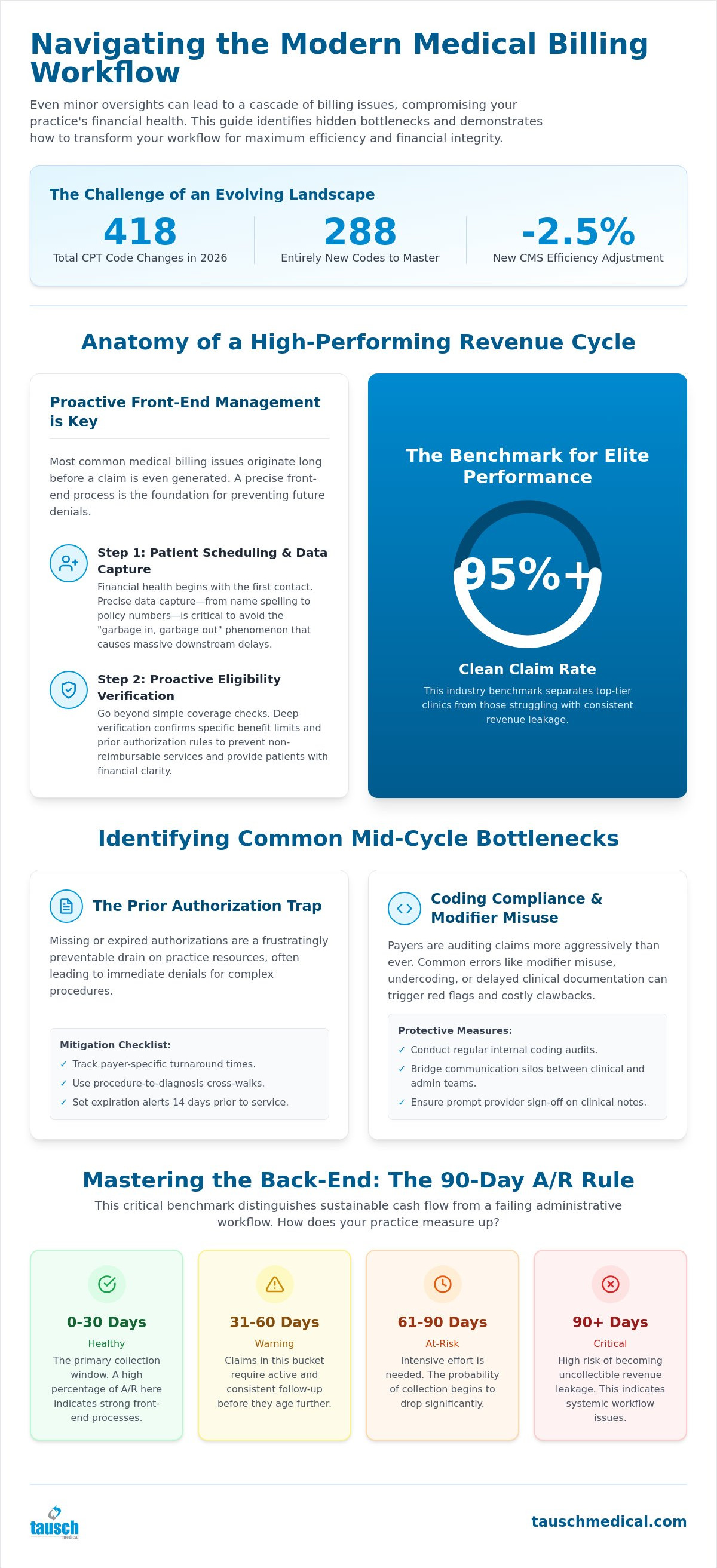
Did you know that the 2026 CPT code set introduced 418 total changes, including 288 entirely new codes that your administrative team must master to prevent immediate claim rejections? Many healthcare providers find that even a minor oversight in documentation or a slight delay in insurance verification can lead to a cascade of common medical billing workflow issues that compromise the financial health of the entire practice. It's frustrating to watch your staff struggle with burnout while your A/R turnover slows due to increasingly aggressive payer audits and the complexities of the "One Big Beautiful Bill Act."
We understand that you've built your practice on a foundation of clinical excellence, and your financial operations should reflect that same level of precision. In this guide, we'll identify the hidden bottlenecks in your revenue cycle and demonstrate how to transform your workflow for maximum efficiency. You'll learn how to navigate the new -2.5% CMS efficiency adjustment and implement sophisticated strategies that lead to reduced denial rates, faster reimbursement cycles, and a much clearer visibility into your long-term financial performance. By addressing these friction points with clinical-financial accuracy, you can secure the sustainable growth your practice deserves.
Key Takeaways
- Understand why the "Front-End" of your Revenue Cycle Management represents the most pivotal point for preventing future claim denials before they occur.
- Identify and resolve common medical billing workflow issues, such as coding inaccuracies and delayed clinical documentation, that lead to significant revenue leakage.
- Learn to apply the "90-day rule" to your accounts receivable to distinguish between sustainable cash flow and a failing administrative workflow.
- Discover how to reclaim collectible revenue that is often lost due to insufficient bandwidth for comprehensive denial management and A/R follow-up.
The Anatomy of a High-Performing Medical Practice Billing Workflow
A modern Medical Billing Process isn't a linear back-office task; it's a sophisticated, multi-stage Revenue Cycle Management (RCM) ecosystem. In the 2026 healthcare environment, where the One Big Beautiful Bill Act demands unprecedented price transparency, your workflow must be a seamless bridge between clinical care and financial integrity. Top-tier practices don't just react to denials. They engineer them out of existence by focusing on the Front-End. This proactive approach is essential because most common medical billing workflow issues originate long before a claim is even generated. To maintain premium performance, practices should strive for a Clean Claim Rate of 95% or higher. This benchmark separates elite clinics from those struggling with consistent revenue leakage.
Step 1: Patient Scheduling and Data Capture
Financial health begins with the first phone call. Utilizing professional patient scheduling services ensures that data capture is precise from the start. We frequently encounter the "garbage in, garbage out" phenomenon, where minor clerical errors in name spelling or policy numbers lead to massive downstream delays. In 2026, scheduling and billing are inextricably linked. An error at the front desk is effectively a future denial in waiting. Precision at this stage is the only way to safeguard your practice against administrative friction.
Step 2: Proactive Insurance Eligibility Verification
Simple coverage checks are no longer sufficient to protect your margins. Deep eligibility verification involves confirming specific benefit limits and the latest prior authorization requirements, which have become more stringent following recent CMS updates. Failing to perform this level of scrutiny leads to the impact of inaccurate insurance verification, often resulting in non-reimbursable services. By identifying potential common medical billing workflow issues at the verification stage, you provide your patients with the financial clarity required by modern transparency laws while securing your practice's reimbursement.
Common Medical Billing Workflow Issues and Mid-Cycle Bottlenecks
Mid-cycle friction often manifests as a communication breakdown between the clinical floor and the administrative office. These "billing silos" prevent critical data from flowing naturally, turning high-volume patient encounters into administrative nightmares. When the billing team operates in isolation from the front desk, the risk of common medical billing workflow issues increases exponentially, particularly regarding delayed clinical documentation. If a provider doesn't sign off on notes promptly, the entire reimbursement cycle grinds to a halt, directly impacting your cash flow and increasing the age of your accounts receivable.
To prevent these silos in the increasingly digital environment of 2026, having a robust and secure IT network is essential; many growing practices utilize managed services from Trinity Networx, LLC to ensure their clinical and administrative systems stay perfectly synced and protected.
The Prior Authorization Trap
In competitive specialty markets such as Houston or Atlanta, the volume of complex procedures requires a rigid authorization protocol. Missing or expired authorizations are among the most frustratingly preventable common medical billing workflow issues that drain practice resources. We've seen practices lose thousands simply because an authorization wasn't updated for a changed CPT code. To mitigate this, we recommend a standardized tracking template that includes:
- Payer-specific authorization turnaround times.
- Procedure-to-diagnosis cross-walks for medical necessity.
- Expiration date alerts set for 14 days prior to the scheduled service.
Coding Compliance and Modifier Misuse
Precision in coding is increasingly difficult as payers audit claims more aggressively in 2026. Many practices unknowingly fall victim to Common Medical Billing and Coding Errors, specifically modifier misuse and undercoding, which can trigger red flags. Ensuring revenue integrity requires a sophisticated approach to medical billing payment posting services, where every line item is scrutinized against the original contract. Regular internal audits act as a clinical-financial safeguard, identifying these patterns before they result in costly clawbacks. If you're finding these mid-cycle complexities overwhelming, exploring expert billing management can provide the specialized support needed to bridge these documentation gaps.
Back-End Breakdowns: Denial Management and A/R Recovery
The back-end of the revenue cycle serves as the ultimate diagnostic for practice health. We frequently observe practices that "write off" collectible revenue simply because their internal teams lack the bandwidth for persistent follow-up. This neglect is one of the most destructive common medical billing workflow issues, as it turns earned income into lost opportunity. The "90-day rule" serves as a critical threshold; once a claim crosses this mark without resolution, the probability of collection plummets. This stagnation often signals a failing workflow that cannot keep pace with the aggressive auditing environment of 2026.
Strategic Denial Management
Recovery efforts must be surgical rather than reactive. By categorizing rejections into "hard" and "soft" denials, your team can prioritize claims that merely require documentation clarification or corrected modifiers. Adopting denial prevention and management best practices ensures that your appeals are data-driven and timely. This proactive stance is detailed further in our 2026 guide to medical claim denial management, which provides a roadmap for turning rejections into realized revenue.
Optimizing Accounts Receivable in Competitive Markets
In major healthcare hubs like New York, Miami, or Dallas, payer-specific nuances can complicate the recovery process. For instance, the Florida Patient Overpayment Law, effective January 1, 2026, requires providers to refund overpayments within 30 days, adding another layer of urgency to financial reconciliation. Specialized medical accounts receivable services provide the regional expertise needed to manage these requirements without overwhelming your staff. By integrating expert AR and denial management services, you resolve common medical billing workflow issues while allowing your clinical team to focus entirely on patient care.
Securing Your Practice’s Financial Future in 2026
Identifying and resolving common medical billing workflow issues is no longer a luxury; it’s a fundamental requirement for clinical sustainability. We’ve explored how a high-performing revenue cycle depends on the synergy between front-end data capture and back-end denial management. By eliminating communication silos and prioritizing proactive insurance verification, your practice can achieve the 95% clean claim rate that separates industry leaders from those facing consistent revenue leakage. Transformation begins with acknowledging that specialized expertise is the bridge between clinical excellence and financial integrity; for information on medical products that support this standard of care, click here.
Tausch Medical provides the comprehensive RCM support and specialized denial management expertise needed to navigate the complexities of the modern payer landscape. We invite you to elevate your practice management through our professional billing solutions, ensuring your team stays focused on patient care while we secure your reimbursement. Experience the peace of mind that comes from a streamlined, expert-led billing process designed for the demands of 2026.
Want to see how Tausch Medical can support your practice with reliable medical billing, prior authorization, eligibility verification, A/R follow-up, and RCM support? Start with our free two-week trial and experience the difference before making a commitment: free trial form
Frequently Asked Questions
What is the most common cause of medical billing delays?
The primary driver of delays is the lack of real-time insurance verification at the point of patient intake. When eligibility is not confirmed with clinical precision before the encounter, it creates common medical billing workflow issues that lead to immediate claim rejections. Ensuring that patient demographics and coverage details are validated during the initial scheduling phase is the most effective way to eliminate these preventable administrative bottlenecks.
How often should a practice audit its billing workflow?
We recommend conducting a comprehensive workflow audit at least once per year, supplemented by monthly performance reviews of key metrics. This consistent oversight allows you to identify emerging common medical billing workflow issues caused by updated payer policies or internal staffing changes. Regular auditing ensures your practice remains aligned with the latest CPT revisions and maintains the high clean claim rates necessary for sustained financial health.
Can outsourcing medical billing improve patient satisfaction?
Outsourcing your billing operations significantly enhances the patient experience by providing greater financial clarity and reducing billing disputes. When experts handle the complexities of your revenue cycle, patients receive more accurate statements and benefit from a more transparent billing process. This administrative relief also allows your clinical staff to focus entirely on patient care, fostering a more supportive and professional environment within the practice.
What is a good benchmark for "Days in A/R" in 2026?
For a high-performing medical practice in 2026, the target for "Days in A/R" should be 35 days or fewer. Maintaining this benchmark is crucial for ensuring consistent cash flow and protecting the practice against the timely filing limits imposed by major payers. If your A/R consistently exceeds 45 days, it is a clear indicator that your current workflow requires strategic optimization to prevent long-term revenue loss.
Want to see how Tausch Medical can support your practice with reliable medical billing, prior authorization, eligibility verification, A/R follow-up, and RCM support? Start with our free two-week trial and experience the difference before making a commitment: free trial form
Disclaimer
This article is for general informational purposes only and does not constitute legal, medical, billing, coding, compliance, or financial advice. Healthcare rules, payer policies, and reimbursement guidelines may change and may vary by situation. Please consult qualified professionals or official sources before making decisions based on this content. Tausch Medical is not responsible for any loss or liability arising from reliance on this information.


