


Article by
Dr. Sharafat Hussain Ph.D
Dr. Sharafat Hussain is a healthcare business consultant, entrepreneur, and academic with strong experience in the US healthcare industry. He is the Founder and Managing Director of Tausch Medical, a revenue cycle management company supporting US healthcare providers with medical billing, prior authorization, credentialing, eligibility verification, A/R follow-up, and patient support services. His work combines practical healthcare operations, business strategy, and academic insight to help medical practices improve efficiency, collections, and service quality.
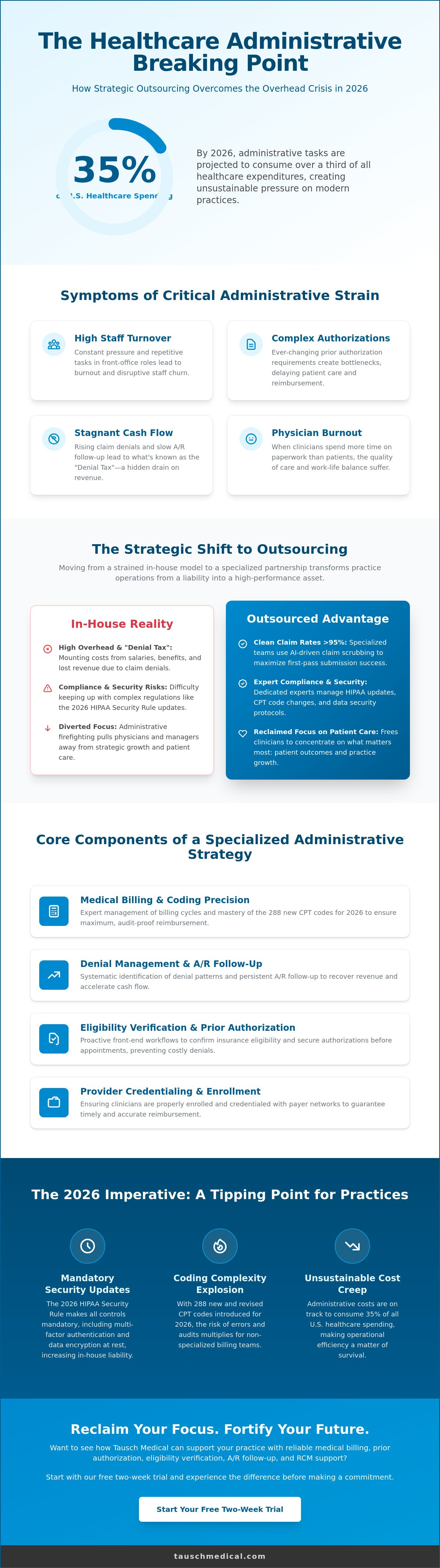
Administrative costs now represent up to 35% of all healthcare spending in the United States, a figure that highlights a critical breaking point for modern practices. You've likely experienced the mounting pressure of high staff turnover in front-office roles and the increasingly complex prior authorization requirements that seem to change by the week. It's exhausting to manage stagnant cash flow from claim denials when your primary mission is patient health.
We understand that maintaining clinical precision requires more than just medical expertise; it demands an elite operational foundation. This strategic guide explores how healthcare administrative outsourcing serves as a vital resource for providers aiming to optimize their revenue cycles and reduce overhead in 2026. You'll learn how to achieve clean claim rates above 95% while navigating the latest HIPAA security updates and AI-driven audit trends. We'll outline the path to reclaiming your focus and improving your work-life balance, ensuring your practice remains both profitable and patient-centered in an evolving landscape.
Key Takeaways
- Learn how healthcare administrative outsourcing has evolved from simple staffing into a clinical-grade partnership that secures your practice against the complexities of the 2026 regulatory environment.
- Identify the "Denial Tax" and other hidden overhead costs associated with in-house billing teams to understand the true impact on your practice’s net revenue.
- Discover how specialized revenue cycle management and automated insurance verification workflows can push clean claim rates above the 95% threshold.
- Establish a framework for evaluating potential partners based on real-time financial transparency and adherence to the latest 2026 data security standards.
- Understand the strategic shift required to return your primary focus to patient care while maintaining a robust, precision-engineered administrative infrastructure.
Understanding the Scope of Healthcare Administrative Outsourcing
In the 2026 fiscal environment, the definition of healthcare administrative outsourcing has moved far beyond simple task delegation. It's now a precision-engineered strategy that integrates medical billing, compliance, and clinical documentation into a unified ecosystem. This evolution reflects the broader maturation of medical outsourcing, where specialized firms provide the clinical-financial expertise that general business process outsourcing (BPO) providers cannot match. The transition from traditional staffing to these specialized partnerships is driven by necessity; the 2026 HIPAA Security Rule updates have made all security controls mandatory, including multi-factor authentication and data encryption at rest. Managing these requirements in-house creates a high-risk liability that many providers are no longer willing to carry.
The Administrative Burden Crisis
Administrative friction does more than just frustrate staff; it leads to patient leakage when scheduling delays or authorization errors prevent timely care. When physicians spend more time on paperwork than on patient interaction, the clinical quality of the practice inevitably suffers. By the end of 2026, administrative costs are projected to consume nearly 35% of total U.S. healthcare expenditures, forcing a paradigm shift in how private practices manage their operational overhead. To support this transition, many organizations look to Mytech Partners for the strategic IT consulting and managed support necessary to maintain a high-performing digital infrastructure.
Key Categories of Outsourced Support
Modern support is split between front-end tasks, like eligibility verification and patient scheduling, and back-end functions, such as denial management and accounts receivable follow-up. Healthcare administrative outsourcing ensures that technology-enabled services, like AI-driven claim scrubbing, are aligned with clinical outcomes. This strategic alignment stabilizes the revenue cycle and allows clinicians to return to their primary purpose: patient care. By leveraging external expertise for these complex workflows, practices can achieve the financial stability required to invest in world-class medical technology and better patient experiences.
Core Components of a Specialized Administrative Strategy
A specialized strategy for healthcare administrative outsourcing must be as precise as the clinical procedures it supports. It's no longer sufficient to manage a practice with a generalist mindset. Instead, providers require an integrated approach that connects front-office patient engagement with back-office financial rigor. This synergy provides immense value to medical professionals by ensuring that clinical outcomes are mirrored by financial health.
Maximizing Revenue Through Billing Excellence
Effective medical billing outsourcing acts as the engine for practice growth. With 288 new or revised CPT codes introduced for 2026, coding precision is non-negotiable for avoiding audits. Expert medical claim denial management transforms potential losses into recovered revenue by identifying systemic rejection patterns. Systematic follow-up on accounts receivable reduces the average collection time, providing the liquid capital necessary for expanding your medical portfolio.
Credentialing and Authorization: The Compliance Gatekeepers
The strategic value of provider credentialing services in 2026 cannot be overstated. As payer networks become more restrictive, professional enrollment ensures your clinicians are recognized and reimbursed at the highest possible tiers. Robust insurance verification at the point of entry prevents front-end denials, which often account for significant administrative friction. Navigating complex payer networks requires a dedicated team that understands the nuances of professional enrollment and prior authorization workflows.
Optimizing these core components leads to a more resilient practice. It's about building a foundation that supports long-term success. If you're looking to enhance your practice's operational efficiency, consider exploring a tailored revenue cycle management solution that adapts to your specific clinical needs.
The Financial Architecture: In-House vs. Strategic Outsourcing
Building a resilient practice requires a clear understanding of the total cost of ownership regarding your back office. While in-house staffing might seem manageable, the "fully loaded" cost of an employee is often 1.4 times their base salary when you account for benefits, payroll taxes, and ongoing training. Healthcare administrative outsourcing replaces these fixed, heavy labor costs with a variable, performance-based model. This shift is particularly vital when considering the "Denial Tax" inherent in internal operations. Research indicates that in-house billing teams typically face denial rates between 12% and 18%, whereas specialized partners average closer to 2% to 5%.
Effectively managing these complex overheads often necessitates specialized professional advisory. For instance, CTC Tax & Accounting offers the bookkeeping and tax compliance services required to navigate the broader financial responsibilities of a growing medical practice with precision.
Direct Cost Comparison
Transitioning from a fixed salary model to a percentage-of-collections framework ensures that your administrative expenses scale directly with your success. You also avoid the significant productivity dip during the standard 6-8 week "ramp-up" period required for new hires. A single full-time credentialing specialist often commands a higher annual package in salary and benefits than a comprehensive outsourced service that manages multiple provider enrollments with greater precision. It's also important to stay informed on State Medicaid outsourcing regulations to ensure your financial architecture remains compliant across all payer types.
The ROI of Clean Claims
The financial impact of a 5% increase in clean claim rates is transformative for a practice's bottom line. Higher clean claim rates don't just accelerate cash flow; they eliminate the labor-intensive cost of reworking denied claims. By capturing more revenue on the first submission, practices can strategically reinvest administrative savings into world-class clinical technology or portfolio expansion. Aggressive management of accounts receivable ensures that your hard-earned revenue isn't lost to timely filing limits or payer delays. This precision-focused approach turns the administrative department from a cost center into a primary driver of long-term profitability.
Strategic Selection: Evaluating an Outsourcing Partner
The selection of a partner for healthcare administrative outsourcing is a high-stakes decision that directly impacts both your clinical reputation and financial stability. A premium medical practice requires more than a generic vendor; it needs a strategic extension that mirrors its own commitment to excellence. You should prioritize partners who offer real-time transparency through advanced reporting dashboards. This allows you to monitor your financial health without delay. In the 2026 regulatory environment, compliance must go beyond basic HIPAA standards. Your partner should verify that all 2026 mandatory security controls, such as multi-factor authentication and data encryption at rest, are strictly enforced across their systems. Additionally, specialty-specific expertise is vital; generic firms often fail niche practices because they don't understand the unique CPT nuances or payer hurdles specific to your field. Seamless integration with your existing EHR is also essential to maintain data integrity and workflow continuity.
Operational Synergy and Communication
Effective collaboration relies on more than just software; it requires a dedicated account manager who understands your practice's unique workflow. This individual acts as a bridge, ensuring that medical practice scheduling outsourcing is perfectly synchronized with your billing cycles. When scheduling and billing operate in harmony, patient friction decreases and the likelihood of front-end errors drops significantly. You should establish clear Key Performance Indicators (KPIs) at the start of the partnership. Focus on clean claim rates and average days in accounts receivable to measure success objectively.
Scalability and Long-Term Partnership
A partner's ability to support your growth is a critical factor in long-term viability. As you expand your clinical portfolio or add new locations, your administrative support must scale without compromising accuracy. Comprehensive revenue cycle management provides the financial roadmap for this expansion. It ensures that increased patient volume translates into healthy cash flow. Evaluating a partner's industry reputation and financial stability protects your practice from the disruptions caused by vendor turnover. If you're ready to elevate your practice's operations, we invite you to consult with Tausch Medical's experts about building a precision-engineered administrative strategy.
Optimizing Practice Performance with Tausch Medical
Tausch Medical stands at the intersection of clinical precision and operational excellence. We provide precision-engineered solutions for healthcare administrative outsourcing that adapt to the rigorous demands of the 2026 medical landscape. Our commitment to clinical-grade accuracy ensures that your revenue cycle remains as healthy as the patients you treat. By choosing Tausch, you gain access to national-scale resources while receiving the boutique attention to detail that your specialty practice deserves. Our partnership is built on a foundation of absolute transparency, continuous innovation, and measurable financial results.
Comprehensive RCM and Billing Solutions
We develop tailored strategies specifically for independent and specialty practices that require a high level of coding sophistication. Our advanced denial management protocols and A/R recovery systems are designed to capture revenue that often slips through the cracks of less specialized firms. You'll receive customized reporting that provides the clarity needed for executive decision-making. These insights allow you to lead your practice with data-driven confidence rather than administrative guesswork.
Starting Your Transition to Administrative Excellence
The transition to a new administrative partner shouldn't disrupt your clinical operations. Our onboarding process is designed for minimal disruption and maximum impact, ensuring seamless data migration and workflow integration. We take the heavy lifting out of complex credentialing and authorization workflows, managing the intricate details so your staff can stay focused on the patient experience. If you're ready to elevate your practice, you can schedule a strategic consultation with Tausch Medical today to discuss your specific needs.
Want to see how Tausch Medical can support your practice with reliable medical billing, prior authorization, eligibility verification, A/R follow-up, and RCM support? Start with our free two-week trial and experience the difference before making a commitment: free trial form
Securing Your Clinical Future Through Operational Excellence
The transition from traditional staffing to specialized healthcare administrative outsourcing represents a fundamental shift in how modern practices maintain their clinical and financial integrity. We've explored the financial architecture of the strategic model and identified the critical importance of partners who offer real-time transparency and 2026-grade security. By stabilizing your revenue cycle, you ensure your practice has the liquid capital necessary to invest in world-class medical innovation and superior patient experiences.
Tausch Medical provides the clinical-grade precision required to navigate the current complex payer landscape. Our partners benefit from a 98%+ clean claim rate, specialized denial management expertise, and comprehensive national provider credentialing. These benchmarks aren't just aspirations; they're the standard for a practice that refuses to compromise on quality or profitability.
Optimize your practice revenue with Tausch Medical’s expert administrative outsourcing.
Want to see how Tausch Medical can support your practice with reliable medical billing, prior authorization, eligibility verification, A/R follow-up, and RCM support? Start with our free two-week trial and experience the difference before making a commitment: free trial form
Your journey toward a more efficient, patient-focused practice is within reach. We look forward to supporting your continued success as a leader in healthcare delivery.
Frequently Asked Questions
What is healthcare administrative outsourcing and how does it work?
Healthcare administrative outsourcing involves delegating non-clinical operational tasks to a specialized partner who manages your revenue cycle and front-office functions. The process works through deep integration with your existing EHR and practice management systems, allowing an external team to handle billing, coding, and scheduling with clinical-grade precision. This setup ensures that your practice operates with a high level of expertise without the burden of direct staff management.
How much can a medical practice save by outsourcing administrative tasks?
Practices save money by replacing fixed overhead, such as salaries, benefits, and PTO, with a scalable, performance-oriented cost structure. You eliminate the hidden expenses of recruitment, training, and the infrastructure required to maintain an in-house billing department. By reducing administrative friction and improving clean claim rates, your practice captures more revenue while lowering the overall cost of collections.
Is healthcare administrative outsourcing HIPAA compliant?
Professional outsourcing is strictly HIPAA compliant and must meet the updated 2026 security standards. This includes mandatory multi-factor authentication, encryption of data at rest, and biannual vulnerability scanning. A reputable partner ensures that all protected health information is handled with the highest level of cybersecurity, protecting your practice from the legal and financial risks associated with data breaches or non-compliance.
Can I outsource patient scheduling without losing control of my calendar?
You retain full control over your clinical calendar through real-time synchronization between your office and the outsourcing partner. You set the parameters for appointment types, duration, and provider availability, while the external team manages patient inquiries and data entry. This collaborative approach reduces the front-desk burden and ensures that your schedule is optimized according to your specific clinical preferences and workflow.
What is the difference between RCM and medical billing outsourcing?
Medical billing is the technical process of submitting claims and following up on payments, while Revenue Cycle Management (RCM) is a holistic financial strategy. RCM encompasses the entire patient journey, from initial eligibility verification and prior authorization to final collections and denial management. Broadening your scope to include comprehensive RCM provides a more stable financial foundation than simple billing services alone.
How long does it take to transition to an outsourced administrative partner?
A successful transition to a specialized partner generally takes between thirty and sixty days. This timeframe allows for thorough system integration, the establishment of communication protocols, and the mapping of your specific practice workflows. A structured onboarding process ensures that your revenue cycle remains uninterrupted while your new administrative foundation is precision-engineered for long-term success and clinical-grade accuracy.
Does outsourcing administrative tasks affect the patient experience?
Outsourcing significantly enhances the patient experience by providing more accurate insurance verification and professional scheduling interactions. When administrative tasks are handled by experts, patients experience fewer billing surprises and smoother check-in processes. This professional efficiency reflects positively on your practice's brand, allowing your clinical team to provide undivided attention to patient care during every visit.
What specific tasks are included in healthcare administrative outsourcing?
The scope of healthcare administrative outsourcing typically includes medical billing, insurance verification, and prior authorization workflows. It also covers essential back-office functions like accounts receivable follow-up, denial management, and provider credentialing. By bundling these services, a practice can achieve a unified operational strategy that supports both clinical excellence and robust financial growth in a competitive medical environment.
Disclaimer
This article is for general informational purposes only and does not constitute legal, medical, billing, coding, compliance, or financial advice. Healthcare rules, payer policies, and reimbursement guidelines may change and may vary by situation. Please consult qualified professionals or official sources before making decisions based on this content. Tausch Medical is not responsible for any loss or liability arising from reliance on this information.


