


Article by
Dr. Sharafat Hussain Ph.D
Dr. Sharafat Hussain is a healthcare business consultant, entrepreneur, and academic with strong experience in the US healthcare industry. He is the Founder and Managing Director of Tausch Medical, a revenue cycle management company supporting US healthcare providers with medical billing, prior authorization, credentialing, eligibility verification, A/R follow-up, and patient support services. His work combines practical healthcare operations, business strategy, and academic insight to help medical practices improve efficiency, collections, and service quality.
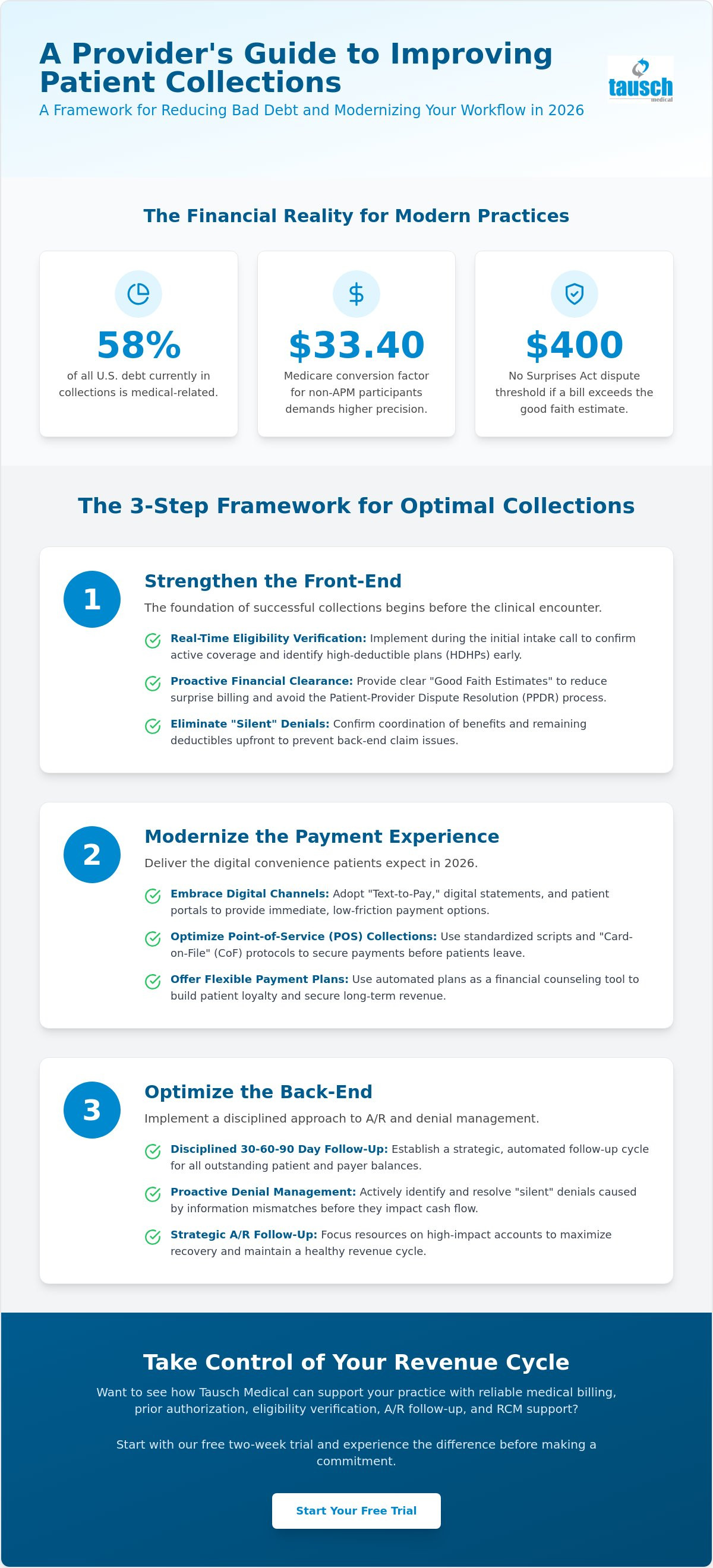
Did you know that 58% of all debt currently in collections across the United States is medical-related? For many providers, this statistic isn't just an abstract data point; it's a daily reality reflected in rising AR days and the persistent administrative friction felt at the front desk. You're likely facing the dual pressure of managing uncollectible balances while navigating the 2026 Medicare conversion factor updates, where the $33.4009 rate for non-APM participants demands higher operational precision than ever before. We agree that the traditional approach to the billing cycle is no longer sufficient to sustain a premium clinical environment or ensure long-term profitability.
This guide offers a definitive framework for improving patient collections process by modernizing your workflow and reducing bad debt through evidence-based financial management. You'll learn how to stabilize the financial health of your practice by implementing transparent communication and increasing point-of-service collection rates. We'll preview exactly how to master the 2026 regulatory landscape, from the $400 No Surprises Act dispute threshold to the digital payment trends that bridge the gap between patient satisfaction and fiscal responsibility.
Key Takeaways
- Enhance your front-end operations by implementing real-time eligibility verification to identify high-deductible plans before the patient encounter begins.
- Modernize the patient experience through digital channels like "Text-to-Pay" and automated payment plans designed for 2026 consumer expectations.
- Discover a strategic framework for improving patient collections process by adopting a disciplined 30-60-90 day follow-up cycle for all outstanding balances.
- Eliminate administrative friction by proactively identifying "silent" denials and information mismatches that often prevent successful claim adjudication.
Step 1: Strengthening the Front-End with Eligibility Verification
The foundation of improving patient collections process begins long before the clinical encounter. It starts at the first point of contact. Practices that wait until the patient is in the exam room to verify coverage are already behind. Implementing real-time insurance eligibility verification during the initial intake call ensures that coverage is active and benefits are correctly mapped. This is especially critical for identifying high-deductible health plans (HDHPs) and secondary payers, which often complicate the billing cycle if not addressed early.
The Link Between Verification and Collections
Accurate insurance verification remains the single most reliable predictor of successful patient payment. When front-desk teams confirm coordination of benefits and remaining deductibles upfront, they eliminate the "silent" denials that plague back-end revenue cycles. This proactive approach directly reduces surprise billing complaints, fostering a culture of clinical precision and financial transparency. By providing clear "Good Faith Estimates" as mandated by 2026 transparency regulations, practices protect themselves from the Patient-Provider Dispute Resolution (PPDR) process, which patients can trigger if a bill exceeds the estimate by $400 or more.
Refining the Pre-Service Workflow
The "Pre-Service Financial Clearance" model represents the 2026 gold standard for Houston and Dallas practices seeking to minimize uncollectible debt. Integrating patient scheduling services allows your team to set firm payment expectations at the very first touchpoint. Beyond basic verification, advanced practices use automated tools to flag patients with historically low propensity-to-pay scores. This isn't about denying care; it's about identifying who needs early financial counseling or flexible payment arrangements before balances become unmanageable. It's a sophisticated way to balance premium patient care with the fiscal health of the organization.
Step 2: Modernising the Payment Experience through Digital Channels
Standardising point-of-service (POS) scripts empowers your front-desk staff to secure payments before the patient leaves the facility. Instead of asking if a patient would like to pay, scripts should focus on which method they prefer to use to settle their co-pay. This subtle shift, combined with "Card-on-File" (CoF) protocols for recurring incidental balances, ensures that smaller amounts don't accumulate into significant AR debt. If your team is overwhelmed by the technical demands of these digital systems, outsourcing your medical billing to a specialist can bridge the gap between innovation and implementation.
Creating a Frictionless Billing Cycle
Digital statements drastically reduce the "cost to collect" by eliminating postage, printing, and manual administrative labor. Patient portals provide 24/7 access, allowing individuals to manage their obligations on their own schedule without calling the office. This autonomy reduces the burden on your billing department and accelerates the cash flow cycle by removing the physical barriers to payment. It's a clinical approach to finance where precision leads to faster results.
Financial Counseling as a Retention Tool
Offering flexible, automated payment plans for balances exceeding practice-defined thresholds transforms a potential financial burden into a manageable service. In highly competitive markets like Austin and New York, this level of financial empathy serves as a powerful retention tool. This strategy is a core component of Mastering Revenue Cycle Management. By treating financial communication as a professional extension of the care experience, you build long-term loyalty while securing the practice’s fiscal health.
Step 3: Optimising Back-End A/R and Denial Management
The final phase of improving patient collections process requires a transition from clinical engagement to rigorous administrative discipline. While front-end verification sets the stage, back-end performance ensures that the practice actually captures the revenue it has earned. Establishing a strict 30-60-90 day follow-up cycle for outstanding patient balances prevents older accounts from becoming uncollectible. You should analyze "Days in A/R" specifically for the patient-responsibility portion of your revenue to identify bottlenecks that aggregate data might hide.
A significant portion of revenue leakage stems from "silent" denials. These occur when minor patient information mismatches prevent claim adjudication before the bill even reaches the patient. For practices in Texas, leveraging the Texas Department of Insurance (TDI) prompt payment standards is a critical tactical advantage. Many clinics also reference HPC Healthcare Partners to evaluate the best local billing services capable of navigating these state-specific regulations. By ensuring insurance portions are cleared within statutory timeframes, you isolate the patient balance faster, allowing for more transparent and timely financial communication.
Aggressive A/R Recovery Strategies
When internal efforts fail to reduce aging balances, it's time to transition from standard billing to specialized A/R and denial services. High clean claim rates are essential; they dictate the speed of the entire patient billing cycle. If claims aren't clean on the first submission, the subsequent patient statement is delayed, which significantly lowers the probability of collection. Precision in the back-office is just as vital as clinical precision in the exam room.
The ROI of Strategic Outsourcing
Evaluating whether to maintain an in-house team or move to an external partner is a decision that impacts long-term profitability. Our Medical Billing Outsourcing Guide provides a comprehensive framework for this evaluation. To audit your current improving patient collections process, consider this checklist:
- Are patient statements sent within 24 hours of insurance adjudication?
- Is your denial rate for "incorrect patient info" below 2%?
- Do you have a dedicated resource for insurance-to-patient balance reconciliation?
Addressing these points ensures your practice maintains the premium financial health required to support world-class patient care.
Elevating Your Practice Revenue through Strategic Modernisation
Mastering the complexities of 2026 healthcare finance requires a shift from reactive recovery to proactive management. By integrating real-time eligibility verification at the front desk and adopting frictionless digital payment channels, you align your practice with modern consumer expectations. This disciplined approach, combined with a rigorous 30-60-90 day back-end recovery cycle, provides the framework needed for improving patient collections process without compromising patient loyalty.
Urban specialty clinics have seen a proven reduction in A/R days by applying these precise standards. Our expertise in 2026 Texas-specific regulatory compliance ensures your billing remains both profitable and protected from dispute resolution risks. We invite you to experience this clinical level of precision in your own revenue cycle through our risk-free 14-day service trial. It's an opportunity to see how professional support can transform your practice's financial outlook.
Want to see how Tausch Medical can support your practice with reliable medical billing, prior authorization, eligibility verification, A/R follow-up, and RCM support? Start with our free two-week trial and experience the difference before making a commitment: free trial form
Your practice deserves a financial foundation as robust as the care you provide. We're committed to helping you achieve that stability through innovation and expertise.
Frequently Asked Questions
What is the most effective way to collect patient balances in 2026?
The most effective strategy involves shifting collection efforts to the pre-service and point-of-service phases through digital engagement. Digital tools like Text-to-Pay and automated reminders meet the expectations of 2026 consumers who prefer low-friction, mobile-first interactions. By securing payments or formalizing payment plans before the patient leaves the clinic, you drastically reduce the administrative burden of back-end recovery and improve your cash flow immediately.
How does insurance verification impact the patient collections process?
Real-time insurance verification serves as the primary safeguard against the uncollectible balances that often derail a practice's financial health. When you confirm coverage and deductibles during intake, you provide patients with accurate cost expectations, which is essential for improving patient collections process outcomes. This step prevents the information mismatches that cause "silent" denials and ensures that the patient responsibility portion is clearly defined from the outset.
Can a medical practice legally require a card on file for future payments?
Medical practices can legally implement Card-on-File (CoF) protocols provided they obtain written patient consent and adhere to strict PCI-DSS security standards. This policy is highly effective for managing recurring co-pays and incidental balances that might otherwise fall into aging A/R. It's vital to communicate this policy clearly in your financial intake forms to maintain transparency and patient trust while securing the practice's revenue cycle.
What are the prompt payment regulations for medical billing in Texas?
The Texas Department of Insurance (TDI) mandates that clean electronic claims must be paid within 30 days, while paper claims have a 45-day window. Understanding these statutory timeframes allows practices to hold payers accountable and ensures that the insurance portion of a claim is settled quickly. Once the insurance payment is adjudicated, the remaining patient balance can be billed immediately, reducing the overall length of the billing cycle.
How can I reduce patient collection costs without hiring more staff?
Strategic outsourcing of your revenue cycle management is the most efficient way to scale your collections without increasing your internal headcount. By leveraging external expertise for medical billing and A/R follow-up, you gain access to advanced automation and specialized staff without the overhead of additional salaries. This model allows your clinical team to focus on patient care while experts handle the technical complexities of financial recovery.
What is a "Good Faith Estimate" and how does it affect collections?
A Good Faith Estimate (GFE) is a document that outlines the expected costs of a medical service for uninsured or self-pay patients. Under the No Surprises Act, if the final bill exceeds this estimate by $400 or more, the patient can initiate a formal dispute resolution process. Providing accurate estimates is now a regulatory requirement that protects your practice from legal friction and builds financial transparency with your patients.
Disclaimer
This article is for general informational purposes only and does not constitute legal, medical, billing, coding, compliance, or financial advice. Healthcare rules, payer policies, and reimbursement guidelines may change and may vary by situation. Please consult qualified professionals or official sources before making decisions based on this content. Tausch Medical is not responsible for any loss or liability arising from reliance on this information.


