


Article by
Dr. Sharafat Hussain Ph.D
Dr. Sharafat Hussain is a healthcare business consultant, entrepreneur, and academic with strong experience in the US healthcare industry. He is the Founder and Managing Director of Tausch Medical, a revenue cycle management company supporting US healthcare providers with medical billing, prior authorization, credentialing, eligibility verification, A/R follow-up, and patient support services. His work combines practical healthcare operations, business strategy, and academic insight to help medical practices improve efficiency, collections, and service quality.
In 2026, the traditional approach to medical billing for small practices has evolved from a back-office task into a high-stakes clinical discipline where even a minor coding oversight can jeopardize your entire revenue cycle. You likely entered the medical field to focus on patient outcomes and clinical excellence, not to spend your evenings untangling complex insurance verifications or chasing down aged accounts receivable. The exhaustion of managing constant staff turnover while watching claim denial rates climb is a burden that many dedicated providers share; it is a cycle that often feels impossible to break without the right technical infrastructure.
This guide will show you how to transform these administrative hurdles into a streamlined engine of financial growth and stability. We promise to reveal the specialized strategies that allow small practices to eliminate burnout and maximize collections through expert revenue cycle management. We will explore the essential shift toward clinical precision in billing, the impact of the ICD-11 transition on your workflow, and the practical steps required to achieve a faster, more reliable reimbursement cycle that finally scales with your professional ambitions. By the end of this article, you will have a clear roadmap to reclaim your time and secure your practice’s financial future.
Key Takeaways
- Identify the specific administrative triggers causing revenue leakage and learn how to navigate the heightened insurance verification demands of the 2026 landscape.
- Master the transition from basic claim resubmission to sophisticated denial management that addresses root causes to secure long-term financial health.
- Optimize medical billing for small practices by leveraging aggressive accounts receivable recovery techniques to capture revenue from aging claims.
- Evaluate the cost-benefit ratio of outsourcing to a dedicated RCM partner, allowing your practice to scale without the burden of increasing administrative overhead.
Navigating Medical Billing Challenges for Small Practices in 2026
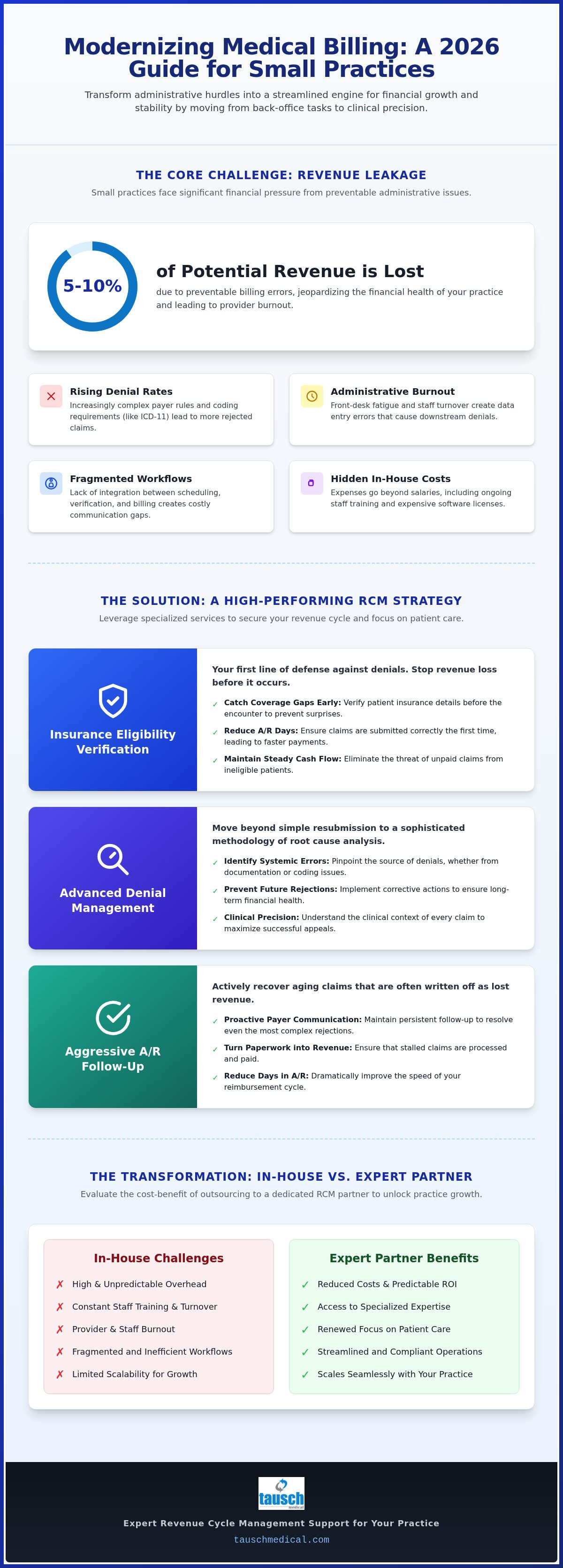
The financial health of an independent clinic depends on more than just clinical excellence. Industry data indicates that small practices often lose between 5% and 10% of their potential revenue due to entirely preventable billing errors. This leakage stems from the increasing complexity of the Medical Billing Overview, where shifting payer rules and the full integration of ICD-11 demand constant vigilance. For many providers, managing medical billing for small practices has become a source of profound stress rather than a steady revenue stream.
Relying solely on an in-house model often creates a cycle of hidden costs. Beyond basic salaries, the investment required for ongoing staff training and expensive software licenses can deplete resources that should be dedicated to patient care. When a practice tries to bridge the gap between clinical excellence and financial sustainability without expert support, the resulting friction often manifests as administrative burnout. It's a high-stakes environment where a single coding oversight can jeopardize your entire cash flow.
The Impact of Administrative Burnout on Independent Practices
Front-desk staff often bear the brunt of these administrative complexities. Fatigue at the point of entry leads to downstream billing denials that are notoriously difficult to recover. Utilizing professional patient scheduling services ensures that the revenue cycle begins with precision from the very first call. This proactive approach prevents the data entry errors that frequently cause claims to be rejected months later, allowing your team to focus on the patient experience rather than paperwork.
Why Insurance Eligibility Verification is Your First Line of Defense
The most effective way to protect your bottom line is to stop denials before they occur. Implementing rigorous insurance verification protocols allows your team to catch coverage gaps early. Eligibility verification reduces A/R days by ensuring coverage before the encounter. By prioritizing this step, practices can maintain a steady cash flow and focus on delivering high-quality care without the looming threat of unpaid claims or complex patient balance disputes.
Key Features of a High-Performing Medical Billing Service
Success in medical billing for small practices requires more than just functional software; it demands a partner who understands the clinical context of every claim. High-performing services move beyond the superficial cycle of simply resubmitting denied claims. Instead, they employ a sophisticated methodology focused on root cause analysis. This clinical precision ensures that systemic errors, whether they originate in documentation or payer-specific coding requirements, are identified and corrected at the source to prevent future rejections.
Navigating regional payer nuances in major hubs like Houston, Dallas, San Antonio, and New York requires localized expertise that generic platforms cannot replicate. A premium partner ensures that every workflow maintains strict HIPAA Compliance in Medical Billing, safeguarding sensitive patient data while maximizing reimbursement. Transparency is equally vital. You should maintain full visibility through comprehensive reporting and real-time analytics, allowing you to stay in control of your financial health without performing the manual labor yourself.
Advanced Denial Management and A/R Follow-up
The 2026 standard for A/R and denial services involves aggressive recovery of aging claims that many practices typically write off as lost revenue. By maintaining proactive, persistent communication with payers, expert teams can significantly reduce days in accounts receivable. This relentless follow-up ensures that even the most complex insurance rejections are resolved, turning stalled paperwork into realized revenue for your practice.
The Role of Provider Credentialing in Revenue Flow
Delayed credentialing often acts as a silent revenue killer for expanding clinics. Utilizing professional provider credentialing services ensures that new clinicians can begin billing immediately upon joining the team. This strategic alignment prevents the administrative bottlenecks that often stall growth and disrupt cash flow. If your current workflow feels fragmented, you might consider how professional billing support can unify these critical processes and provide a foundation for long-term success.
The ROI of Outsourcing: Transitioning Your Practice for Growth
Transitioning to a professional medical billing firm often yields a significantly higher return on investment than maintaining a traditional in-house department. When you calculate the total cost of ownership for internal billing, including recruitment, benefits, and the recurring need for technical training, the financial burden is substantial. By outsourcing medical billing for small practices, providers convert fixed labor costs into a variable expense that aligns directly with actual revenue. This shift ensures that your practice scales effortlessly, allowing you to increase patient volume without hitting the administrative bottlenecks that typically stall growth.
Financial growth must be balanced with meticulous adherence to 2026 healthcare regulations and evolving HIPAA standards. Adhering to the OIG Compliance Guidance for Physician Practices is not just a legal requirement; it's a fundamental part of a secure revenue cycle. Tausch Medical integrates clinical precision with financial expertise to ensure every claim meets the highest standards of accuracy. This dual focus protects your practice from audits while simultaneously accelerating your reimbursement timeline through a more disciplined submission process.
Strategic Outsourcing for Local Providers
Partnering with a firm that possesses deep knowledge of the Texas and East Coast payer landscapes is a distinct advantage. Regional nuances in insurance behavior in cities like Houston, Dallas, or New York can significantly impact your bottom line if they're ignored. For a more comprehensive exploration of these high-level tactics, you can read our guide on Mastering Revenue Cycle Management to understand how localized strategy drives practice longevity.
Experiencing the Value: The Risk-Free Trial Approach
A short-term trial often reveals immediate leaks in a current billing workflow that have gone unnoticed for years. It's an opportunity to see how professional intervention changes the trajectory of your aging claims without any initial commitment. The Tausch Medical free trial allows providers to see real-time A/R improvements before signing a contract. This transparency ensures that the decision to transition is based on proven results and clinical-grade data rather than abstract promises.
Securing Your Practice’s Financial Future in 2026
The landscape of healthcare reimbursement is becoming increasingly specialized, requiring a level of precision that matches your own clinical standards. By integrating expert denial management and professional provider credentialing into your daily workflow, you eliminate the friction that often leads to administrative burnout. Optimizing medical billing for small practices isn't just about capturing lost revenue; it's about building a resilient foundation that supports sustainable growth and superior patient care, a goal shared by community-focused organizations like Quality Comprehensive Health Center. Specialized A/R recovery ensures that no claim is left behind, turning historical losses into current capital for your facility.
A resilient foundation also extends to the physical integrity of your clinic; for providers overseeing renovations or safety compliance, you can explore Asbestos Abatement to learn how specialized contractors manage hazardous material removal in clinical environments.
You have the opportunity to transform your revenue cycle from a source of stress into a streamlined engine for success. Experience how a partnership built on clinical precision and financial expertise can redefine your operational efficiency. Want to see how Tausch Medical can support your practice with reliable medical billing, prior authorization, eligibility verification, A/R follow-up, and RCM support? Start with our free two-week trial and experience the difference before making a commitment: free trial form
Frequently Asked Questions
Is medical billing outsourcing cost-effective for a solo practitioner?
Outsourcing is highly cost-effective for solo practitioners because it transforms fixed administrative overhead into a variable expense tied directly to collected revenue. Instead of paying for full-time salaries, benefits, and expensive software licenses, you only pay for results. This model ensures that your financial interests are perfectly aligned with your billing partner, allowing you to maintain a lean operation while accessing high-level expertise that a solo office rarely possesses internally.
How do specialized billing services handle complex claim denials for small practices?
Specialized services utilize root cause analysis to address complex claim denials rather than simply resubmitting rejected claims. This involves identifying systemic errors in coding or payer-specific documentation requirements to prevent future occurrences. By digging into the clinical and technical reasons behind a rejection, expert billers secure reimbursements that an overextended in-house team might otherwise write off as uncollectible or lost revenue.
What is the difference between medical billing and full revenue cycle management (RCM)?
Medical billing is a specific component focused on claim submission and payment, while full revenue cycle management (RCM) encompasses the entire lifecycle of a patient encounter. RCM includes everything from initial patient scheduling and insurance verification to final A/R recovery and financial reporting. Choosing a comprehensive RCM approach ensures that every administrative touchpoint is optimized to support the financial health of medical billing for small practices.
Can a billing service help with provider credentialing and insurance enrollment?
Yes, a professional billing partner provides comprehensive provider credentialing and insurance enrollment services to ensure your clinicians are fully authorized to receive payments. This process is critical for growing practices that need to add new providers without experiencing a lapse in cash flow. Expert management of these applications prevents the common delays and administrative errors that often stall a practice's expansion into new insurance networks.
How much control will I have over my patient data if I outsource billing?
You retain full ownership and 24/7 visibility of your patient data through secure, cloud-based reporting platforms. Outsourcing doesn't mean losing control; it provides you with more structured data and real-time analytics to make informed business decisions. Every workflow is designed to exceed standard HIPAA requirements, ensuring that your practice remains compliant while you monitor every stage of the revenue cycle from any location with complete transparency.
What is the typical ROI for a small practice switching to professional medical billing?
The typical ROI for a small practice switching to professional billing manifests as a significant reduction in denial rates and a marked decrease in days in accounts receivable. While specific results vary based on your current efficiency, most practices see a notable increase in net collections and a reduction in administrative labor costs. Beyond the financial gains, the return includes more time for providers to focus on clinical excellence rather than administrative paperwork.
Disclaimer
This article is for general informational purposes only and does not constitute legal, medical, billing, coding, compliance, or financial advice. Healthcare rules, payer policies, and reimbursement guidelines may change and may vary by situation. Please consult qualified professionals or official sources before making decisions based on this content. Tausch Medical is not responsible for any loss or liability arising from reliance on this information.


