


Article by
Dr. Sharafat Hussain Ph.D
Dr. Sharafat Hussain is a healthcare business consultant, entrepreneur, and academic with strong experience in the US healthcare industry. He is the Founder and Managing Director of Tausch Medical, a revenue cycle management company supporting US healthcare providers with medical billing, prior authorization, credentialing, eligibility verification, A/R follow-up, and patient support services. His work combines practical healthcare operations, business strategy, and academic insight to help medical practices improve efficiency, collections, and service quality.
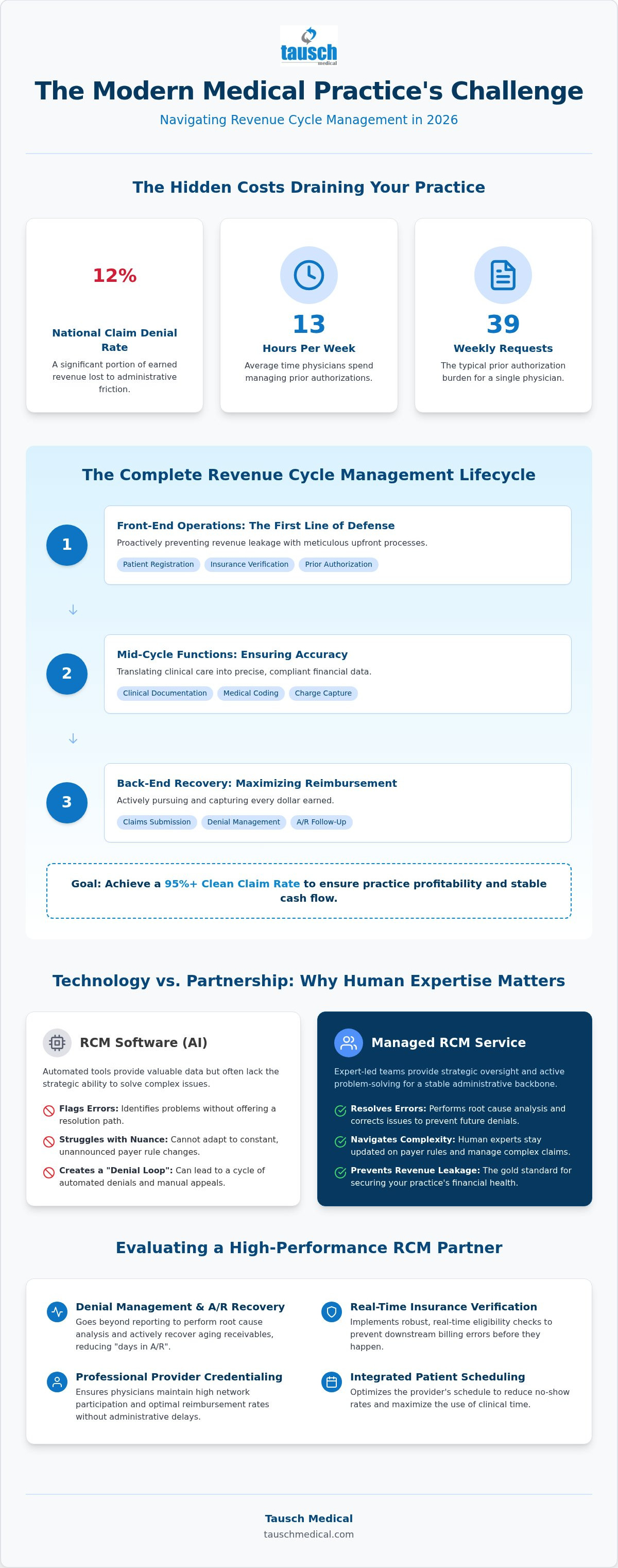
With national claim denial rates reaching nearly 12% in 2026, the average medical practice is losing a significant portion of its earned revenue to administrative friction. You likely didn't dedicate your career to medicine to spend 13 hours every week managing the 39 prior authorization requests that now burden the typical physician's schedule. Utilizing specialized healthcare revenue cycle management services has become a necessity for practices that want to move beyond the exhaustion of inconsistent cash flow and the ongoing challenge of administrative staff turnover.
This guide demonstrates how these services transform systemic bottlenecks into a predictable engine for growth and clinical focus. By integrating expert oversight with the latest technological advancements, you can secure the financial health of your practice while returning your attention to patient care. We will examine the 2026 CMS regulatory shifts, the impact of predictive analytics on reimbursement cycles, and the strategic outsourcing frameworks that reduce your administrative burden and maximize your practice's ROI.
Key Takeaways
- Understand how the evolution of healthcare revenue cycle management services has transitioned from simple transactional billing to a holistic financial strategy essential for 2026.
- Learn to identify high-performance features in service providers, focusing on the precision of insurance eligibility verification to preemptively stop revenue leakage.
- Discover the direct correlation between professional provider credentialing and your practice's ability to maintain high network participation and reimbursement rates.
- Explore how a clinical-first approach to administrative support can resolve local market bottlenecks and transform your practice's financial health into a scalable operation.
What Are Healthcare Revenue Cycle Management Services?
Understanding What is Revenue Cycle Management (RCM) requires looking beyond basic billing. It's a sophisticated suite of financial processes managing patient identity, clinical documentation, and collections. In 2026, healthcare revenue cycle management services have evolved from transactional tasks into a holistic strategy. This shift is critical for practice solvency in competitive hubs like Dallas and Houston, where administrative efficiency directly dictates market longevity. Practices in these regions face intense pressure to maintain clean claim rates above 95% to remain profitable in a landscape of rising costs.
The Core Components of a Modern RCM Lifecycle
The lifecycle begins long before a patient enters the exam room. Effective healthcare revenue cycle management services prioritize front-end operations, including patient registration and meticulous insurance verification. Mid-cycle functions ensure that clinical documentation and medical coding reflect the complexity of care provided. Finally, back-end recovery focuses on Medical claim denial management and A/R follow-up to capture revenue that often slips through the cracks. In 2026, this includes meeting the new CMS mandate for 72-hour responses on urgent prior authorizations, a task that requires constant vigilance and specialized expertise.
Service vs. Software: Why Technology Isn't Enough
While 80% of health systems now explore generative AI for financial tasks, software alone cannot solve the "denial-and-appeal" loop. Technology often struggles with the nuance of payer-specific authorization rules that change without notice. Expert human intervention remains the gold standard for navigating these complexities. A managed service provides the strategic oversight that static software lacks. It ensures that complex claims are handled with clinical precision. Software flags errors. Partners resolve them. This human-led approach prevents revenue leakage that automated systems frequently overlook, providing a stable administrative backbone for independent practices.
Key Features to Evaluate in RCM Service Providers
While many SaaS platforms focus on AI automation, the most effective healthcare revenue cycle management services prioritize a high-touch approach that integrates clinical knowledge with financial strategy. You should evaluate providers based on their ability to handle the entire lifecycle, including key steps in healthcare RCM like registration and coding. A partner that offers end-to-end support provides a distinct advantage over software that merely flags errors without resolving them.
Denial Management and A/R Recovery Strategies
With industry-wide claim denial rates reaching nearly 12% in 2026, a service provider must do more than just report failures. They need to perform root cause analysis to identify why claims are failing. Often, these failures stem from incorrect patient data or missed prior authorization windows. Effective A/R management moves beyond basic billing to active recovery, reducing the "days in A/R" metric that can cripple a practice's cash flow. For a deeper dive into these strategies, see our guide on Mastering Revenue Cycle Management.
Insurance Verification: The First Line of Defense
Real-time eligibility checks are your primary defense against downstream billing errors. In 2026, managing the burden of complex prior authorizations is more demanding than ever. Specialty practices often find that physician staff spend at least 13 hours a week on these tasks, highlighting why outsourced healthcare revenue cycle management services are becoming the industry standard. A premium RCM partner handles this burden, ensuring compliance with the latest CMS response rules for urgent and standard requests. Inaccurate verification leads to a Impact of Inaccurate Insurance Verification that delays reimbursement and frustrates patients.
Don't overlook the impact of professional provider credentialing services. These ensure your practice maintains network participation and high reimbursement rates. Additionally, integrated patient scheduling reduces no-show rates and maximizes provider time. You can experience the difference in your daily operations by choosing a partner that treats your administrative health with clinical precision.
Optimizing Your Practice with Tausch Medical RCM Solutions
Tausch Medical approaches financial health with the same clinical precision you apply to patient care. By aligning high-level technological superiority with a supportive partnership model, we provide the administrative backbone necessary for independent practices to thrive. Our healthcare revenue cycle management services are designed to eliminate the friction between clinical documentation and final reimbursement. This allows your team to reclaim their time and refocus on direct patient care—supported by high-quality resources from a trusted medical supply distributor USA—while we manage the complexities of the financial lifecycle.
Scalability remains a primary concern for growing practices. Choosing medical billing outsourcing enables you to expand your patient volume without the proportional increase in overhead costs or staff turnover. We act as your specialized knowledge center, ensuring that your financial operations remain resilient regardless of market volatility or changing payer requirements.
Local Payer Expertise in Major US Hubs
Success in healthcare revenue cycle management services requires more than general knowledge; it demands local market intelligence. We navigate the specific regional payer nuances found in Texas hubs like Houston and Austin, as well as East Coast markets such as Philadelphia and DC. This localized expertise is critical for effective credentialing and enrollment. It ensures that your practice isn't just participating in networks but is positioned for the highest possible reimbursement rates within your specific geography.
The Path to Implementation: What to Expect
The onboarding process for our medical billing services is structured to be seamless and secure. We prioritize data integrity and HIPAA compliance from the initial data migration through the full integration of your workflows. Our team handles the heavy lifting, allowing for a transition that doesn't disrupt your daily operations. In 2026, the ROI of RCM outsourcing is defined by the immediate transition from high administrative overhead to a scalable, expert-led revenue engine that captures every dollar earned.
Securing Your Practice's Financial Future in 2026
The transition from fragmented billing to a holistic financial strategy is no longer optional for independent practices facing rising denial rates and complex regulatory shifts. By integrating comprehensive A/R and denial management services with expert provider credentialing, you protect your revenue while reclaiming valuable clinical time. Utilizing specialized healthcare revenue cycle management services ensures that your administrative operations match the high standards of your medical care, providing a scalable foundation for long-term growth.
Want to see how Tausch Medical can support your practice with reliable medical billing, prior authorization, eligibility verification, A/R follow-up, and RCM support? Start with our free two-week trial and experience the difference before making a commitment: free trial form
Frequently Asked Questions
What is the difference between medical billing and revenue cycle management?
Medical billing is the specific administrative process of submitting and following up on claims; however, revenue cycle management is a much broader financial strategy. It encompasses the entire patient journey from the initial scheduling and insurance verification through clinical documentation and final payment collection. While billing is transactional, healthcare revenue cycle management services provide a holistic framework that optimizes every touchpoint to ensure your practice captures all earned revenue.
How can RCM services help reduce claim denials in my practice?
Professional RCM services mitigate denials by implementing rigorous front-end controls and performing deep-dive root cause analysis on failed claims. By shifting the focus to pre-encounter accuracy, such as verifying coverage before the patient arrives, you eliminate the clerical errors that often trigger rejections. Expert partners also monitor evolving payer behaviors in real-time, ensuring that your submissions align with the latest 2026 reimbursement requirements and authorization rules.
Is it more cost-effective to outsource RCM or keep it in-house?
Outsourcing is often the more economical choice for independent practices because it converts high fixed labor costs and administrative turnover into a scalable operational model. Managing an in-house team requires significant investment in recruitment, benefits, and specialized billing software that needs constant updates. A managed service provider offers access to a dedicated knowledge center and advanced financial analytics without the overhead, allowing you to focus resources on direct patient care.
Disclaimer
This article is for general informational purposes only and does not constitute legal, medical, billing, coding, compliance, or financial advice. Healthcare rules, payer policies, and reimbursement guidelines may change and may vary by situation. Please consult qualified professionals or official sources before making decisions based on this content. Tausch Medical is not responsible for any loss or liability arising from reliance on this information.


