


Article by
Dr. Sharafat Hussain Ph.D
Dr. Sharafat Hussain is a healthcare business consultant, entrepreneur, and academic with strong experience in the US healthcare industry. He is the Founder and Managing Director of Tausch Medical, a revenue cycle management company supporting US healthcare providers with medical billing, prior authorization, credentialing, eligibility verification, A/R follow-up, and patient support services. His work combines practical healthcare operations, business strategy, and academic insight to help medical practices improve efficiency, collections, and service quality.
If your practice is navigating the projected 12% to 15% industry-wide spike in initial claim denials, the underlying issue might not be your clinical documentation, but a partner who hasn't kept pace with 2026 standards. Recognizing the specific signs you need a new medical billing company is no longer a routine administrative review; it's a strategic imperative for any provider aiming to maintain clinical excellence and financial health. You likely partnered with your current vendor to reduce your workload, yet you find your internal staff still bogged down by eligibility hurdles while your reimbursement cycles continue to lengthen.
We understand that a medical practice functions best when the clinical team can focus entirely on patient outcomes without the shadow of stagnant revenue. This guide offers a comprehensive 2026 audit checklist designed to identify critical red flags in your billing operations and provide a clear framework for transitioning to a partner that optimizes your collections. We will explore the essential benchmarks for clean claim rates, the impact of the latest CMS Physician Fee Schedule changes, and the level of transparency required to ensure your practice thrives in a complex regulatory environment.
Key Takeaways
- Evaluate your financial health by benchmarking your First Pass Resolution Rate against the 95% industry standard to detect systemic coding inefficiencies.
- Identify the operational signs you need a new medical billing company by assessing whether your internal staff is still overwhelmed by insurance verification tasks that your partner should manage.
- Examine your Days in Accounts Receivable (A/R) to ensure they remain below 40 days, a critical threshold that signals whether your vendor is pursuing aggressive follow-up strategies.
- Secure your practice's data sovereignty by demanding 24/7 real-time access to billing software, ensuring your financial information is never held hostage by a third party.
- Mitigate compliance risks by verifying that your vendor possesses deep specialty-specific expertise and integrated provider credentialing services to prevent avoidable technical denials.
Financial Performance Audit: KPIs That Signal Your Billing Company is Failing
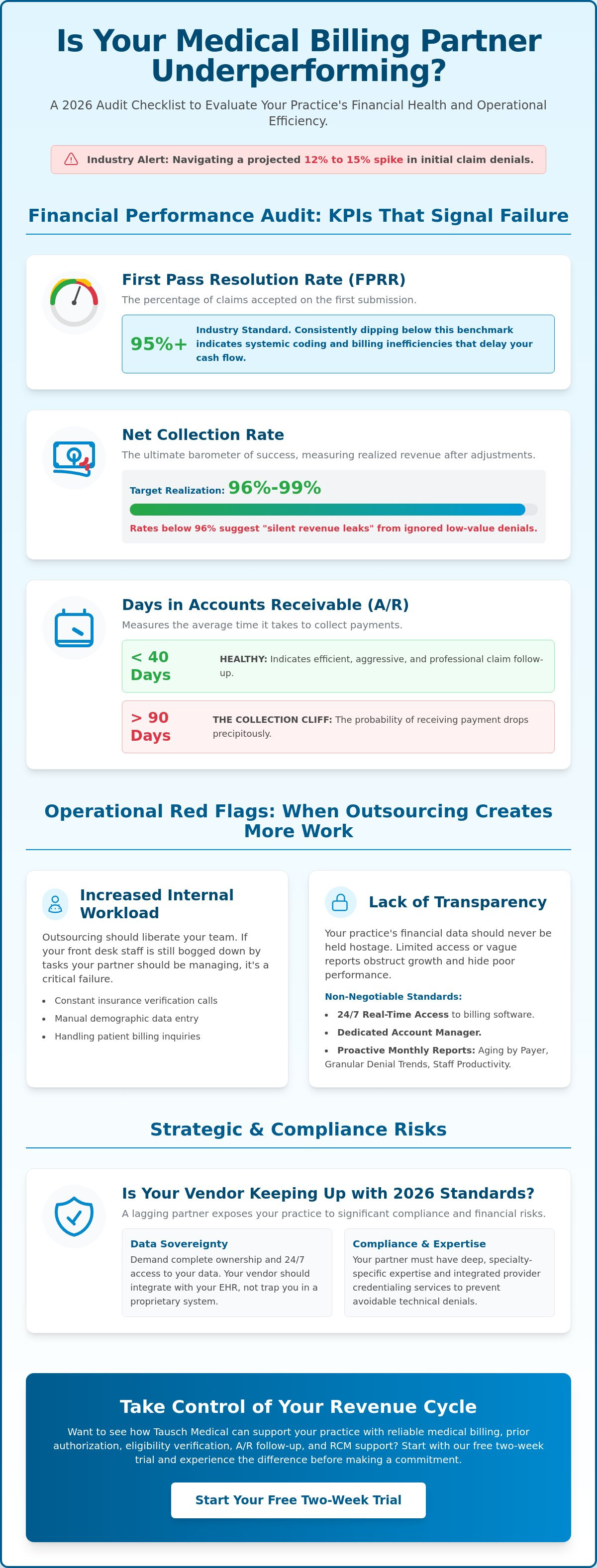
Identifying the specific signs you need a new medical billing company begins with a clinical examination of your financial data. If your First Pass Resolution Rate (FPRR) consistently dips below 95%, you're witnessing systemic coding errors that fundamentally delay your cash flow. A premium billing partner ensures that the medical billing process is optimized for accuracy before the first submission. Your Net Collection Rate serves as the ultimate barometer for success; a high-performing practice should realize between 96% and 99% of its expected revenue after contractual adjustments. Anything less suggests that your current vendor is leaving money on the table through "silent revenue leaks," often caused by ignoring low-value denials that seem too small to appeal but aggregate into significant annual losses.
The Danger of Stagnant Accounts Receivable
Effective medical accounts receivable recovery demands daily, meticulous intervention rather than a reliance on passive, automated resubmissions. When your Days in A/R exceed 40 days, it's a clear indicator that your claims aren't being pursued with the necessary professional rigor. We define the "collection cliff" as the 90-day mark, the point where the statistical probability of receiving payment for a service drops precipitously. A "set it and forget it" mentality from a vendor leads to permanent revenue attrition that compromises your practice's ability to invest in new clinical technologies.
High Denial Rates Without a Resolution Plan
Distinguishing between "soft" denials, which require simple administrative corrections, and "hard" denials, which involve complex clinical appeals, is vital for long-term growth. Your billing partner must provide a detailed monthly analysis that identifies the root causes of these rejections. Without a proactive medical claim denial management strategy, your practice remains vulnerable to the same recurring errors month after month. These persistent patterns are among the most telling signs you need a new medical billing company that prioritizes clinical precision in every financial transaction.
Operational Red Flags: When Your Billing Partner Increases Your Workload
Outsourcing should liberate your team, not create a secondary layer of administrative management. One of the most glaring signs you need a new medical billing company is when your front desk staff remains tethered to the phones for insurance verification tasks that your vendor promised to handle. A premium partner assumes this burden entirely, allowing your clinical staff to focus on patient care rather than demographic data entry. If you don't have 24/7 real-time access to your billing software, your financial data is effectively being held hostage. True operational transparency ensures that your practice remains aligned with current medical billing compliance standards, protecting you from federal scrutiny while maintaining workflow efficiency.
The Transparency Test: Reports and Real-Time Data
In 2026, cloud-based EHR integration is a non-negotiable standard for medical billing outsourcing. A professional partner provides a dedicated account manager who delivers three essential monthly reports: aging by payer, granular denial trends, and staff productivity logs. These documents shouldn't require a request; they should be a proactive part of your monthly strategy meeting. If you're currently navigating a generic support ticket system just to see your own collection data, your vendor is obstructing your practice's growth. You can consult with our specialists to see how real-time reporting changes your decision-making process.
Administrative Burden and Patient Satisfaction
Operational failures often manifest as patient dissatisfaction. Poor patient scheduling and recurring billing errors lead to frustrating phone calls and patient attrition. When a billing company fails to manage the "front-end" of the revenue cycle, it creates "back-end" disasters that your clinical team eventually has to resolve. A sophisticated partner manages authorizations and eligibility upfront, preventing the "hidden work" that often forces medical professionals to act as billers. This proactive approach ensures that the patient experience remains premium from the first appointment through the final statement.
Strategic and Compliance Risks: Is Your Vendor Keeping Up with 2026 Standards?
Strategic alignment between your clinical specialty and your billing partner's expertise is the final pillar of a healthy revenue cycle. One of the subtle but dangerous signs you need a new medical billing company is a lack of specialty-specific coding knowledge. An orthopedic surgeon in Houston requires vastly different modifier applications than a pediatrician in New York. Generic billing services often miss these nuances, leading to avoidable audits. As we navigate the CMS CY 2026 Physician Fee Schedule, which includes a 3.26% increase in the conversion factor and the complex G2211 code, your vendor must demonstrate an immediate grasp of these changes. Compliance isn't static; it requires rigorous cybersecurity measures, including multi-factor authentication and encrypted data transfers, to safeguard your practice from liability.
The Link Between Credentialing and Revenue
Administrative oversights in enrollment can lead to catastrophic financial losses. Our provider credentialing services are designed to prevent "provider not enrolled" denials before they occur. Even a single month of out-of-network billing due to an expired credential can cost a practice thousands in uncollectible revenue. Integrating provider credentialing services directly into your RCM strategy ensures that every clinician is fully authorized to bill at the highest possible rate. It's about protecting your credentials today to secure your revenue tomorrow.
Adapting to Local Payer Dynamics
Want to see how Tausch Medical can support your practice with reliable medical billing, prior authorization, eligibility verification, A/R follow-up, and RCM support? Start with our free two-week trial and experience the difference before making a commitment: https://tauschmedical.com/free-trial-form
Elevating Your Practice Revenue Through Strategic Partnership
Maintaining a high-performing medical practice requires more than just clinical excellence; it demands a billing partner that operates with the same level of precision and technological superiority. Recognizing the signs you need a new medical billing company is the first step toward reclaiming lost revenue and reducing the administrative burden on your internal team. By prioritizing a first-pass resolution rate above 95% and ensuring your accounts receivable remain under 40 days, you set a foundation for sustainable growth. It's about securing your future. Our approach integrates expert denial management and A/R recovery with comprehensive provider credentialing services, ensuring every service performed is a service paid.
Your practice deserves the clarity provided by dedicated account managers who offer personalized support and real-time data access. Transitioning to a sophisticated RCM model shouldn't be a burden. We provide the expertise needed to navigate the complex regulatory landscape of 2026, allowing you to focus on your patients while we secure your financial health. You can experience this commitment to excellence firsthand through a risk-free trial.
Want to see how Tausch Medical can support your practice with reliable medical billing, prior authorization, eligibility verification, A/R follow-up, and RCM support? Start with our free two-week trial and experience the difference before making a commitment: free trial form
Frequently Asked Questions
How do I know if my medical billing company is overcharging me?
You know you're being overcharged when hidden fees for items like clearinghouse access, patient statements, or basic credentialing are unbundled from your primary service agreement. If the total cost of your billing operations doesn't correlate with a high net collection rate, it's one of the clearest signs you need a new medical billing company. Transparent partners provide a single, comprehensive fee structure that aligns their success directly with your practice's actual revenue growth.
What is a reasonable clean claim rate for a private practice in 2026?
A clean claim rate of 95% or higher is the non-negotiable benchmark for private practices in 2026. Although many practices currently experience a median first-pass acceptance rate of 85%, this 10% gap represents significant administrative waste and delayed liquidity. High-performing vendors achieve the 95% standard by integrating rigorous internal audits and staying ahead of the latest regulatory shifts in payer requirements and coding guidelines.
How long does it typically take to switch to a new medical billing company?
Transitioning to a new medical billing partner generally requires a timeline of 30 to 60 days to ensure a seamless integration of systems and data. This window allows for the secure migration of patient records, the configuration of cloud-based EHR interfaces, and the completion of necessary payer enrollments. A disciplined onboarding strategy minimizes clinical disruption while establishing a superior technical foundation for your practice's long-term financial health and operational efficiency.
Will switching my billing company cause a temporary stop in my cash flow?
A strategic transition ensures that your cash flow remains consistent by maintaining a phased approach to claim submissions. Your new partner should begin processing new encounters while the outgoing vendor concludes work on the existing accounts receivable. Recognizing the signs you need a new medical billing company allows you to plan this overlap carefully, ensuring that your practice's liquidity is never compromised during the migration to a more efficient revenue cycle management model.
Disclaimer
This article is for general informational purposes only and does not constitute legal, medical, billing, coding, compliance, or financial advice. Healthcare rules, payer policies, and reimbursement guidelines may change and may vary by situation. Please consult qualified professionals or official sources before making decisions based on this content. Tausch Medical is not responsible for any loss or liability arising from reliance on this information.


