

Article by
Dr. Sharafat Hussain Ph.D
Dr. Sharafat Hussain is a healthcare business consultant, entrepreneur, and academic with strong experience in the US healthcare industry. He is the Founder and Managing Director of Tausch Medical, a revenue cycle management company supporting US healthcare providers with medical billing, prior authorization, credentialing, eligibility verification, A/R follow-up, and patient support services. His work combines practical healthcare operations, business strategy, and academic insight to help medical practices improve efficiency, collections, and service quality.
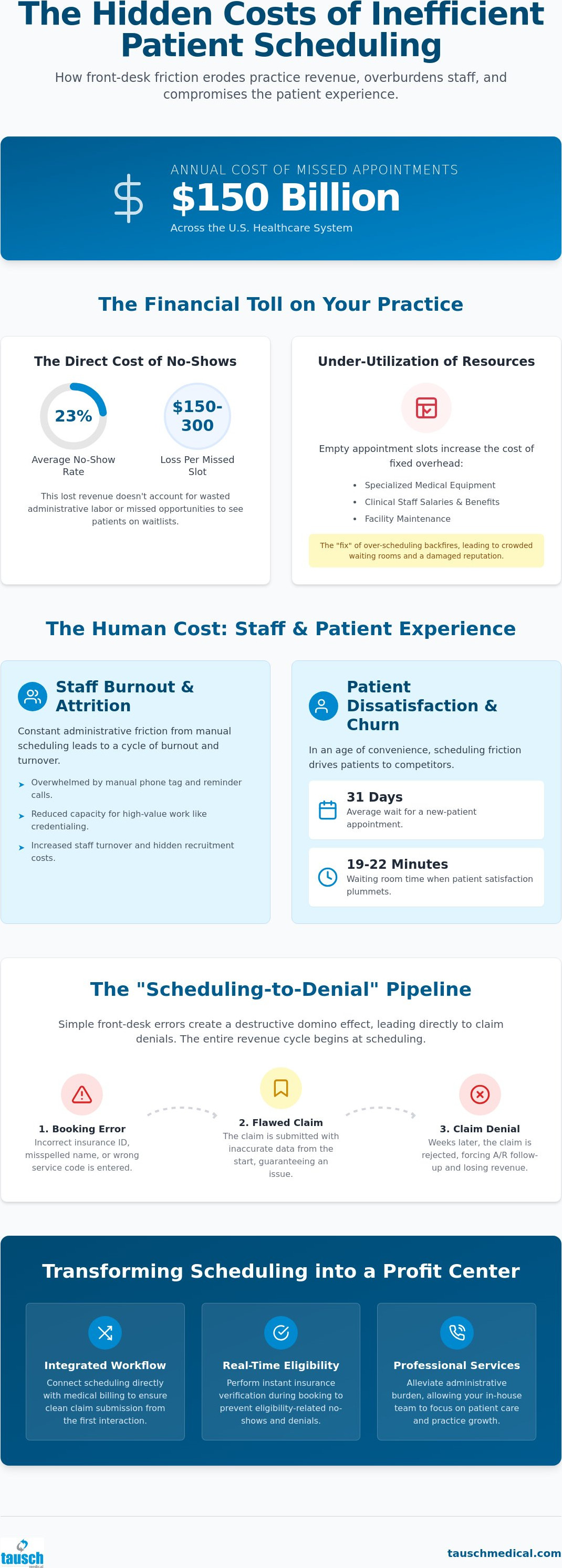
With the annual cost of missed appointments reaching a staggering $150 billion across the U.S. healthcare system, the administrative friction at your front desk is no longer just a minor inconvenience. For many providers, the impact of inefficient patient scheduling manifests as a 23% average no-show rate, which translates to a direct loss of between $150 and $300 for every missed primary care slot. You likely recognize that maintaining a consistent patient volume is essential for clinical excellence, yet manual workflows and scheduling bottlenecks often lead to inconsistent cash flow and an overwhelmed staff. It's a challenge that requires both clinical precision and strategic business oversight to resolve effectively.
This article explores how these operational gaps jeopardize your practice's long-term financial health and clinical reputation. We'll provide a clear analysis of the financial ripple effects caused by scheduling errors while offering strategic insights to recover lost revenue. By the end, you'll have actionable strategies to stabilize your practice through sophisticated front-desk management and enhanced revenue cycle oversight, ensuring your growth remains both sustainable and predictable in 2026.
Key Takeaways
- Identify how scheduling bottlenecks act as a primary driver of revenue leakage by quantifying the hidden costs of unused capacity and fixed overhead.
- Analyze the long-term impact of inefficient patient scheduling on staff retention, as high administrative burdens frequently lead to professional burnout and turnover.
- Understand the correlation between patient churn and front-desk friction, specifically how wait times and booking errors compromise the patient experience.
- Discover strategic frameworks to transform your scheduling process from a simple administrative task into a high-performance profit center.
- Learn the clinical and financial advantages of integrating professional medical billing services with your scheduling to create a unified and resilient revenue cycle.
The Financial Toll: How Inefficient Scheduling Erodes Practice Revenue
The impact of inefficient patient scheduling represents a primary driver of revenue leakage that often remains undetected until month-end reports reveal significant shortfalls. While clinical teams focus on patient outcomes, the front desk serves as the foundational gateway to the entire revenue cycle. When this gateway is compromised by manual errors or poor coordination, it creates a destructive "Scheduling-to-Denial" pipeline. Every keystroke during the initial booking process directly influences the eventual claim; an incorrect insurance ID or a misspelled name at the point of entry virtually guarantees a denial weeks later. Integrating sophisticated medical billing services directly with the scheduling workflow is the only clinical-grade solution to ensure clean claim submission from the very first patient interaction.
The True Cost of No-Shows and Last-Minute Cancellations
A single missed primary care appointment in 2026 costs a practice between $150 and $300 in lost potential revenue. This figure doesn't even account for the administrative labor wasted trying to fill the slot or the missed opportunity to treat a patient currently stuck on a 31-day waitlist. These gaps frequently stem from a failure to perform real-time eligibility checks during the booking phase. You can explore the broader impact of inaccurate insurance verification to understand how these early-stage oversights compound into massive financial deficits for specialized practices.
Under-utilization of Expensive Clinical Resources
Fixed overhead costs, including specialized medical equipment maintenance and clinical staff salaries, remain constant regardless of whether the exam room is occupied. Empty slots drastically increase the relative cost of these resources, eroding the profit margins of even the most premium procedures. Some practices attempt to mitigate this by "over-scheduling," but this reactionary measure typically backfires. It leads to crowded waiting rooms and clinical haste, which ultimately damages the brand's reputation for quality. While modern scheduling software solutions help balance these loads, technology alone cannot replace the professional expertise required to manage a complex medical portfolio with precision and authority.
Operational Stagnation: The Impact on Staff and Patient Experience
The impact of inefficient patient scheduling extends far beyond the balance sheet, deeply affecting the human infrastructure of a medical practice. When front-desk teams are trapped in a cycle of manual phone tag and tedious reminder calls, their capacity for high-value strategic work is severely diminished. This constant administrative friction is a primary catalyst for staff burnout and the subsequent attrition cycles that plague modern clinics. Instead of focusing on critical tasks like provider credentialing services, talented employees find themselves overwhelmed by the chaos of unoptimized calendars and complex multi-provider coordination.
Administrative Burden and the Attrition Cycle
The labor-intensive nature of manual scheduling creates a hidden recruitment cost that many providers overlook. Training new staff to navigate intricate clinical workflows requires significant time and financial investment. When your team is burdened by inefficient processes, they're more likely to seek professional environments that prioritize operational excellence. By implementing professional patient scheduling services, you can alleviate this psychological pressure. This shift allows your internal team to focus on patient-facing care and practice growth while maintaining a calm, professional atmosphere.
Patient Dissatisfaction in the Age of Convenience
In 2026, the average wait time for a new-patient appointment has reached 31 days, making the first interaction more critical than ever. Research indicates that patient satisfaction begins to decline sharply once waiting room times exceed 19 to 22 minutes. In highly competitive markets like New York or Dallas, these delays are not just inconveniences; they're catalysts for churn. Modern patients expect a seamless experience and precise communication from the moment they book. If your practice struggles with double bookings or long hold times, they'll quickly switch to a competitor who offers a more sophisticated journey. Investing in sophisticated scheduling support is a commitment to clinical and operational superiority that preserves your most valuable asset: patient trust.
Strategic Solutions: Transforming Scheduling into a Profit Center
Mitigating the impact of inefficient patient scheduling requires more than just a software upgrade; it demands a fundamental shift toward a high-performance administrative framework. While many organizations rely solely on automation, software alone cannot navigate the nuanced clinical requirements of insurance carriers or resolve complex patient inquiries with the necessary authority. A truly sophisticated solution involves outsourcing medical billing services in tandem with scheduling to create a unified Revenue Cycle Management (RCM) strategy. This integrated approach ensures that every appointment is clinically and financially vetted long before the patient enters the exam room.
In high-volume medical hubs like Houston or Atlanta, operational precision is the primary differentiator between stagnant practices and market leaders. By utilizing advanced data analytics to predict no-show patterns, providers can optimize their daily calendars with surgical accuracy. This level of professional management transforms the front desk from a cost center into a strategic engine for growth, allowing your practice to focus on delivering world-class care while maintaining a premium patient experience.
For example, specialized clinics like Dr. Harris Medical Weight Loss often see improved patient outcomes when their administrative friction is minimized; to see how such a practice operates, you can find out more.
The Role of Professional Managed Services in RCM
Specialized scheduling teams provide the human expertise necessary to handle prior authorizations and eligibility verification in real-time. This proactive intervention prevents the "Scheduling-to-Denial" pipeline by identifying potential coverage issues before the clinical encounter occurs. When you integrate scheduling with professional AR and denial management, you effectively close the revenue loop. This synergy ensures that any booking error is caught and corrected instantly, protecting your practice from the administrative friction that leads to unpaid claims.
Scalable Growth Through Administrative Outsourcing
Removing the scheduling bottleneck is the most effective way to expand your practice without the burden of increasing physical headcount or office space. Administrative outsourcing provides a scalable foundation that adapts to your patient volume, allowing for seamless growth into new territories or specialties. For a deeper understanding of how these elements fit together, we recommend our comprehensive guide on mastering revenue cycle management. By delegating these complex tasks to elite specialists, you secure both the clinical reputation and the financial future of your organization.
While clinical efficiency is paramount, managing the physical infrastructure of a growing practice is equally vital; those looking to optimize their real estate assets can discover TBM Property Management for professional guidance.
Securing Practice Resilience Through Operational Excellence
The long-term impact of inefficient patient scheduling is far more than an administrative hurdle; it's a structural threat to your practice's growth and clinical reputation. By recognizing that the scheduling process is the actual starting point of your revenue cycle, you can move away from reactive fixes and toward a model of sustainable profitability. We've explored how professional oversight eliminates the "Scheduling-to-Denial" pipeline while reducing the burnout that leads to staff attrition. High-volume practices deserve a partner who understands the nuances of the US-based healthcare market. With expert denial management and comprehensive RCM support, you can protect your margins while focusing on patient outcomes. It's time to replace friction with precision.
Want to see how Tausch Medical can support your practice with reliable medical billing, prior authorization, eligibility verification, A/R follow-up, and RCM support? Start with our free two-week trial and experience the difference before making a commitment: free trial form
Frequently Asked Questions
How does inefficient scheduling directly affect my practice's cash flow?
Inefficient scheduling creates unrecoverable gaps in revenue while your fixed overhead costs remain constant. When a slot remains empty, expenses for clinical staff and medical equipment maintenance continue, but the practice doesn't generate the income needed to offset them. This leads to inconsistent patient volume and unpredictable fluctuations in your monthly accounts receivable, making it difficult to maintain a stable and healthy cash flow.
What is the average no-show rate for medical practices in 2026?
The average no-show rate for U.S. outpatient practices in 2026 is 23%, which creates a substantial financial burden for healthcare providers. The impact of inefficient patient scheduling is particularly severe in specialties like behavioral health, where no-show rates can climb as high as 50%. Since a single missed primary care appointment costs between $150 and $300, these gaps represent a massive annual loss for unoptimized practices.
Can outsourcing patient scheduling actually improve the patient experience?
Outsourcing to a professional team enhances the patient experience by providing immediate, elite-level communication and significantly reducing hold times. Specialized administrative partners handle complex inquiries with clinical precision, ensuring that patients don't face the frustration of clerical errors. This sophisticated approach prevents double bookings and manages waitlists more effectively, directly addressing the dissatisfaction caused by long wait times and poor front-desk coordination.
What is the link between scheduling errors and insurance claim denials?
Scheduling errors are a primary driver of insurance claim denials because they introduce inaccurate data or missing authorizations at the very start of the revenue cycle. When eligibility verification is handled poorly during the booking process, it's a guarantee that claims will be rejected weeks later. Professional management ensures that insurance details are captured accurately and authorizations are secured before the clinical encounter, protecting your practice from avoidable financial losses.
Disclaimer
This article is for general informational purposes only and does not constitute legal, medical, billing, coding, compliance, or financial advice. Healthcare rules, payer policies, and reimbursement guidelines may change and may vary by situation. Please consult qualified professionals or official sources before making decisions based on this content. Tausch Medical is not responsible for any loss or liability arising from reliance on this information.


