


Article by
Dr. Sharafat Hussain Ph.D
Dr. Sharafat Hussain is a healthcare business consultant, entrepreneur, and academic with strong experience in the US healthcare industry. He is the Founder and Managing Director of Tausch Medical, a revenue cycle management company supporting US healthcare providers with medical billing, prior authorization, credentialing, eligibility verification, A/R follow-up, and patient support services. His work combines practical healthcare operations, business strategy, and academic insight to help medical practices improve efficiency, collections, and service quality.
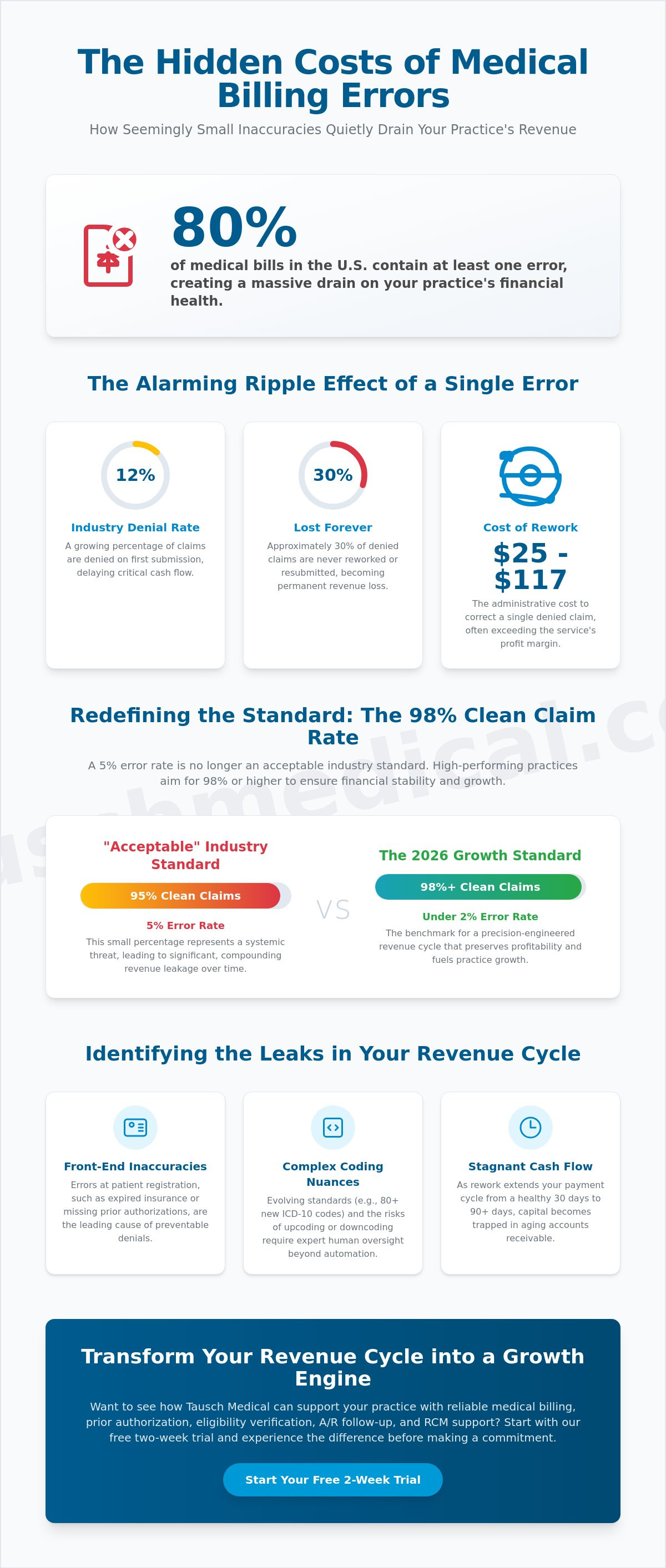
Did you know that approximately 80% of medical bills in the United States contain at least one error? In an era where industry wide denial rates have climbed to nearly 12%, these medical billing errors costing revenue represent a silent but significant drain on your practice's clinical and financial health. While your patient volume may be higher than ever, stagnant cash flow and the rising cost of claim rework, often ranging from $25 to $117 per denial, can leave your team feeling burnt out and your growth potential capped.
We recognize that maintaining a premium standard of care while navigating the increasingly complex payer requirements of 2026 is a monumental challenge. This guide will show you how to uncover the hidden financial leaks within your revenue cycle and provide the expert strategies needed to transform your billing into a precision engineered growth engine. We'll explore how to identify specific vulnerabilities, reduce your days in Accounts Receivable, and implement the rigorous standards required to achieve a clean claim rate of 98% or higher.
Key Takeaways
- Redefine your operational standards by understanding why an industry-standard 5% error rate is a systemic threat and why a 98% clean claim rate is the only acceptable benchmark for 2026.
- Discover how medical billing errors costing revenue extend far beyond simple denials, including the high administrative "cost to collect" and the 30% of claims that are never resubmitted.
- Learn why relying solely on EHR automation and "auto-coding" can lead to systemic failures, and why expert human oversight remains essential for complex specialty authorizations.
- Shift your perspective on Revenue Cycle Management from an administrative expense to a strategic growth engine capable of recovering significant percentages of lost income.
- Identify specific "leaks" in your current workflow to effectively reduce days in Accounts Receivable and stabilize your practice’s long-term cash flow.
The Acceptable Error Rate Myth: Why "Small" Mistakes Are Massive Revenue Killers
Many healthcare administrators operate under the dangerous assumption that a 5% error rate is an industry standard; however, this mindset overlooks the reality of systemic revenue leakage. In the highly scrutinized environment of 2026, a 5% failure rate isn't a minor administrative hurdle. It's a significant financial drain that erodes your practice's bottom line. High performing practices now recognize that anything less than a 98% clean claim rate requires immediate intervention to preserve profitability. We define the clean claim rate as the primary metric of a practice's financial efficiency, representing the percentage of claims that pass through the payer's system without rejection or manual intervention on the first submission.
The Ripple Effect of Front-End Inaccuracies
The journey through the medical billing process begins long before a clinical encounter occurs. Inaccuracies during patient registration or insurance verification remain the leading causes of preventable revenue loss. When a front desk team fails to identify an expired policy or a missing authorization during scheduling, they create a compounding effect that leads to catastrophic denials downstream. You can learn how insurance verification prevents denials by implementing rigorous data capture protocols at the first point of patient contact. These medical billing errors costing revenue often stem from simple oversights that could be eliminated with clinical precision in administrative workflows.
Coding Nuances in 2026: Beyond the Basics
The continued evolution of coding standards, including the introduction of 80 new ICD-10-PCS codes as of April 1, 2026, has significantly increased the complexity of specialty billing. Precision in documentation is no longer optional. Practices that struggle with "upcoding" face severe compliance audits, while those that "downcode" to avoid scrutiny are essentially leaving earned money on the table. Both practices distort the true value of your clinical services and compromise your long term growth. Achieving excellence requires a sophisticated balance between technological tools and the expert human oversight necessary to navigate these evolving coding requirements.
Beyond the Denied Claim: Calculating the True Price of Billing Inaccuracies
Many practice managers mistakenly view a denied claim as a mere delay in payment. This perspective ignores a harsh reality: approximately 30% of denied claims are never resubmitted, transforming what should have been realized income into a permanent loss. These medical billing errors costing revenue create a financial vacuum that many practices fail to quantify until their cash flow becomes critical. When a claim enters the rework cycle, it isn't just the reimbursement at risk; it's the operational health of your entire office. If your payment cycle extends from a healthy 30 days to 90 or more, your capital is effectively held hostage by administrative friction.
The "Cost to Collect" encompasses far more than just the initial filing. It includes the hidden expense of staff hours spent on hold with payers, the physical costs of postage for appeals, and the technological overhead required to track disputes. A report by the Consumer Financial Protection Bureau highlights the significant financial consequences of medical billing inaccuracies for both providers and patients alike. This financial strain often manifests as a clinical failure of the business model, where the cost of rework erodes the very margins necessary for sustainability.
The Administrative Burden of Rework
Correcting a single error often costs between $25 and $117 in labor and resources. When you calculate the hourly wages of skilled billing staff against the value of a low-complexity visit, the cost of "fixing" the claim often exceeds the actual profit margin of the service provided. In competitive markets like Houston and Dallas, these errors also drive patient churn. Patients rarely switch doctors because of the care; they switch because of the frustration caused by inaccurate statements and insurance disputes.
Opportunity Cost and Cash Flow Stagnation
Capital tied up in aging accounts receivable prevents you from investing in the latest medical technology or expanding your clinic's footprint. This financial stagnation is accompanied by a heavy psychological toll. Constant claim rework is a leading driver of staff turnover and provider burnout. By mastering your medical accounts receivable follow-up process, you can reclaim these lost hours and reinvest them into patient outcomes. Transitioning to professional billing support allows your team to focus on clinical excellence rather than administrative firefighting.
Common Billing Pitfalls: Why Technology Alone Won’t Fix Your Cash Flow
In the quest for efficiency, many practices fall into the trap of the "Software Savior" myth. They assume high-end EHR systems will automatically rectify any medical billing errors costing revenue before they reach the payer. This reliance is misplaced. Automated systems are excellent at processing data but often fail to catch the subtle coding nuances that trigger denials in complex specialties. Without human intervention, "Auto-Coding" can lead to systemic inaccuracies that drain your practice's resources over time.
Identifying "Silent Denials" is another area where technology often falls short. These are claims that sit in a perpetual "pending" state, never moving to payment but also not appearing on a standard denial report. They represent a significant portion of medical billing errors costing revenue because they are effectively invisible to standard software filters. These stagnant claims require a specialist's eye to move them from the "pending" graveyard into the "paid" column.
"An automated billing system is only as effective as the expert pilot navigating the turbulent, ever-shifting landscape of payer-specific regulations."
The Credentialing Connection
Even the most advanced software cannot overcome the hurdle of outdated provider credentialing. When a provider's status expires, payers issue immediate, non-negotiable rejections that no amount of automated rework can fix. These administrative oversights lead to "out-of-network" surprises that damage both your revenue and your patient relationships. You can find a strategic guide to provider credentialing services to ensure your practice remains compliant and fully reimbursed.
Payer-Specific Rule Complexity
Diverse markets like New York and Atlanta operate under vastly different regulatory frameworks and payer behaviors. A "one size fits all" configuration in your billing software will inevitably lead to errors. Real-time eligibility verification at the point of care is the only way to ensure that the technology is working for you, not against you. To secure your practice's financial future, consider partnering with a team that provides expert medical billing services to provide the necessary human oversight for your technology.
From Leakage to Leverage: Turning Revenue Cycle Management into a Growth Engine
Many practice owners view Revenue Cycle Management (RCM) as a necessary administrative expense, yet this perspective overlooks its potential as a high-yield growth engine. When medical billing errors costing revenue are left unaddressed, they represent a clinical failure of your business's financial health. By reframing RCM as a strategic investment rather than a cost center, you transition from a defensive posture to a proactive strategy that actively captures every dollar earned. Professional denial management doesn't just fix mistakes; it systematically recovers an average of 15-20% in previously "lost" revenue that would otherwise remain uncollected.
A dedicated A/R recovery team is essential for addressing older, neglected claims that have sat dormant for months. These claims often represent significant capital that can be reclaimed through persistent, specialized follow-up. Moving from a reactive workflow, where you wait for denials to arrive, to a proactive model allows you to identify potential medical billing errors costing revenue before they leave your office. This shift ensures that your practice operates with the same clinical precision in its finances as it does in patient care.
The Roadmap to 98% Clean Claims
Achieving a 98% clean claim rate requires a rigorous audit of your current billing lifecycle to identify immediate areas for improvement. This process involves examining front-end data entry, verifying authorization protocols, and deploying specialized A/R follow-up to reduce the total number of days in accounts receivable. You can explore our comprehensive approach to recovering revenue through expert claim denial management to see how precision auditing transforms your bottom line.
Scaling Your Practice with Confidence
Want to see how Tausch Medical can support your practice with reliable medical billing, prior authorization, eligibility verification, A/R follow-up, and RCM support? Start with our free two-week trial and experience the difference before making a commitment: free trial form
Mastering Your Revenue Cycle for Sustainable Growth
The clinical health of your practice is inextricably linked to its financial precision. We've uncovered how the myth of the "acceptable" error rate masks significant financial leaks and how specialized denial management can recover substantial portions of previously lost income. By moving beyond a reliance on software alone and integrating expert human oversight, you transform your billing department from an administrative burden into a powerful engine for expansion. Addressing medical billing errors costing revenue isn't just about balancing books; it's about securing the resources needed to provide world-class care in an increasingly complex payer environment. For those interested in how specialized medical centers maintain this focus, you can discover Praxis Dr. Tobias Meile. Our specialized denial management experts are dedicated to helping you achieve a 98% or higher clean claim rate.
Want to see how Tausch Medical can support your practice with reliable medical billing, prior authorization, eligibility verification, A/R follow-up, and RCM support? Start with our free two-week trial and experience the difference before making a commitment: https://tauschmedical.com/free-trial-form
Take the first step toward a more resilient and profitable future today. Your practice deserves a financial foundation as robust as the care you provide.
Frequently Asked Questions
What is the most common medical billing error costing practices revenue?
Incorrect or incomplete patient information at the front end remains the most frequent error. This includes misspelled names, incorrect insurance IDs, or outdated eligibility data. These administrative oversights create a ripple effect, leading to immediate claim rejections and extended payment cycles that disrupt your practice's financial stability. Precision at the point of registration is the first step in protecting your earned income and ensuring long term sustainability.
How much does a single denied claim actually cost a medical practice in 2026?
The administrative cost to rework a single denied claim typically ranges from $25 to $117. This figure accounts for the labor hours required for staff to research the denial, contact payers, and resubmit documentation. When you consider that 30% of denied claims are never resubmitted, the true cost includes both the rework expense and the total loss of the original reimbursement, which can devastate a practice's margins.
Can medical billing software prevent all revenue-costing errors?
No, technology alone cannot eliminate all medical billing errors costing revenue because software often lacks the clinical nuance required for specialty billing. While EHR systems catch basic data entry mistakes, they frequently miss complex payer-specific rules or silent denials where claims remain pending indefinitely. Expert human oversight is essential to navigate the sophisticated denial patterns used by modern insurance carriers and ensure every claim reaches its full value.
What is an "acceptable" clean claim rate for a private practice?
A clean claim rate of 98% or higher is the current industry benchmark for high-performing private practices. Operating below this threshold indicates systemic revenue leakage that can significantly compromise your cash flow. Achieving this level of precision requires a proactive approach to eligibility verification and rigorous internal auditing before claims are submitted to the clearinghouse to ensure maximum reimbursement on the first pass without manual intervention.
How does outsourcing medical billing improve a practice’s bottom line?
Outsourcing transforms your revenue cycle from a cost center into a growth engine by providing access to specialized denial management and A/R recovery teams. This partnership allows your clinical staff to focus on patient care while experts work to recover a significant percentage of previously lost revenue. Professional services ensure that provider credentialing and payer-specific requirements are handled with clinical precision, reducing overall administrative overhead and stabilizing your monthly income.
Disclaimer
This article is for general informational purposes only and does not constitute legal, medical, billing, coding, compliance, or financial advice. Healthcare rules, payer policies, and reimbursement guidelines may change and may vary by situation. Please consult qualified professionals or official sources before making decisions based on this content. Tausch Medical is not responsible for any loss or liability arising from reliance on this information.


