


Article by
Dr. Sharafat Hussain Ph.D
Dr. Sharafat Hussain is a healthcare business consultant, entrepreneur, and academic with strong experience in the US healthcare industry. He is the Founder and Managing Director of Tausch Medical, a revenue cycle management company supporting US healthcare providers with medical billing, prior authorization, credentialing, eligibility verification, A/R follow-up, and patient support services. His work combines practical healthcare operations, business strategy, and academic insight to help medical practices improve efficiency, collections, and service quality.
Research indicates that in-house billing teams currently face denial rates as high as 18%, whereas specialized partners maintain figures as low as 2%. When evaluating the merits of in-house vs outsourced medical billing, it's clear that the decision impacts more than just your monthly budget; it defines your practice's ability to remain resilient in an increasingly complex payer landscape. We understand the pressure of rising administrative overhead and the lack of transparency that often plagues traditional billing departments.
This guide provides a comprehensive analysis of the real costs and performance metrics necessary to optimize your revenue. You'll discover how to lower your A/R days and achieve clean claim rates exceeding 95% by leveraging the right strategic model. We'll also preview the critical 2026 regulatory shifts, including the new HIPAA requirements for substance use disorder records, to ensure your practice remains both compliant and profitable in the year ahead.
Key Takeaways
- Analyze the comprehensive cost structure of billing operations, contrasting the fixed overhead of internal staffing with the scalable, results-oriented percentage model.
- Evaluate critical performance benchmarks, including clean claim rates and A/R cycles, to resolve the in-house vs outsourced medical billing dilemma for your specific practice volume.
- Implement sophisticated denial management strategies and insurance verification workflows designed to neutralize complex payer patterns and maximize revenue recovery.
- Ensure seamless compliance with 2026 HIPAA standards while maintaining full operational transparency through real-time reporting and expert-led transition protocols.
In-House vs. Outsourced Medical Billing: A Strategic Cost Analysis
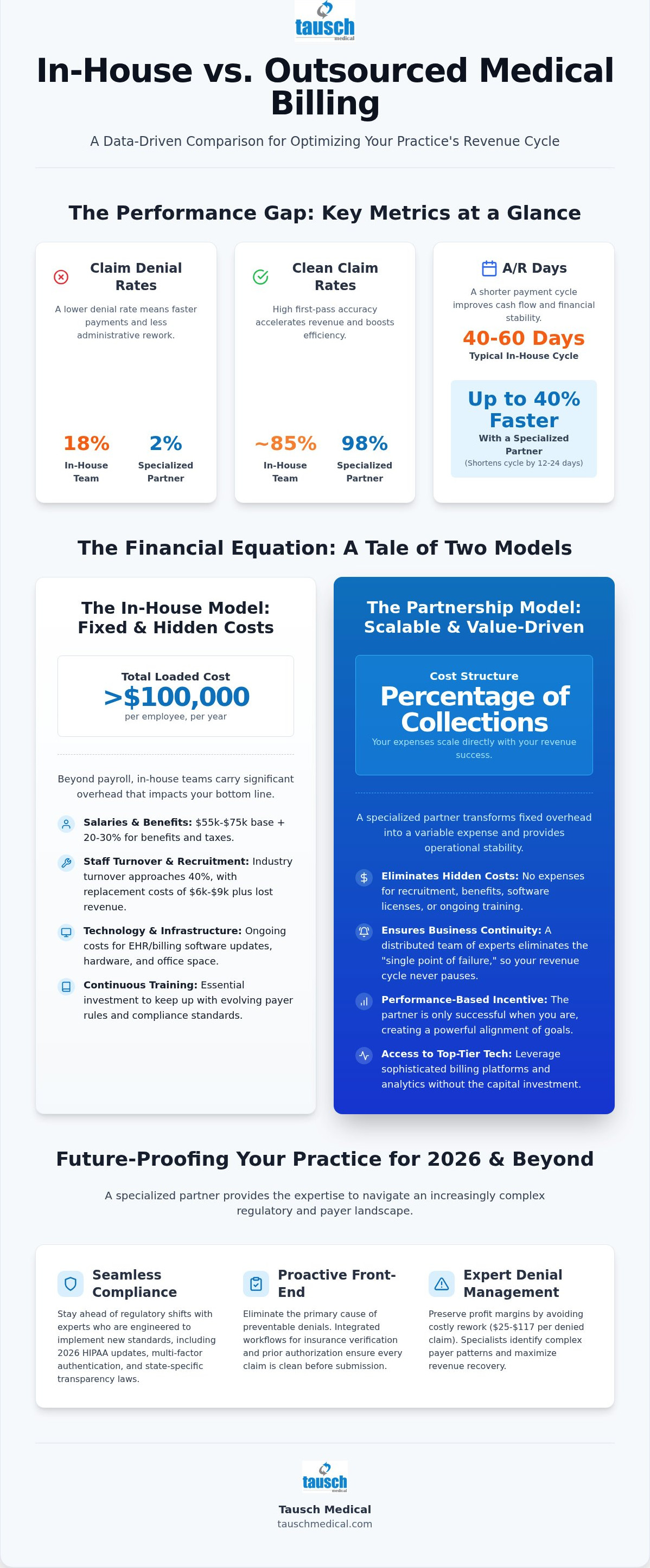
Understanding the financial implications of in-house vs outsourced medical billing requires a deep dive into both visible and submerged expenses. Since the early history of medical billing, the shift from manual ledgers to digital systems has moved the cost burden from simple administrative labor to sophisticated technology. For an internal team, direct costs start with salaries ranging from $55,000 to $75,000 per biller, plus a 20-30% premium for benefits and payroll taxes. Outsourcing instead utilizes a percentage of collections model, which ensures that your expenses only scale alongside your actual revenue success.
Beyond the payroll, indirect costs like office space and hardware contribute to a total loaded cost often exceeding $100,000 per in-house employee. Practices must also invest in ongoing medical billing training to stay ahead of 2026 compliance standards and evolving payer rules. Technology overhead adds a final layer of complexity; the price of keeping EHR and billing software updated for new HIPAA encryption protocols is a significant, non-negotiable necessity for internal departments that many managers overlook during initial budgeting.
The Hidden Impact of Staff Turnover and Recruitment
Recruitment is a silent revenue killer in the current labor market. In competitive healthcare hubs like Houston and Atlanta, retaining specialized billers is increasingly difficult because industry turnover rates now approach 40%. When a key staff member departs, the resulting billing interruption can cost between $6,000 and $9,000 in replacement fees, not including the revenue lost from unworked claims while the seat remains empty. Tausch Medical provides essential continuity by eliminating the single point of failure within your office through a distributed team of experts who ensure your revenue cycle never pauses.
Revenue Cycle Performance: Accuracy, Denials, and A/R Days
Performance metrics provide the most objective data for the in-house vs outsourced medical billing debate. Specialized providers typically maintain clean claim rates between 95% and 98%, whereas internal teams often struggle to exceed 85% due to the multitasking requirements of a busy clinical environment. This precision isn't just about administrative speed; it's about the sophisticated medical claim denial management required to handle complex 2026 insurance patterns. Since reworking a single denied claim costs between $25 and $117, a professional approach directly preserves your profit margins by reducing avoidable labor.
When comparing the performance of in-house vs outsourced medical billing, the acceleration of the cash flow cycle becomes a decisive factor. While in-house cycles average 40 to 60 days, professional services can reduce A/R days by as much as 40%, effectively shortening the payment cycle by 12 to 24 days. This acceleration provides the predictable revenue needed for practice expansion and long term technology investment. You can experience these efficiency gains firsthand through a two-week free trial, which demonstrates how specialized focus eliminates administrative bottlenecks.
Mastering Insurance Verification and Prior Authorization
In 2026, front-end errors represent the primary catalyst for back-end revenue loss. Failing to confirm eligibility or obtain proper authorization accounts for the majority of preventable denials. Utilizing dedicated insurance verification services ensures that patient coverage is validated before the clinical encounter even begins. Tausch Medical integrates these authorization workflows seamlessly into your scheduling; this guarantees that every procedure is fully billable and drastically reduces the risk of costly post-service disputes that often frustrate patient relations.
Transitioning to Outsourced Billing: Ensuring Compliance and Control
Transitioning from an internal team to outsource medical billing services requires a strategic shift in how you view operational control. While the in-house vs outsourced medical billing debate often centers on immediate costs, the 2026 landscape demands a focus on data security and regional compliance. Modern HIPAA updates now mandate stricter multi-factor authentication and accelerated PHI access, requirements that professional partners are specifically engineered to implement. Additionally, a partner with local expertise in Texas or New York understands the nuanced insurance response times and state-specific billing transparency laws that often deviate from federal baselines, providing a layer of protection against regional audit triggers.
Transparency is actually enhanced rather than lost during this transition. Sophisticated real-time reporting dashboards allow you to maintain a constant pulse on your practice's financial health, offering granular visibility that manual internal processes usually lack. This technological superiority ensures that every claim is tracked with clinical precision from submission to final adjudication, turning raw data into actionable business intelligence.
Steps to a Seamless Integration with Tausch Medical
Our integration begins with a comprehensive initial audit designed to uncover uncollected revenue and identify structural bottlenecks within your current revenue cycle. We then align your front-desk workflows, ensuring that patient scheduling and data entry are perfectly synchronized with the billing cycle to prevent front-end errors. To eliminate transition anxiety, we offer an "Experience the Difference" phase through our two-week free trial. This risk-mitigation strategy allows you to validate our performance metrics and see the tangible impact on your clean claim rates before finalizing a long-term partnership.
Optimizing Your Revenue Strategy for 2026
Transitioning to a specialized revenue cycle model is no longer a matter of simple cost reduction; it's an investment in clinical precision and operational resilience. We've analyzed how professional RCM teams consistently outperform internal departments by maintaining superior clean claim rates and significantly shortening A/R cycles. This choice between in-house vs outsourced medical billing ultimately dictates your practice's ability to navigate the increasingly complex payer landscape of 2026 while maintaining strict HIPAA compliance.
Maintaining operational efficiency often requires delegating specialized tasks to experts who understand the nuances of their field. Just as healthcare providers outsource revenue cycles to improve performance, industrial facilities can learn more about Tired Tyres to discover how specialized waste management streamlines the disposal of scrap tires and rubber products.
If you're ready to eliminate administrative bottlenecks, Tausch Medical offers expert denial management, professional provider credentialing, and local support in over 15 major US metros. Start your free two-week trial today to witness how our premium RCM support transforms your financial performance. We're committed to helping you turn administrative challenges into a foundation for sustainable practice growth.
Frequently Asked Questions
Is it cheaper to do medical billing in-house or outsource?
Will I lose control of my billing if I outsource to a company like Tausch Medical?
You'll actually gain more visibility into your revenue cycle through real-time reporting dashboards. Unlike manual internal processes that often lack transparency, we provide granular data on every claim. This allows you to maintain a constant pulse on performance metrics without the burden of daily management, keeping you in full control of your practice's financial health with clinical precision.
How much do medical billing companies charge in 2026?
Most professional firms utilize a percentage-of-collections model to ensure their incentives are perfectly aligned with your practice's success. Some providers may offer flat per-claim fees or monthly retainers depending on your volume and specific needs. Choosing the right structure for in-house vs outsourced medical billing depends on your clinical specialty and the complexity of your typical insurance denial patterns.
How long does it take to transition from in-house to outsourced billing?
A seamless transition generally follows a structured timeline starting with a comprehensive audit and workflow synchronization. While the initial setup happens quickly, the full optimization of your revenue cycle typically takes several weeks as we align front-desk tasks with our processing systems. We utilize a trial period to validate performance and ensure your cash flow remains steady during the integration phase.
Disclaimer
This article is for general informational purposes only and does not constitute legal, medical, billing, coding, compliance, or financial advice. Healthcare rules, payer policies, and reimbursement guidelines may change and may vary by situation. Please consult qualified professionals or official sources before making decisions based on this content. Tausch Medical is not responsible for any loss or liability arising from reliance on this information.


