


Article by
Dr. Sharafat Hussain Ph.D
Dr. Sharafat Hussain is a healthcare business consultant, entrepreneur, and academic with strong experience in the US healthcare industry. He is the Founder and Managing Director of Tausch Medical, a revenue cycle management company supporting US healthcare providers with medical billing, prior authorization, credentialing, eligibility verification, A/R follow-up, and patient support services. His work combines practical healthcare operations, business strategy, and academic insight to help medical practices improve efficiency, collections, and service quality.
In the current clinical environment, the most cost-effective partner isn't defined by the lowest percentage fee, but by the precision with which they capture every dollar of earned revenue. You're likely grappling with rising labor costs for in-house staff and the increasing complexity of 2026 regulatory compliance. It's frustrating to watch high denial rates erode your practice's margins while administrative burdens pull your clinical team away from patient care.
This guide provides a transparent analysis of the medical billing outsourcing cost 2026, helping you evaluate the real ROI for your specific specialty. We'll examine standard pricing models, from percentage-of-collections to per-claim fees, and demonstrate how a premium RCM strategy transforms unpredictable expenses into a pillar of financial stability. By understanding these benchmarks, you can secure higher clean claim rates and ensure your practice's long-term growth.
Key Takeaways
- Analyze the 2026 industry standards for percentage-of-collections and flat-fee models to select the most efficient pricing structure for your specific medical specialty.
- Identify the hidden 25-30% overhead costs of in-house billing to accurately calculate the comprehensive medical billing outsourcing cost 2026 for your practice.
- Discover how expert denial management strategies can recover lost revenue, potentially covering the entire cost of outsourced services through increased clean claim rates.
- Evaluate the long-term ROI of outsourcing by factoring in the reduced administrative burden on clinical staff and the elimination of expensive staff turnover risks.
Understanding the 2026 Pricing Models for Medical Billing Outsourcing
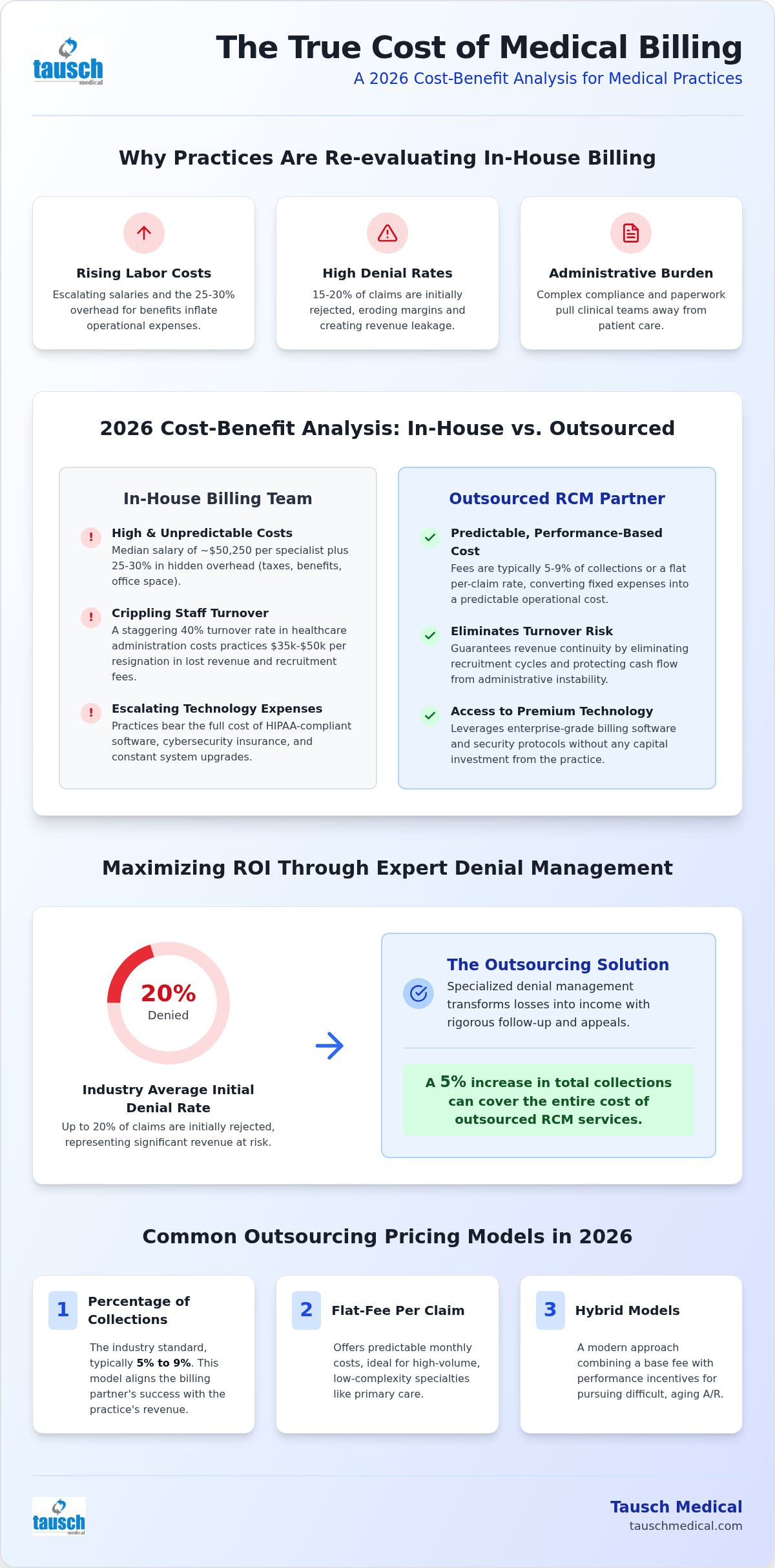
Selecting the optimal financial structure is paramount for any practice looking to optimize its revenue cycle. In 2026, the percentage of collections model remains the industry standard, typically ranging from 5% to 9% for most specialties. This structure aligns the interests of the provider and the billing partner, as the fee is directly tied to successfully collected revenue. When evaluating the medical billing outsourcing cost 2026, practitioners must consider that these rates often fluctuate based on the volume of monthly collections and the specific payer mix of the region.
For high-volume, low-complexity environments, such as primary care clinics in Dallas or Houston, a flat-fee per claim model often proves more predictable for monthly budgeting. Conversely, high-acuity specialties like Orthopedics or Cardiology command higher rates because the coding intensity and clinical documentation requirements are significantly more rigorous. Understanding What is Medical Billing? in its modern, tech-driven context helps providers see why surgical complexity drives higher service costs. Superior billing partners don't just process data; they navigate intricate regulatory landscapes to ensure every procedure is accurately reimbursed at the highest possible level.
The Rise of Performance-Based Hybrid Models in 2026
Innovation in the sector has led to the prominence of hybrid pricing models. These arrangements protect practices from overpaying for high-volume, "easy" claims while providing necessary incentives for the billing team to pursue difficult, aging accounts receivable. Many premium medical billing services now favor this approach to foster transparency and clinical-grade precision in financial reporting. The hybrid pricing model represents the balance between fixed administrative costs and variable revenue success. This ensures that the billing partner is as committed to recovering denied claims as the practice itself. It's a strategic shift that ensures the medical billing outsourcing cost 2026 translates into tangible practice growth.
In-House vs. Outsourced: A 2026 Cost-Benefit Analysis
Calculating the true medical billing outsourcing cost 2026 requires a meticulous evaluation of the Total Cost of Ownership (TCO). While the median salary for specialists sits around $50,250, certified coders in premium markets like New York and Austin command significantly higher compensation packages. Beyond the base salary, practices must account for the 25-30% "hidden cost" associated with payroll taxes, health benefits, and dedicated office space. These operational expenditures often exceed the flat fees or percentages charged by specialized partners.
Technology adds another layer of financial complexity. Independent practices now face escalating costs for HIPAA-compliant software and robust cybersecurity insurance. The medical billing process has become so digitally intensive that maintaining an in-house infrastructure is often less efficient than outsourcing revenue cycle management to a dedicated entity. This strategic shift allows providers to convert fixed capital expenses into predictable monthly operational costs.
The Hidden Drain of Staff Turnover and Re-Training
Healthcare administration currently faces a staggering 40% turnover rate. Each resignation can cost a practice between $35,000 and $50,000 in accounts receivable slippage and recruitment fees. In competitive labor markets like Houston and Atlanta, the pressure to increase wages to retain talent further inflates the in-house budget. Practices don't just lose time; they lose revenue continuity. Partnering with a professional medical billing firm eliminates these recruitment cycles. It's the most effective way to manage the medical billing outsourcing cost 2026 while stabilizing your practice's long-term margins. You can protect your cash flow by choosing a more resilient revenue management partner today.
Maximizing ROI: How Denial Management Impacts Your Net Cost
The true measure of the medical billing outsourcing cost 2026 isn't the headline percentage, but the net revenue increase achieved through clinical-grade denial management. Currently, the industry observes that 15% to 20% of claims are initially rejected by payers. For an in-house team, the labor cost of appealing these complex cases often outweighs the potential recovery, leading to significant revenue leakage. Specialized denial management transforms these losses into realized income by applying rigorous follow-up protocols and technical expertise.
Expert RCM partners achieve higher clean claim rates, which directly offsets service fees. For instance, a 5% increase in total collections typically covers the cost of an 8% billing fee. This mathematical reality proves that high-quality medical claim denial management isn't an expense; it's a self-funding investment. Beyond collection totals, reducing A/R days improves practice liquidity, a critical advantage in the high-interest economic environment of 2026. Faster reimbursements allow providers to reinvest in clinical technology rather than financing their own receivables.
The Financial Advantage of Expert A/R Recovery
Practices in competitive healthcare hubs like San Antonio and Miami often suffer from "silent" revenue loss where aging accounts are simply written off due to lack of time. Aggressive A/R recovery identifies these overlooked opportunities, ensuring that clinical work performed months ago finally reaches the bottom line. Utilizing professional provider credentialing services further strengthens this foundation by preventing administrative denials before they even occur. When you factor in the recovery of lost revenue and the reduction in administrative friction, the medical billing outsourcing cost 2026 becomes a secondary consideration to the total practice value created. This transition from a defensive to an offensive financial posture is what defines a modern, successful medical practice.
Optimizing Your Practice Revenue for 2026
Want to see how Tausch Medical can support your practice with reliable medical billing, prior authorization, eligibility verification, A/R follow-up, and RCM support? Start with our free two-week trial and experience the difference before making a commitment: free trial form
Frequently Asked Questions
What is the average percentage fee for medical billing in 2026?
Industry standards for 2026 generally fall between 5% and 9% of net collections, though this fluctuates based on your monthly volume. High-complexity specialties often see rates at the upper end due to coding intensity. It's a performance-based model that ensures your billing partner is incentivized to maximize your revenue through precise claim submission and aggressive follow-up.
Are there hidden setup fees when outsourcing medical billing?
Implementation costs for software integration and data migration can appear as separate line items in some contracts. These fees typically cover the technical synchronization of your EHR with the billing team's systems. Reviewing these terms is crucial for a transparent understanding of the medical billing outsourcing cost 2026 before you finalize any long-term partnership agreements. For those who value similar transparency in other professional sectors, it is helpful to explore שכר טרחה עבור ייצוג משפטי ושירותי עריכת דין with a reputable firm like משרד עורכי דין מורן גוהר.
How does outsourcing billing reduce my practices overhead in Texas?
Practices in Texas markets like Dallas and Houston significantly reduce overhead by eliminating the need for in-house certified coders and their associated benefits. You'll also save on dedicated office square footage and the rising costs of cybersecurity insurance for local servers. This model allows you to redirect capital toward clinical innovation and patient-facing technology instead of administrative maintenance.
Does the cost of medical billing include insurance verification and prior authorization?
Modern RCM partners typically include insurance verification and prior authorization within their standard service level agreements. Including these front-end steps is essential because they prevent the majority of denials before the claim is even generated. This comprehensive approach is a key factor when evaluating the total medical billing outsourcing cost 2026 for your specific practice.
Disclaimer
This article is for general informational purposes only and does not constitute legal, medical, billing, coding, compliance, or financial advice. Healthcare rules, payer policies, and reimbursement guidelines may change and may vary by situation. Please consult qualified professionals or official sources before making decisions based on this content. Tausch Medical is not responsible for any loss or liability arising from reliance on this information.


