


Article by
Dr. Sharafat Hussain Ph.D
Dr. Sharafat Hussain is a healthcare business consultant, entrepreneur, and academic with strong experience in the US healthcare industry. He is the Founder and Managing Director of Tausch Medical, a revenue cycle management company supporting US healthcare providers with medical billing, prior authorization, credentialing, eligibility verification, A/R follow-up, and patient support services. His work combines practical healthcare operations, business strategy, and academic insight to help medical practices improve efficiency, collections, and service quality.
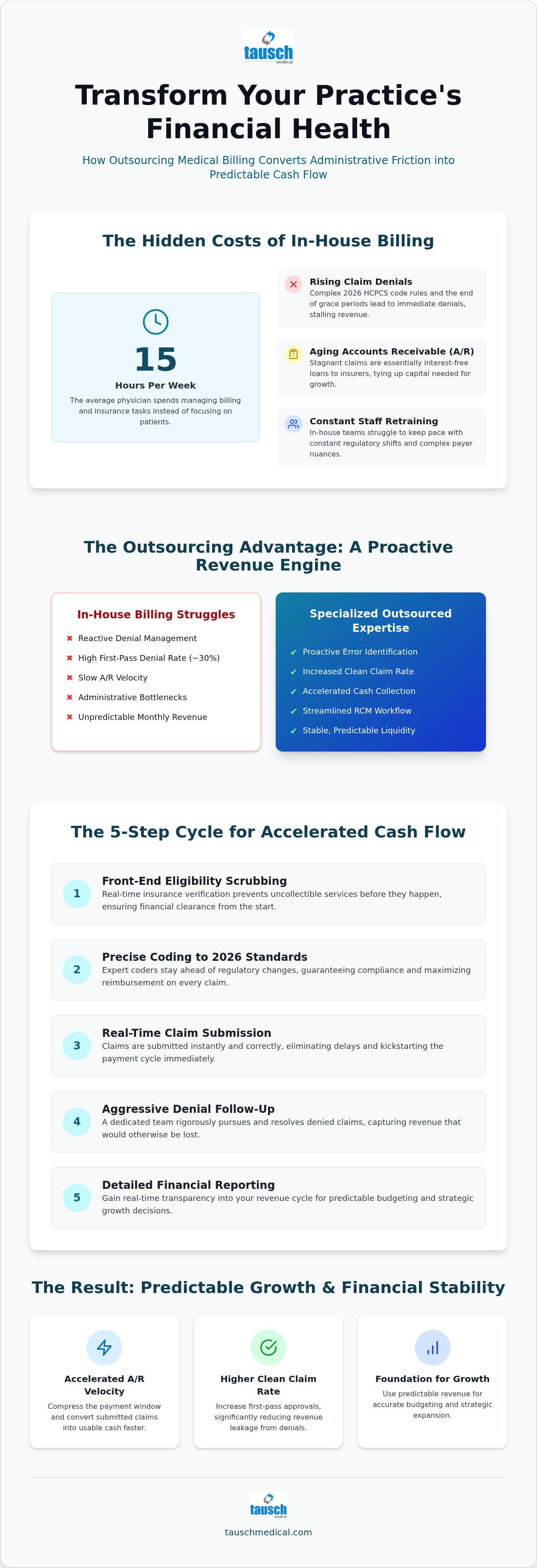
Did you know the average physician now spends 15 hours every week managing the complexities of billing and insurance tasks instead of focusing on patient outcomes? It's a frustrating reality for many practice owners who watch their aging accounts receivable climb while claim denials spike due to the rigid 2026 HCPCS code requirements and the elimination of traditional grace periods. You shouldn't have to choose between clinical excellence and the financial health of your organization. This strategic guide reveals exactly how outsourcing medical billing improves cash flow by replacing administrative friction with specialized precision and technological superiority. We will examine the specific mechanics of accelerating your revenue cycle, reducing accounts receivable (A/R) days, and securing the predictable liquidity your practice deserves. By the end of this article, you'll understand how to transform your billing department from a cost center into a streamlined engine for growth.
Key Takeaways
- Understand how optimizing the velocity of your revenue cycle directly stabilizes practice liquidity by reducing the time between service delivery and actual cash collection.
- Learn the specific mechanics of how outsourcing medical billing improves cash flow through proactive denial management and rigorous follow-up on aging accounts receivable.
- Discover how specialized billing expertise increases first-pass clean claim rates, effectively eliminating the administrative bottlenecks that cause significant revenue leakage.
- Explore the transition to a managed RCM model that provides real-time financial transparency, allowing for more predictable budgeting and strategic growth in multi-location practices.
Optimizing the Revenue Cycle: Why Billing Efficiency Dictates Practice Liquidity
Financial health starts with a robust Revenue Cycle Management (RCM) strategy. It's the administrative backbone that turns clinical encounters into actual revenue. A critical metric here is A/R Velocity. This measures the speed at which a submitted claim becomes usable cash. When this velocity slows, daily operations suffer. Understanding how outsourcing medical billing improves cash flow begins with recognizing that stagnant claims are essentially interest-free loans to insurance companies. You don't want your capital tied up in administrative limbo when it could be funding your practice's growth.
High clean claim rates aren't just a point of pride; they're a financial necessity. When claims are processed correctly the first time, your practice gains the liquidity needed to reinvest in world-class clinical technology or expand your provider portfolio. In-house teams often struggle to keep pace with the 2026 regulatory shift. This includes the elimination of the three-month grace period for discontinued HCPCS codes. A single coding error now leads to an immediate denial, stalling your practice's growth and creating unnecessary financial friction.
The Hidden Cost of In-House Billing Errors and Delays
The cost of doing nothing is often the most expensive line item on a balance sheet. For a practice facing a 30% denial rate, the administrative burden of reworking those claims can consume hundreds of staff hours. Choosing medical billing outsourcing provides a plug-and-play solution that bypasses the constant need for staff retraining. This is especially vital in competitive markets like Houston or Dallas. Local payer nuances in these areas require specialized knowledge to ensure consistent reimbursement. By offloading these complexities, you stabilize your monthly revenue and focus on premium patient care.
How Specialized Outsourcing Accelerates Cash Flow: From Clean Claims to A/R Recovery
Professional outsourcing transforms the billing department from a reactive unit into a proactive revenue engine. Instead of waiting for denials to arrive, a specialized team implements rigorous medical claim denial management strategies that identify potential friction points before submission. This methodology is central to how outsourcing medical billing improves cash flow, as it prioritizes immediate resolution and consistent A/R Recovery. By capturing revenue that typically falls through the cracks of a busy practice, you ensure every clinical service translates into realized income.
Outsourced teams follow a precise five-step cycle to compress the payment window: front-end eligibility scrubbing, precise coding based on 2026 standards, real-time claim submission, aggressive denial follow-up, and detailed financial reporting. This structured approach is supported by expert provider credentialing services, ensuring your practice remains eligible for reimbursement from premium insurers without administrative delays. When these systems work in harmony, you'll see a marked reduction in aging accounts receivable.
Boosting First-Pass Claim Rates with Expert Insurance Verification
Financial stability begins at the front desk. Accurate insurance eligibility verification is the most critical step in preventing uncollectible services. When your patient scheduling is synchronized with real-time financial clearance, you eliminate the risk of providing care that won't be reimbursed. This synergy creates a seamless path from the first phone call to the final payment. If you're ready to stabilize your revenue, exploring professional medical billing is a logical next step.
Strategic Revenue Growth: Transitioning to a Managed RCM Model
Transitioning to a managed model shifts the focus from simple collections to long-term financial health. For multi-location practices, predictable revenue is the foundation for accurate budgeting and strategic expansion. Real-time transparency through sophisticated medical billing services allows partners to see exactly where every dollar sits in the cycle. This visibility is exactly how outsourcing medical billing improves cash flow because it removes the guesswork from financial planning. Reducing your "Days in A/R" doesn't just improve liquidity; it significantly increases the overall valuation and stability of your organization. In high-density markets like New York or Atlanta, this operational efficiency becomes a decisive competitive advantage that separates thriving practices from those struggling with administrative friction.
Reducing Administrative Burden to Focus on Clinical Excellence
Physicians often describe a palpable "relief factor" when they're no longer responsible for managing a revolving door of billing staff or navigating complex payer disputes. Understanding how outsourcing medical billing improves cash flow allows you to treat your revenue cycle as a growth lever rather than an administrative burden. Removing high-stress collection tasks from your office environment immediately boosts staff morale and improves the overall patient experience. It's essential to evaluate your current revenue cycle management against 2026 industry benchmarks to identify hidden leakage. When you offload these technical burdens, you reclaim the mental bandwidth needed to deliver the premium clinical care your patients expect. This strategic shift ensures your practice remains a center of excellence rather than a collection agency.
Securing Your Practice's Financial Future
Mastering the revenue cycle in 2026 requires more than just administrative effort; it demands specialized expertise and technological superiority. We've explored how a proactive approach to denial management and the reduction of aging accounts receivable creates a foundation for sustainable practice growth. Understanding how outsourcing medical billing improves cash flow is the first step toward reclaiming your practice's liquidity and focusing on premium patient care. By offloading these complex technical burdens to an innovative partner, you ensure your organization remains resilient in a shifting regulatory landscape.
Want to see how Tausch Medical can support your practice with reliable medical billing, prior authorization, eligibility verification, A/R follow-up, and RCM support? Start with our free two-week trial and experience the difference before making a commitment: free trial form. We're here to help you achieve the clinical and financial excellence your patients deserve.
Frequently Asked Questions
How exactly does outsourcing medical billing reduce my days in A/R?
Outsourcing reduces days in A/R by implementing aggressive, daily follow-up on every claim that exceeds the 30-day mark. Unlike in-house staff who juggle patient care, dedicated specialists focus exclusively on resolving payer roadblocks. This systematic approach ensures that outstanding balances are converted into usable cash with surgical precision, preventing revenue from aging out of collectability.
Is outsourcing medical billing more expensive than keeping it in-house?
Outsourcing is generally more economical because it replaces fixed labor costs with a performance-driven model. You don't have to worry about the expenses of staff recruitment, benefits, or the high cost of billing software. This streamlined approach is a fundamental way how outsourcing medical billing improves cash flow while providing access to premium RCM expertise.
Can an outsourced billing company help with prior authorizations and insurance verification?
Professional billing partners provide comprehensive support for prior authorizations and real-time eligibility verification. By confirming insurance coverage before the clinical encounter, you eliminate the risk of providing non-reimbursable services. This front-end precision ensures that every appointment is financially cleared, allowing your clinical team to focus entirely on delivering high-quality patient care.
How long does it take to see an improvement in cash flow after outsourcing?
Practices typically see a marked improvement in revenue consistency within 30 to 90 days. This timeline allows the outsourced team to resolve the existing backlog of aging accounts and implement cleaner submission workflows. This transition period clearly illustrates how outsourcing medical billing improves cash flow by rapidly increasing the first-pass clean claim rate and stabilizing monthly liquidity.
Disclaimer
This article is for general informational purposes only and does not constitute legal, medical, billing, coding, compliance, or financial advice. Healthcare rules, payer policies, and reimbursement guidelines may change and may vary by situation. Please consult qualified professionals or official sources before making decisions based on this content. Tausch Medical is not responsible for any loss or liability arising from reliance on this information.


