


Article by
Dr. Sharafat Hussain Ph.D
Dr. Sharafat Hussain is a healthcare business consultant, entrepreneur, and academic with strong experience in the US healthcare industry. He is the Founder and Managing Director of Tausch Medical, a revenue cycle management company supporting US healthcare providers with medical billing, prior authorization, credentialing, eligibility verification, A/R follow-up, and patient support services. His work combines practical healthcare operations, business strategy, and academic insight to help medical practices improve efficiency, collections, and service quality.
Could your practice afford to let 65% of its denied claims go uncollected? With industry-wide denial rates hitting 11.8% in 2026, providers are struggling under heavy administrative burdens and delayed cash flow. It's exhausting to keep pace with shifting payer policies and new CMS-0057-F requirements while maintaining clinical precision. You likely feel that every denied claim distracts from your primary mission of patient care. Implementing robust medical billing denial management best practices isn't just about back-office recovery; it's a vital strategy for long-term financial health.
This guide provides the framework you need to identify, prevent, and overturn denials with surgical accuracy. We'll show you how to optimize cash flow by shifting from reactive rework to proactive data validation. You'll discover how to achieve a clean claim rate of 98% or higher. From 2026 coding updates to reducing days in AR, we're outlining the path to a more efficient, profitable practice.
Key Takeaways
- Learn to distinguish between rejections and denials to deploy the most effective strategic framework for revenue recovery.
- Master medical billing denial management best practices by implementing proactive eligibility verification and standardized authorization protocols.
- Discover how to use data-driven denial logs to identify payer-specific patterns and eliminate recurring administrative bottlenecks.
- Establish precise benchmarks for Days in AR to accelerate your revenue recovery and focus more time on premium patient care.
Categorizing Medical Claim Denials: The First Step Toward Recovery
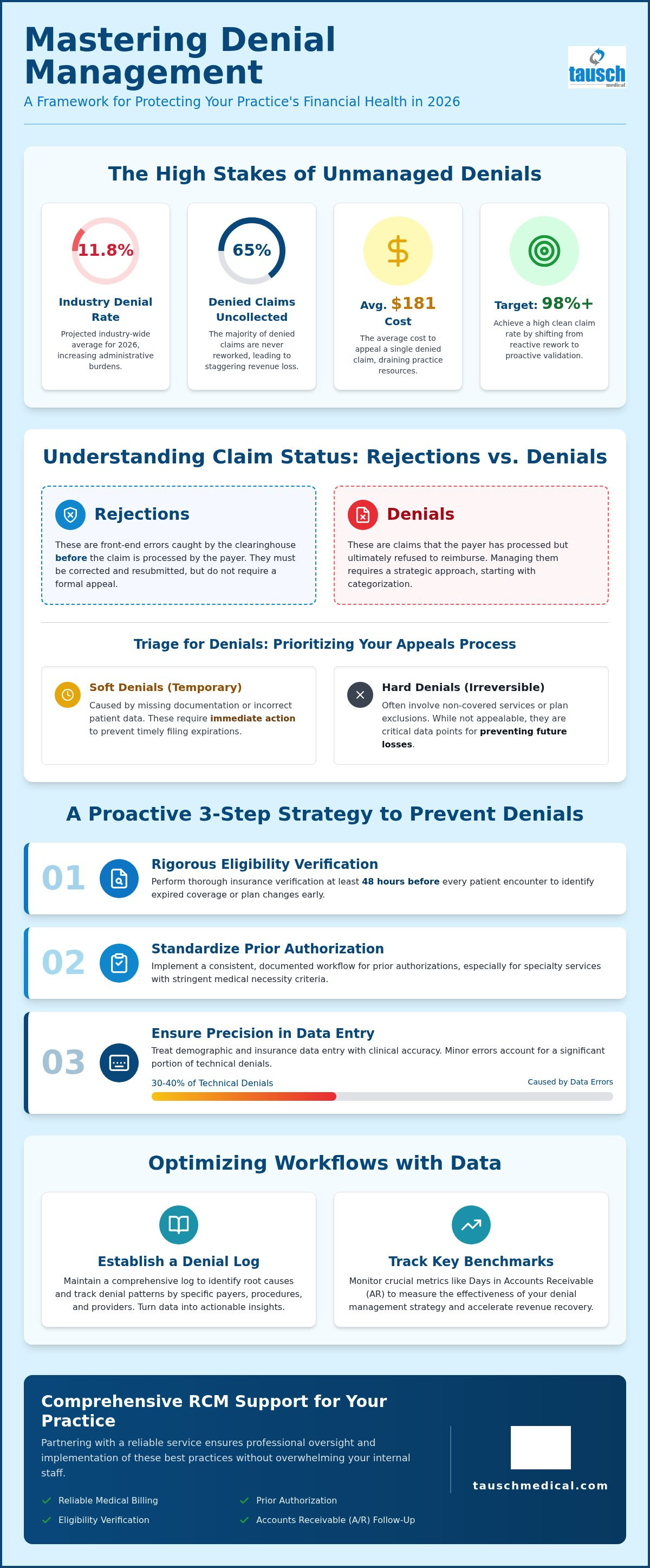
Effective denial management is far more than a reactive administrative task; it's the strategic process of identifying, reviewing, and resolving unpaid claims to protect a practice's financial integrity. By implementing medical billing denial management best practices, clinics can transform their revenue cycle from a source of frustration into a streamlined engine of growth. Success begins with a clear distinction between rejections and denials. While rejections are front-end errors caught by the clearinghouse before processing, denials represent claims that payers have received but ultimately refused to reimburse. Understanding this nuance allows teams to utilize AR and denial services to track these categories accurately, which is the foundational step in recovering lost revenue.
The financial stakes in 2026 are exceptionally high. Industry data indicates the average cost to appeal a single denied claim has reached approximately $181. When you consider that more than half of all denials are never reworked, the cumulative loss to your practice's cash flow is staggering. This reality dictates that prevention isn't just a goal; it's the only viable long-term strategy for medical groups. Shifting your focus toward front-end accuracy reduces the administrative burden on your staff and preserves the premium quality of your practice management.
Hard vs. Soft Denials: Prioritizing Your Appeals Process
Not all denials are created equal, and triage is essential for operational efficiency. Soft denials are temporary setbacks, often caused by missing documentation or incorrect patient data. These require immediate action to prevent 'timely filing' expirations that turn a recoverable claim into a permanent loss. Conversely, hard denials are often irreversible, such as those involving non-covered services or plan exclusions. While these may not be appealable, they serve as critical data points. Analyzing them helps you adjust clinical documentation habits and patient education protocols to avoid future losses. For a deeper dive into these frameworks, see our Medical Claim Denial Management: The 2026 Guide to Revenue Recovery.
Front-End Best Practices: Preventing Denials Before They Happen
Precision in the revenue cycle begins long before the patient enters the exam room. High-performing practices implement medical billing denial management best practices by performing rigorous insurance eligibility verification at least 48 hours before every encounter. This proactive step identifies expired coverage or plan changes that would otherwise trigger a denial. Comprehensive insurance verification and authorization serves as the cornerstone of clean claims, ensuring that the financial foundation of the visit is secure and compliant with 2026 regulations.
Standardizing the prior authorization workflow is equally critical, especially for specialty services where medical necessity criteria are increasingly stringent. Front-desk staff must understand that their role is clinical in its accuracy. Minor data entry errors account for 30% to 40% of technical denials. Training your team to treat demographic entry with the same precision as a medical procedure significantly reduces administrative friction and prevents the constant changes in payer policies from disrupting your workflow. Many practices find that partnering with reliable medical billing services ensures this level of professional oversight without overwhelming internal staff.
The Role of Insurance Verification and Patient Scheduling
Accuracy starts at the first touchpoint. If you don't capture demographic data correctly from the start, the entire claim is compromised. By outsourcing patient scheduling, practices ensure that information is captured correctly from the very beginning. This professional oversight prevents the 'Ripple Effect' of inaccurate verification, where a single initial error leads to downstream delays in payment and increased rework costs. For a detailed analysis of these consequences, explore this guide on verification impact. Integrating these medical billing denial management best practices into your scheduling routine creates a seamless transition from patient intake to final reimbursement.
Data-Driven Denial Management: Optimizing AR and Workflows
Effective revenue recovery demands a shift from anecdotal observations to rigorous, evidence-based data analysis. Establishing a comprehensive 'Denial Log' is essential for identifying root causes by specific payer. In regional hubs like Texas, tracking patterns with major entities such as Blue Cross Blue Shield of Texas or UnitedHealthcare reveals specific adjudication trends that general data might miss. This level of granularity allows your team to address systemic issues at the source rather than treating every denial as an isolated incident.
Setting a strict benchmark for 'Days in AR' and performing weekly performance reviews are foundational medical billing denial management best practices. These reviews allow your management team to identify bottlenecks in the appeals cycle before they compromise your monthly cash flow. By monitoring these metrics closely, you can ensure that your practice's financial health remains as precise and reliable as your clinical outcomes, even as payer requirements become more complex in 2026.
Many practices overlook the critical role of provider credentialing, which frequently leads to preventable 'out-of-network' or 'provider not enrolled' denials. Ensuring that every clinician is properly enrolled and updated with all payers is a non-negotiable prerequisite for mastering revenue cycle management in 2026. This proactive administrative alignment prevents revenue leakage and protects the practice's professional reputation.
Strategic Outsourcing: Leveraging Expert RCM Partners
Evaluating the cost-benefit of outsourcing medical billing often reveals that overstretched in-house teams lack the capacity for deep-dive root cause analysis. A professional partner provides the clinical precision and premium quality required for 2026 compliance, transforming your revenue cycle into a streamlined engine of growth. By leveraging a team that specializes in high-level RCM, you gain access to sophisticated tracking tools and expert oversight that ensure your practice remains at the forefront of the industry while focusing entirely on patient care.
Securing Your Practice's Financial Future Through Precision RCM
Mastering medical billing denial management best practices is no longer optional in a landscape defined by rising payer complexity and strict compliance rules. By shifting your focus toward rigorous front-end verification and utilizing data-driven root cause analysis, you protect your practice from the high costs of unappealed claims. Our specialized RCM support and expert denial management ensure that your revenue cycle operates with clinical precision, while professional provider credentialing keeps your enrollment status current. These strategic steps allow you to reclaim lost revenue and dedicate more resources to premium patient care. You don't have to navigate these administrative burdens alone.
Want to see how Tausch Medical can support your practice with reliable medical billing, prior authorization, eligibility verification, A/R follow-up, and RCM support? Start with our free two-week trial and experience the difference before making a commitment: free trial form
Frequently Asked Questions
What is the most common reason for medical claim denials in 2026?
The most frequent causes in 2026 involve missing or inaccurate information and eligibility issues. Payer policy shifts and the 31% increase in prior authorization denials have made medical necessity documentation a primary challenge. Many practices also struggle with the 288 new CPT codes and 614 new ICD-10-CM codes introduced this year, leading to coding errors that trigger immediate technical denials.
How can a medical practice reduce its denial rate quickly?
How can a medical practice reduce its denial rate quickly?
Implementing medical billing denial management best practices starts with moving verification to the front end. Verifying insurance eligibility at least 48 hours before the encounter prevents coverage-related rejections. Standardizing prior authorization workflows and training staff on data entry precision can reduce technical errors by 30% to 40%. These shifts create a clean claim rate of 98% or higher, accelerating your practice’s cash flow. For clinics in specialized fields, you can learn more about Azriel Rehab Centers and how they manage complex coordination for federal employee injury cases in San Antonio to maintain high efficiency.
A claim rejection occurs at the clearinghouse level before the payer processes the claim, usually due to formatting or data errors. These don't enter the payer's system and require immediate correction. A claim denial happens after the payer processes the submission but refuses payment. Denials require a formal appeal process and often involve deeper issues like medical necessity or provider credentialing status.
How much does it cost a medical practice to appeal a denied claim?
Industry data for 2026 indicates the average cost to appeal a single denied claim is approximately $181. This figure accounts for administrative labor, clinical review time, and overhead expenses. Because the cost of rework ranges between $25 and $118 per claim, many practices find that proactive medical billing denial management best practices are far more cost-effective than reactive recovery efforts.
Disclaimer
This article is for general informational purposes only and does not constitute legal, medical, billing, coding, compliance, or financial advice. Healthcare rules, payer policies, and reimbursement guidelines may change and may vary by situation. Please consult qualified professionals or official sources before making decisions based on this content. Tausch Medical is not responsible for any loss or liability arising from reliance on this information.


