


Article by
Dr. Sharafat Hussain Ph.D
Dr. Sharafat Hussain is a healthcare business consultant, entrepreneur, and academic with strong experience in the US healthcare industry. He is the Founder and Managing Director of Tausch Medical, a revenue cycle management company supporting US healthcare providers with medical billing, prior authorization, credentialing, eligibility verification, A/R follow-up, and patient support services. His work combines practical healthcare operations, business strategy, and academic insight to help medical practices improve efficiency, collections, and service quality.
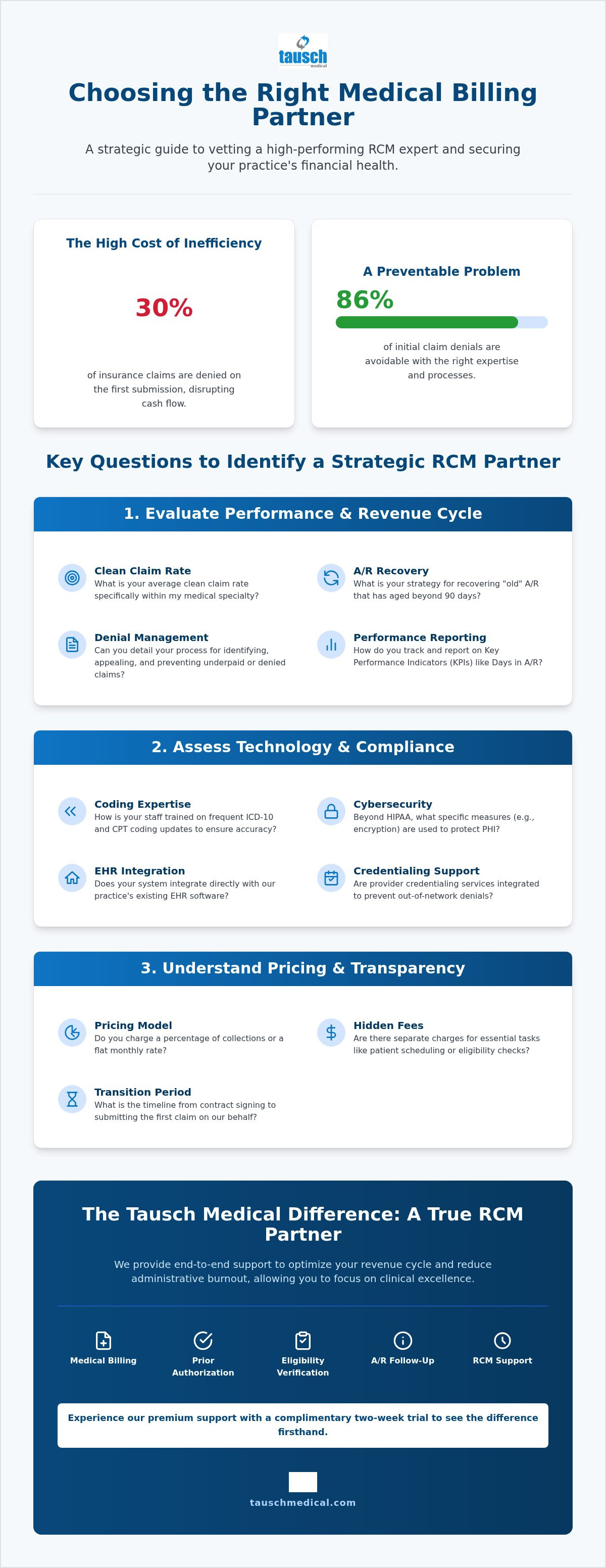
With approximately 30% of insurance claims denied on the first submission and 86% of those being avoidable, your practice's financial health depends on more than just paperwork. Administrative burnout and high A/R days often stem from a lack of clinical precision, turning the revenue cycle into a source of constant frustration. Finding a partner who offers premium support requires a strategic approach, starting with the right questions to ask a medical billing company to ensure they meet your rigorous standards.
We recognize that you seek a partnership rooted in transparency and technological superiority. This guide provides the framework to navigate the vetting process with confidence, ensuring you align with a high-performing RCM expert. You'll discover fifteen critical inquiries that reveal a provider's capabilities in denial management and compliance, allowing you to secure the operational stability and long term success your clinical excellence demands.
Key Takeaways
- Understand how to evaluate a partner's clean claim rates and specialty-specific appeal processes to ensure maximum revenue recovery.
- Identify the essential questions to ask a medical billing company to verify their technical proficiency with EHR integration and strict adherence to 2026 coding updates.
- Gain clarity on various pricing models and service inclusions to avoid hidden fees for essential tasks like patient scheduling and eligibility verification.
- Learn to distinguish between a simple vendor and a strategic RCM partner capable of reducing administrative burnout while optimizing your practice's cash flow.
Evaluating Revenue Cycle Performance and Claim Success Rates
Selecting a partner isn't about finding a vendor; it's about securing a strategic RCM expert. A foundational Medical Billing Overview highlights that efficiency begins with technical precision. The clean claim rate is the primary metric for billing efficiency, measuring the percentage of claims successfully processed on the first submission.
Among the essential questions to ask a medical billing company, you must inquire about their average clean claim rate within your specific medical specialty. Generalists often overlook the nuances of complex coding, which leads to revenue leakage. Demand a clear explanation of their process for identifying and appealing underpaid claims, as passive acceptance of initial payer offers can silently erode your profitability.
Transparency in reporting remains non-negotiable for premium practices. Ask how they track and report Key Performance Indicators, specifically Days in Accounts Receivable (A/R). A high-performing partner provides real time dashboards that link billing activity directly to practice cash flow. These performance metrics represent the most vital questions to ask a medical billing company during your initial consultation.
Probing Denial Management and A/R Recovery Workflows
Sophisticated medical claim denial management prevents minor clerical errors from becoming systemic financial losses. You should request a breakdown of their secondary and tertiary follow-up procedures to ensure no revenue is left on the table. Inquire specifically about their strategy for recovering 'old' A/R that has exceeded the 90 day mark. While many vendors ignore these aged accounts, a dedicated partner uses targeted recovery workflows to reclaim this vital capital, ensuring your practice maintains the liquidity necessary for clinical innovation.
Assessing Compliance, Technology, and Staff Expertise
Technological superiority is not a luxury in modern healthcare; it's a prerequisite for financial stability. When evaluating potential partners, one of the most critical questions to ask a medical billing company involves their strategy for staff training on ICD-10 and CPT coding updates. With CMS implementing frequent adjustments to reimbursement pathways, your partner's expertise must remain dynamic to prevent costly errors. As noted by Forbes on Medical Billing and Coding, the complexity of these professional roles requires ongoing certification and specialized knowledge to ensure accuracy.
Integration capabilities define the efficiency of your daily operations. You must determine if their system integrates directly with your existing EHR or if a disruptive data migration is required. Beyond basic HIPAA compliance, ask about specific cybersecurity measures used to protect Protected Health Information (PHI). Premium providers employ advanced encryption and multi-factor authentication to mitigate the rising risks of ransomware and data breaches. Many high-performing practices find that outsourcing revenue cycle management provides a more robust compliance framework than in-house teams can typically maintain.
Verifying HIPAA Protocols and Specialized Credentialing Support
Revenue leakage often begins before a patient even enters the exam room. Ensure their provider credentialing services are fully integrated with the billing workflow to prevent 'out-of-network' claim denials. A strategic partner provides regular compliance audits and transparent reporting, ensuring every provider in your group remains properly enrolled with all payers. These technical questions to ask a medical billing company help you identify a partner who prioritizes clinical precision and administrative security. If you are ready to enhance your practice's operational integrity, consider exploring a professional billing assessment to identify hidden vulnerabilities.
Understanding Pricing Models and Service Transparency
Strategic financial planning requires absolute clarity regarding fee structures. You must determine if a potential partner operates on a percentage of collections or a flat monthly rate. While percentage based models often align incentives, you should verify if there are additional charges for essential tasks like patient scheduling or eligibility verification. These hidden costs often distinguish a standard vendor from a premium partner who prioritizes comprehensive support.
Transparency also extends to the implementation phase. Ask about the transition period; knowing how long it takes to move from contract signing to the first claim submission is vital for maintaining practice cash flow. These operational details are among the most important questions to ask a medical billing company to avoid unforeseen disruptions during the onboarding process. A partner's ability to provide a clear timeline reflects their organizational maturity and commitment to your success.
Clarifying Data Ownership and the Onboarding Experience
Data integrity is the cornerstone of a secure practice. You must establish who owns the billing data and how it is exported if the partnership ends. A professional partner ensures that your data remains your asset, providing clear protocols for migration. During onboarding, inquire if you'll have a dedicated account manager. Having a single point of professional contact ensures that complex RCM issues are resolved with clinical precision rather than through a generic call center. These are vital questions to ask a medical billing company before signing any long term agreement.
Deciding to outsource medical billing services is a significant step toward scaling your practice. Unlike traditional vendors who demand immediate, long term commitments, a high performing expert should offer a risk free framework to evaluate their service. This "try before you buy" approach allows you to experience their performance firsthand, ensuring the partnership meets your rigorous standards for excellence and reliability.
Securing Your Practice’s Financial Future
Selecting a revenue cycle partner requires more than a simple comparison of fees; it demands a rigorous evaluation of clinical precision. By utilizing these critical questions to ask a medical billing company, you transition from a passive vendor relationship to a high performing partnership. You've learned how to verify clean claim rates, ensure seamless EHR integration, and demand transparency regarding data ownership. Expert Denial Management and Professional Provider Credentialing are not just features but essential pillars for reducing administrative burnout. Specialized A/R Recovery ensures that no revenue is left unclaimed, providing the stability your practice needs to thrive. We invite you to take the next step toward operational excellence.
Want to see how Tausch Medical can support your practice with reliable medical billing, prior authorization, eligibility verification, A/R follow-up, and RCM support? Start with our free two-week trial and experience the difference before making a commitment: free trial form
Frequently Asked Questions
What is a fair percentage to pay a medical billing company in 2026?
Industry standards for outsourced billing typically range between 5% and 10% of net collections, depending on your specialty and claim volume. For behavioral health practices, working with a niche provider like Lumiere Billing can often justify these costs by significantly reducing specialized claim denials. While cost is a factor, the primary focus should be on the net return. A slightly higher fee often includes comprehensive denial management and A/R recovery, which prevents significant revenue leakage. These are essential questions to ask a medical billing company to ensure long term profitability.
How long does it typically take to onboard with a new billing service?
A successful onboarding process generally takes 30 to 60 days to complete. This period is necessary for credentialing audits, secure EHR data integration, and establishing communication protocols. Premium providers use this time to align their workflows with your clinical operations. Rushing this phase can lead to significant claim submission delays, so a structured, methodical approach is always the preferred standard for professional RCM partners.
What happens to my current A/R if I switch to a new billing company?
When transitioning, you can choose to have your new partner manage existing legacy accounts or start fresh with new submissions. Many practices prefer a specialized A/R recovery service to aggressively pursue balances older than 90 days. It's crucial to define data ownership and export formats before the contract begins. This ensures that your financial history remains accessible and that no outstanding claims are overlooked.
Do medical billing companies handle patient collections and inquiries?
Full service RCM experts typically handle patient statements, billing inquiries, and basic collections as part of their integrated support. This often extends to patient scheduling and eligibility verification to prevent denials before they occur. By outsourcing these interactions, your in-house team can focus entirely on clinical care. This level of specialized support is mirrored in other sectors of healthcare; for instance, medical facilities in the Bahamas rely on Tropic Air Rescue for expert emergency transport so they can focus on immediate patient stabilization. Professional billing partners ensure that patient communication remains respectful and accurate, which helps maintain high patient satisfaction levels.
Disclaimer
This article is for general informational purposes only and does not constitute legal, medical, billing, coding, compliance, or financial advice. Healthcare rules, payer policies, and reimbursement guidelines may change and may vary by situation. Please consult qualified professionals or official sources before making decisions based on this content. Tausch Medical is not responsible for any loss or liability arising from reliance on this information.


