


Article by
Dr. Sharafat Hussain Ph.D
Dr. Sharafat Hussain is a healthcare business consultant, entrepreneur, and academic with strong experience in the US healthcare industry. He is the Founder and Managing Director of Tausch Medical, a revenue cycle management company supporting US healthcare providers with medical billing, prior authorization, credentialing, eligibility verification, A/R follow-up, and patient support services. His work combines practical healthcare operations, business strategy, and academic insight to help medical practices improve efficiency, collections, and service quality.
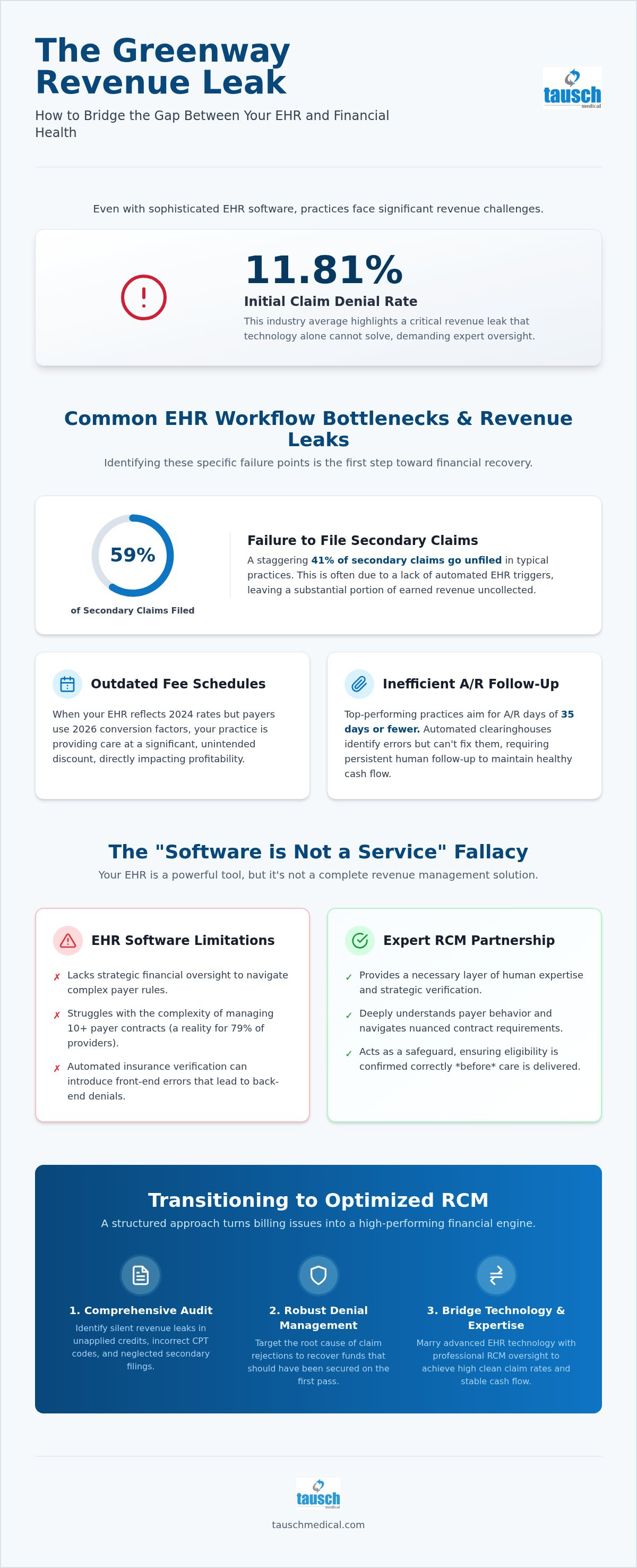
With initial claim denial rates reaching 11.81 percent in recent industry reports, many practices discover that even sophisticated software can't stop the revenue leak on its own. Resolving greenway medical billing problems requires more than a simple software update; it demands clinical precision and an uncompromising commitment to revenue cycle excellence. You likely invested in Greenway Prime Suite or Intergy to streamline clinical workflows, yet your front-desk staff remains buried under a heavy administrative burden while patient collection rates continue to stagnate.
This guide identifies the specific RCM bottlenecks within your EHR and demonstrates how professional medical billing support transforms these hurdles into a high-performing financial engine. We'll explore strategies to reduce your AR days and achieve higher clean claim rates through a more seamless integration between your technology and expert billing oversight. By bridging the gap between software functionality and operational efficiency, you can finally secure the financial health your practice deserves.
Key Takeaways
- Learn to identify specific workflow bottlenecks, such as the failure to file secondary claims, which often compromise the financial integrity of ambulatory practices.
- Understand why relying solely on EHR platforms can exacerbate greenway medical billing problems and how a professional RCM partnership ensures seamless integration between clinical and financial cycles.
- Discover how to close the "patient prompt" gap to prevent delayed collection letters from creating hidden revenue leaks in your practice’s daily operations.
- Master a comprehensive audit and denial management strategy designed to target the root causes of claim rejections and optimize your overall revenue cycle performance.
Identifying Common Greenway Medical Billing Problems & Workflow Bottlenecks
Ambulatory practices often encounter significant friction when managing the technical nuances of secondary claim filing. Industry data indicates that only about 59 percent of secondary claims are filed in typical practices, which means a substantial portion of earned revenue remains uncollected. Within the context of greenway medical billing problems, this failure often originates from a lack of automated triggers. The "patient prompt" gap also creates a specific failure point where collection letters are delayed or entirely missed, slowing down the reimbursement cycle from the very start.
Practice profitability is further compromised when outdated payer fee schedules aren't updated within the Electronic Health Record (EHR). If your internal systems reflect 2024 rates while payers have implemented the 2026 conversion factors, your practice is inadvertently providing care at a significant discount. These administrative coding burdens do more than just frustrate your front-desk staff; they escalate compliance risks. Without expert intervention, these systemic errors require aggressive medical claim denial management to recover funds that should have been secured on the first pass.
The Impact of Poor AR Follow-Up on Cash Flow
Automated clearinghouse services offer speed, but they often lack the sophistication to resolve the underlying clinical documentation issues found in complex denials. They might categorize an error, but they don't fix it. This is why dedicated AR and denial services are vital for resolving greenway medical billing problems and maintaining clinical focus. AR days represent the average duration between the date of service and the receipt of payment; in 2026, top-tier Houston medical groups aim for a benchmark of 35 days or fewer to ensure financial stability. Achieving this requires a level of persistence that software algorithms simply can't replicate.
Why EHR Software Limitations Lead to Revenue Leakage
Many providers fall into the "Software is not a Service" fallacy, assuming that a high-end platform can autonomously manage complex revenue cycle management. While Greenway Prime Suite or the AI-powered Novare platform provide robust clinical tools, they don't replace the strategic oversight required to navigate 2026’s fiscal landscape. Integration challenges often arise because clinical documentation doesn't always align perfectly with the financial billing cycle, leading to silent revenue leaks. Today, 79 percent of providers manage contracts with 10 or more payers simultaneously, creating a level of complexity that basic software logic can't resolve without expert intervention. These systemic greenway medical billing problems highlight the necessity of a partner who understands the nuance behind the data.
Resolving greenway medical billing problems requires more than code; it requires a deep understanding of payer behavior that even "AI-by-design" systems often lack. Relying on automation alone for insurance verification often results in front-end errors that become back-end disasters. Practices that outsource medical billing services find that human expertise provides the necessary layer of verification that technology currently lacks. This professional oversight acts as a safeguard against the common pitfalls of automated systems.
Bridging the Gap Between Clinical EHR and Practice Management
Inaccurate insurance eligibility verification at the point of care triggers a ripple effect of denials that can paralyze cash flow. Implementing professional insurance verification at the front desk level ensures that patient coverage is confirmed before the encounter even begins. High clean claim rates are the clinical evidence of a healthy practice, achievable only through the marriage of advanced technology and professional RCM oversight. If you're ready to stabilize your revenue, consider how professional billing support can eliminate these software-driven bottlenecks.
Transitioning to Optimized RCM: Resolve Billing Issues
Transitioning away from greenway medical billing problems begins with a comprehensive audit of your existing financial workflows. This diagnostic process identifies silent revenue leaks that often hide within unapplied credits, improperly mapped CPT codes, or neglected secondary filings. A robust denial management strategy must target these root causes rather than simply resubmitting rejected claims without correction. By evaluating the ROI of outsourcing medical billing services, practices often find that the cost of professional intervention is significantly lower than the sustained revenue loss caused by in-house software limitations.
Localized expertise provides a distinct advantage in payer negotiations, particularly in competitive markets like Houston, Dallas, and New York. Understanding the specific regional requirements of major insurance carriers allows for more aggressive follow-up and higher recovery rates. This specialized knowledge ensures that your practice management remains aligned with both national standards and local nuances, turning administrative hurdles into streamlined financial pathways.
The Risk-Free Path to Practice Stability
Ensuring long-term financial health also requires meticulous provider credentialing to prevent enrollment-related rejections before they occur. Tausch Medical offers a strategic bridge for practices in Houston and across the country, providing the localized RCM knowledge necessary to resolve complex greenway medical billing problems. A trial period serves as an essential diagnostic tool, allowing you to audit current software performance and billing accuracy without a long-term commitment. This evidence-based approach ensures that every clinical encounter is matched by professional financial recovery.
Want to see how Tausch Medical can support your practice with reliable medical billing, prior authorization, eligibility verification, A/R follow-up, and RCM support? Start with our free two-week trial and experience the difference before making a commitment: free trial form
Securing Your Financial Future in 2026
Stabilizing your practice’s revenue requires a shift from passive software reliance to active revenue cycle management. We've explored how greenway medical billing problems often stem from systemic workflow gaps, such as neglected secondary claims and outdated fee schedules. By integrating specialized denial management experts and comprehensive provider credentialing into your operations, you move beyond the limitations of your EHR. This transition ensures that clinical documentation translates directly into maximized practice profitability without the administrative burden on your staff. Your clinical excellence deserves a financial foundation that is just as precise and uncompromising as the care you provide.
Want to see how Tausch Medical can support your practice with reliable medical billing, prior authorization, eligibility verification, A/R follow-up, and RCM support? Start with our free two-week trial and experience the difference before making a commitment: free trial form
Frequently Asked Questions
What are the most common billing complaints for Greenway users in 2026?
Users frequently report "click-heavy" workflows, slow customer support, and high training costs as significant barriers to efficiency. In 2026, many practices also struggle with the complexity of the updated CPT code set, which includes 288 new codes. These technical hurdles often lead to greenway medical billing problems, specifically regarding the automation of secondary claims and the timely dispatch of patient collection letters.
Can I outsource my billing while still using my current Greenway EHR software?
You can seamlessly integrate professional RCM services with your existing Greenway Prime Suite or Intergy platform. Tausch Medical acts as a strategic partner, utilizing your EHR's clinical data to drive precise financial outcomes. This hybrid approach allows your clinical staff to remain within a familiar interface while our experts handle the specialized tasks of denial management and accounts receivable follow-up.
How does professional denial management improve my practice's clean claim rate?
Professional denial management identifies the root causes of rejections, such as coding inaccuracies or missing documentation, rather than simply resubmitting the same data. By resolving these underlying issues before initial submission, you can significantly increase your clean claim rate. This proactive strategy is essential for practices facing the 2026 CMS conversion factor changes and the 2.5 percent efficiency adjustment for non-telehealth codes.
Is insurance verification the primary cause of Greenway medical billing problems?
While not the only factor, inaccurate eligibility verification is a leading cause of initial denials and delayed payments. Many greenway medical billing problems arise when the software fails to capture real-time coverage changes or specific payer requirements. Professional verification at the front desk ensures that patient coverage is confirmed before the encounter, preventing a ripple effect of financial instability throughout the billing cycle.
How much revenue does an average medical practice lose to billing errors annually?
On average, medical practices lose nearly 4.8 percent of their net revenue to unresolved denials. With initial claim denial rates reaching 11.81 percent in recent reports, the financial impact of even minor coding errors is substantial. These losses are often exacerbated by the high cost of in-house billing staff, where the loaded annual cost per full-time employee is estimated to be between $55,000 and $75,000.
Disclaimer
This article is for general informational purposes only and does not constitute legal, medical, billing, coding, compliance, or financial advice. Healthcare rules, payer policies, and reimbursement guidelines may change and may vary by situation. Please consult qualified professionals or official sources before making decisions based on this content. Tausch Medical is not responsible for any loss or liability arising from reliance on this information.


