

Article by
Dr. Sharafat Hussain Ph.D
Dr. Sharafat Hussain is a healthcare business consultant, entrepreneur, and academic with strong experience in the US healthcare industry. He is the Founder and Managing Director of Tausch Medical, a revenue cycle management company supporting US healthcare providers with medical billing, prior authorization, credentialing, eligibility verification, A/R follow-up, and patient support services. His work combines practical healthcare operations, business strategy, and academic insight to help medical practices improve efficiency, collections, and service quality.
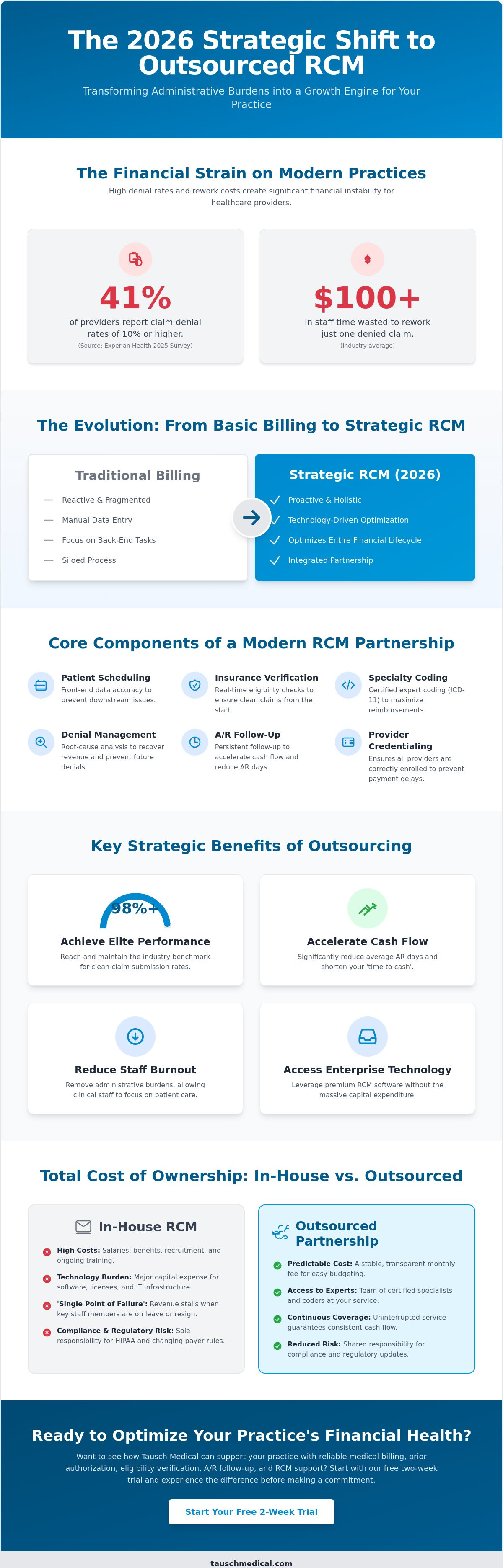
According to a 2025 survey by Experian Health, 41% of healthcare providers report a claim denial rate of 10% or higher, a figure that continues to create financial instability as we move through 2026. If your practice is struggling with these numbers, you aren't alone. Many providers find that the increasing complexity of prior authorizations and the persistent difficulty of hiring certified medical billers have turned their back-office operations into a source of constant stress. This is why outsourcing revenue cycle management is no longer just a cost-saving measure; it's a vital strategic move to protect your clinical mission and ensure long-term viability.
We understand that handing over your financial data requires absolute trust and clinical precision. We agree that your primary focus should remain on patient care, not the exhausting cycle of reworking denied claims that can cost up to $100 in staff time per instance. This guide will show you how to transform your financial operations from an administrative burden into a strategic growth engine through expert RCM outsourcing. We'll explore the latest 2026 regulatory updates, including the 3.26% Medicare conversion factor increase, and provide a roadmap to achieving reduced AR days, lower overhead, and predictable monthly revenue.
Key Takeaways
- Understand the 2026 evolution of the clinical-financial lifecycle, moving beyond manual entry toward intelligent, technology-driven claim optimization.
- Discover how outsourcing revenue cycle management stabilizes your practice’s financial health by accelerating cash flow and significantly reducing average AR days.
- Evaluate the total cost of ownership by comparing in-house salary burdens against the indirect expenses of maintaining HIPAA-compliant infrastructure and software.
- Learn a rigorous selection framework to verify specialty-specific coding credentials and ensure your partner’s technology stack integrates seamlessly with your EHR.
What is Outsourcing Revenue Cycle Management in the 2026 Landscape?
To understand the current shift in healthcare administration, one must first define the core process. What is Revenue Cycle Management? At its foundation, it's the clinical-financial lifecycle that tracks a patient from the initial appointment to the final payment. In 2026, outsourcing revenue cycle management has evolved from a simple back-office utility into a high-precision, technology-driven partnership. Specialized firms now leverage intelligent claim optimization to ensure that clinical services are accurately reflected in financial outcomes, moving beyond the era of manual data entry.
The primary pillars of this modern approach include patient scheduling, insurance verification, coding, and accounts receivable management. These components are more critical than ever due to the 2026 regulatory environment. With the full implementation of ICD-11 and stricter requirements from transparency acts, the margin for error has vanished. Prioritizing outsourcing revenue cycle management ensures that your practice remains compliant while navigating a market where claim complexity is at an all-time high.
The Shift from 'Billing' to Strategic RCM
Traditional billing services often focused on the tail end of the process. Today, end-to-end revenue cycle management replaces those fragmented efforts with a holistic strategy. Real-time data analytics now identify potential revenue leaks before they materialize, allowing practices to adjust workflows proactively. Modern RCM partners function as sophisticated financial consultants who provide the clinical evidence and business intelligence needed to navigate complex payer behaviors. They don't just submit claims; they optimize the entire financial health of the organization.
Comprehensive Components of Modern Outsourcing
Success begins before the patient even enters the exam room. Integrating insurance verification at the front desk is essential to ensure clean claims from the start. Additionally, the chain is only as strong as its weakest link. Professional provider credentialing services are vital to this process. Without accurate credentialing, even the most precise coding cannot prevent payment delays or denials. A comprehensive partner ensures every administrative detail is handled with clinical precision.
The Strategic Benefits of Outsourcing Your Revenue Cycle
Transitioning to a professional model for outsourcing revenue cycle management provides immediate stability to a practice's financial architecture. One of the most tangible advantages is the acceleration of cash flow. By significantly reducing average AR days and shortening the 'time to cash', providers can reinvest in clinical technology rather than chasing overdue payments. This shift is powered by access to elite, certified coding specialists who possess the expertise to navigate the 2026 regulatory environment without the practice having to manage recruitment or retention.
Beyond human capital, this partnership eliminates the 'single point of failure' risk inherent in small, in-house teams. When a solo biller takes leave or resigns, revenue often stalls; an outsourced partner provides continuous, uninterrupted coverage. Practices also gain the ability to leverage enterprise-level RCM technology. This allows for sophisticated data processing and claim tracking without the massive upfront capital expenditure usually required for such premium systems.
Maximizing Yield Through Expert Denial Management
True financial optimization requires moving beyond simple re-billing. Expert teams perform deep root-cause denial analysis to identify why a claim was rejected in the first place. By using payer-specific logic, these specialists recover revenue that less experienced departments often leave behind. The industry benchmark for clean claim rates in 2026 is 98% or higher, a standard that is difficult to maintain without dedicated expertise.
Improving the Patient and Staff Experience
Administrative friction is a primary driver of physician and front-desk burnout. When a practice embraces comprehensive revenue cycle management, it removes the burden of financial dispute from the clinical staff. Patients benefit from transparent, professional billing support that mirrors the high quality of care they receive. This synergy allows providers to dedicate their energy entirely to clinical outcomes, ensuring the practice operates with the precision it deserves. If you're ready to stabilize your operations, exploring professional RCM solutions can be the catalyst for this transformation.
In-House vs. Outsourced RCM: The Total Cost of Ownership
Evaluating the financial efficiency of your practice requires a deep dive into the total cost of ownership (TCO) for your billing operations. Most providers focus on the visible line items, but the true expense of an internal department is often obscured by indirect overhead. Direct costs alone are substantial; in 2026, salaries for in-house medical billers typically range from $55,000 to $75,000, with benefits and payroll taxes adding another 20% to 30% to the base figure. When you factor in the price of office space, hardware, and the maintenance of HIPAA-compliant servers, the investment becomes a significant portion of your operational budget.
Beyond these fixed expenses, 'leakage costs' represent a silent drain on your practice's health. With an estimated 27% of healthcare claims being mispriced annually, the revenue lost to unappealed denials and uncollected balances can be staggering. Reworking a single denied claim costs between $25 and $100 in staff time. Transitioning to outsourcing revenue cycle management converts these unpredictable, rising costs into a predictable model that scales naturally as you add new providers to your team.
The Hidden Expenses of Internal Staffing
Internal teams require constant training to stay current with annual payer policy changes and 2026 regulatory updates. The cost of turnover in a specialized billing department is particularly high, often reaching 1.5 times the annual salary due to recruitment fees and the loss of institutional knowledge. Billing gaps during staff vacations or medical leave create immediate cash flow disruptions. Professional medical billing outsourcing eliminates these vulnerabilities by providing a continuous, expert presence that doesn't rely on a single individual's availability.
Transparency and Financial Control
A common misconception is that moving away from in-house billing results in a loss of visibility. In reality, modern partnerships offer 24/7 cloud-based dashboards that provide more granular oversight than traditional manual spreadsheets. You can establish clear Key Performance Indicators (KPIs) to hold your partner accountable, ensuring your financial data is always accessible and auditable. If you want to see how these efficiencies apply to your specific volume, you can evaluate our RCM support through a trial period to experience the difference firsthand.
How to Evaluate and Select an RCM Outsourcing Partner
Selecting a partner for outsourcing revenue cycle management is a high-stakes decision that requires a structured evaluation framework. It isn't enough to simply look for a vendor; you need a strategic partner who understands the clinical nuances of your specific specialty. A rigorous selection process ensures that your practice's financial health is managed with the same precision you apply to patient care.
To identify the right fit, follow these five essential steps during your evaluation:
- Step 1: Verify specialty-specific expertise and ensure their team holds certified coding credentials, such as CPC or CCS. This expertise is vital for navigating complex 2026 coding requirements.
- Step 2: Audit their technology stack for seamless integration with your existing EHR. Data silos and manual workarounds are the enemies of efficiency.
- Step 3: Confirm SOC 2 Type II compliance and the existence of robust disaster recovery protocols to protect sensitive patient data.
- Step 4: Analyze fee structures to determine if a percentage of collections or a flat-fee model best aligns with your practice's volume and goals.
- Step 5: Review their specific process for medical claim denial management and their historical success in AR recovery.
Critical Compliance and Security Standards
In the 2026 cybersecurity landscape, basic HIPAA compliance is merely the baseline for entry. A truly professional partner provides regular internal audits to prevent OIG compliance issues and utilizes advanced data encryption alongside secure patient communication portals. These layers of security protect your practice from the rising threat of healthcare data breaches, ensuring that your clinical-financial data remains both private and accessible to authorized personnel only.
The Tausch Medical Advantage: Strategic RCM Growth
Tausch Medical serves as a clinical-financial architect for practices in major hubs like Houston and Atlanta, offering more than just administrative support. We utilize a holistic approach that integrates scheduling, insurance verification, and AR management into one streamlined workflow. This synergy eliminates bottlenecks and maximizes the financial potential of every patient encounter, allowing your practice to thrive in a competitive market.
Want to see how Tausch Medical can support your practice with reliable medical billing, prior authorization, eligibility verification, A/R follow-up, and RCM support? Start with our free two-week trial and experience the difference before making a commitment: free trial form
Securing Your Clinical and Financial Future
We've detailed how a strategic approach to outsourcing revenue cycle management transforms administrative burdens into a catalyst for growth. By prioritizing a 98%+ clean claim rate and leveraging specialized US-based denial management, your practice can eliminate the operational risks that stall cash flow. Our SOC 2 Type II compliant processes ensure that your financial data is handled with clinical precision, allowing you to focus entirely on patient outcomes. This shift is essential for maintaining a premium standard of care while ensuring your practice remains financially resilient.
The transition from fragmented billing to a holistic revenue cycle model is the most effective way to protect your margins in the 2026 regulatory landscape. We're committed to your success as a trusted advisor and technical partner. Want to see how Tausch Medical can support your practice with reliable medical billing, prior authorization, eligibility verification, A/R follow-up, and RCM support? Start with our free two-week trial and experience the difference before making a commitment: free trial form. We are ready to help your practice reach its full potential.
Frequently Asked Questions
What is the typical cost of outsourcing revenue cycle management in 2026?
Most professional partners operate on a percentage-of-collections model. This structure ensures that your interests are perfectly aligned; the RCM firm only receives payment when your practice successfully collects on a claim. Some organizations may offer alternative flat-fee-per-claim or fixed monthly staffing models, depending on the complexity of your medical specialty and your total monthly volume.
Will I lose control over my patient billing data if I outsource?
You retain absolute ownership and visibility of your data throughout the partnership. Modern outsourcing revenue cycle management utilizes secure, cloud-based dashboards that provide 24/7 access to your financial performance. You can monitor every claim's progress in real-time, ensuring that transparency remains a core component of the clinical-financial synergy.
How long does the transition from in-house to outsourced RCM typically take?
A standard implementation usually requires between 30 and 90 days to complete. This timeframe allows for a meticulous setup of provider credentialing, seamless integration with your existing technology, and training for your front-desk staff. A structured transition is vital to ensure that your cash flow remains steady while the new workflows are established with precision.
Can an RCM company work with my current EHR software?
Professional RCM firms are built to be software-agnostic and can integrate with almost all major EHR and practice management platforms. The objective is to create a seamless data bridge that facilitates automated claim submission and real-time eligibility verification. This connectivity eliminates the need for redundant data entry and minimizes the risk of administrative errors.
What is the average increase in collections after outsourcing RCM?
Providers often experience a significant lift in net revenue by capturing the 27% of claims that are typically mispriced in an in-house environment. By driving denial rates well below the 10% industry average and utilizing rigorous follow-up protocols, practices stabilize their monthly income. This growth is achieved through a commitment to clean claim rates and expert recovery of previously lost revenue.
Disclaimer
This article is for general informational purposes only and does not constitute legal, medical, billing, coding, compliance, or financial advice. Healthcare rules, payer policies, and reimbursement guidelines may change and may vary by situation. Please consult qualified professionals or official sources before making decisions based on this content. Tausch Medical is not responsible for any loss or liability arising from reliance on this information.


