


Article by
Dr. Sharafat Hussain Ph.D
Dr. Sharafat Hussain is a healthcare business consultant, entrepreneur, and academic with strong experience in the US healthcare industry. He is the Founder and Managing Director of Tausch Medical, a revenue cycle management company supporting US healthcare providers with medical billing, prior authorization, credentialing, eligibility verification, A/R follow-up, and patient support services. His work combines practical healthcare operations, business strategy, and academic insight to help medical practices improve efficiency, collections, and service quality.
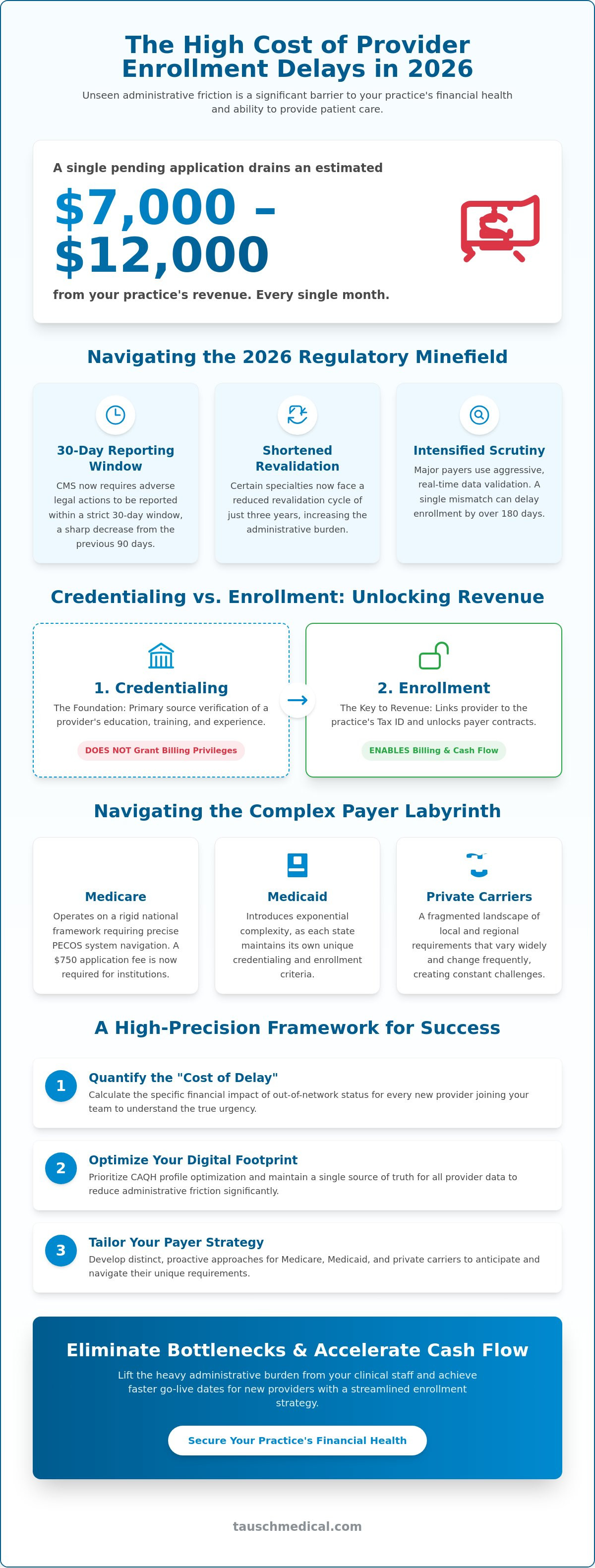
Did you know that a single pending application can drain between $7,000 and $12,000 from your practice's monthly revenue? The 2026 environment for provider enrollment services has shifted into a high-stakes arena where CMS now requires adverse legal actions to be reported within a strict 30 day window. It's an exhausting reality for many healthcare leaders who find themselves trapped in a cycle of repetitive data entry and a total lack of visibility into application statuses. We recognize that these delays aren't merely administrative hurdles; they're significant barriers to both patient care and your organization's financial health.
You deserve a process that reflects the clinical precision and premium standards of your practice. This guide promises to equip you with a strategic framework designed to eliminate administrative bottlenecks and accelerate your practice's cash flow. We'll examine the latest 2026 regulatory updates, including the shortened revalidation cycles for certain specialties, and provide actionable steps to ensure 100% compliance. By the end of this article, you'll understand how to achieve faster go-live dates for new providers while lifting the heavy administrative burden from your clinical staff.
Key Takeaways
- Differentiate between primary source verification and formal payer participation to identify and resolve specific bottlenecks in your revenue pipeline.
- Navigate the diverging requirements of Medicare, Medicaid, and private carriers with a strategy tailored for 2026’s heightened regulatory environment.
- Quantify the financial impact of out-of-network status by calculating the specific "Cost of Delay" for every new provider joining your clinical team.
- Implement a high-precision framework for provider enrollment services that prioritizes CAQH profile optimization to significantly reduce administrative friction.
- Discover how integrating enrollment into a comprehensive revenue cycle management strategy minimizes time-to-revenue and secures your practice’s long-term financial stability.
The Strategic Role of Provider Enrollment Services in 2026
Provider enrollment is the formal process of requesting participation in a health insurance network. It isn't merely an administrative chore; it's the strategic gatekeeper of your practice’s financial viability. The 2026 healthcare market demands a direct correlation between enrollment speed and a practice’s initial 90-day cash flow. When a new provider joins your team, every day they remain out-of-network represents a direct hit to your bottom line. Professional provider enrollment services bridge the gap between clinical readiness and actual reimbursement, ensuring that your expertise is recognized by payers from day one.
The 2026 environment requires a level of digital accuracy that was previously optional. With CMS intensifying oversight and requiring adverse legal actions to be reported within just 30 days, there's no room for error. A single discrepancy in a provider's history can trigger a retroactive revocation of billing privileges. This high-stakes environment rewards organizations that treat data with the same precision they apply to patient care. By prioritizing digital accuracy, you protect your revenue stream from the aggressive data validation protocols now used by major payers.
Enrollment vs. Credentialing: Clearing the Confusion
The Impact of Digital Transformation on Payer Networks
Payer networks have transitioned toward real-time data maintenance. Platforms like CAQH have evolved from simple repositories into dynamic tools for automated revalidation. This digital shift requires a single source of truth for all provider data. This process begins with the acquisition of a National Provider Identifier (NPI), which serves as the unique standard for identifying healthcare providers. In 2026, payers use real-time validation to cross-check this information across multiple databases. If your internal records don't match these national benchmarks, enrollment timelines can stretch beyond 180 days. Modern provider enrollment services leverage these digital advancements to bypass legacy delays, turning administrative friction into a competitive advantage for your practice.
Navigating the Complexities of National Payer Networks
Managing a diverse payer portfolio in 2026 requires more than just administrative persistence; it demands a deep understanding of the diverging protocols between government and private entities. While Medicare operates on a rigid national framework, commercial carriers often present a fragmented landscape of local and regional requirements. For growing national healthcare groups, multi-state enrollment introduces exponential complexity, as each state’s Medicaid program maintains its own unique credentialing and enrollment criteria. Success in this environment hinges on your ability to anticipate these nuances before they result in denied claims or "claims to nowhere."
Medicare and Medicaid: Government Payer Specifics
The Centers for Medicare & Medicaid Services (CMS) has significantly intensified its oversight for the 2026 calendar year. For institutional providers, the Medicare application fee has increased to $750, a necessary investment that requires perfect execution to avoid costly re-submissions. Navigating the PECOS system effectively is only the first step. You must also account for the new 2026 mandate requiring all adverse legal actions to be reported within 30 days, a sharp decrease from the previous 90-day window. Additionally, certain specialties now face a reduced revalidation cycle of just three years. Failing to link your National Provider Identifier (NPI) to the correct group tax ID during these windows remains a primary cause of revenue disruption, often leaving practices with uncollectible debt.
Commercial Insurance Strategy: Beyond the Application
Private payers present a different set of challenges, most notably the "closed panel" objection. When a major carrier claims their network is full, a well-crafted Letter of Intent (LOI) becomes your most powerful tool. This document must go beyond basic credentials to highlight your practice’s unique value, such as specialized clinical outcomes or service in underserved areas. Managing your "par" (participating) versus "non-par" status during the application phase is equally critical. Accepting patients before your effective date can lead to permanent denials that even the most robust appeals process cannot overturn.
Effective provider enrollment services act as a shield against these systemic delays. By maintaining active communication with payer provider relations representatives, you can often negotiate more favorable initial contract terms. If you find the fragmented requirements of national networks are slowing your growth, partnering with a specialized provider credentialing company can provide the technical superiority needed to secure your market position. Precise data management and proactive revalidation are no longer just goals; they're the standards for clinical and financial excellence.
Evaluating Your Strategy: In-House vs. Outsourced Enrollment
Deciding between an internal team and external provider enrollment services often comes down to a misunderstanding of the "Cost of Delay." While a salary might seem like a fixed line item on your ledger, the revenue lost during a 120-day waiting period is a variable that can cripple a practice’s expansion. Industry data shows that practices lose between $7,000 and $12,000 per provider every month due to enrollment gaps. If an in-house staff member makes a single documentation error, which accounts for over 40% of all delays, the "bounce back" from the payer can reset the clock by another 60 days. These aren't just administrative hiccups. They're significant financial leaks.
Hidden costs further complicate the in-house model. High staff turnover in administrative roles leads to constant retraining cycles and lost institutional knowledge. Additionally, the software expenses required to maintain a secure, real-time database of provider credentials can be substantial. Growing practices often find that their internal capacity is stretched thin, leading to a "jack-of-all-trades" approach where billing staff handle complex enrollment. This lack of specialization is a recipe for non-compliance in a year where CMS has intensified its oversight and shortened reporting windows.
The ROI of Professional Provider Enrollment Services
The annual cost of an in-house credentialing specialist can exceed $77,000 when you factor in benefits and overhead. In contrast, a specialized service model offers a predictable cost structure that scales with your provider volume. Professional teams bring a level of technical superiority that internal staff often can't match, particularly when navigating complex payer denials or "closed panel" objections. By ensuring 100% compliance with the 2026 revalidation cycles, you avoid the risk of retroactive billing revocations. For a deeper look at how these decisions impact your bottom line, see our Medical Billing Outsourcing: The 2026 Strategic Guide.
When to Keep Enrollment In-House
There are rare scenarios where internal management remains viable. A single-provider, cash-only practice with minimal insurance participation might manage its own files. However, most organizations reach a critical tipping point when they add their third or fourth provider. At this stage, the administrative burden exceeds the capacity of general office staff. Entrusting your practice’s financial health to someone who is also managing patient scheduling or clinical workflows creates a dangerous bottleneck. The precision required for 2026 payer revalidations is too high for part-time focus. You need a partner who views enrollment as a strategic priority, not a secondary task.
How to Streamline Your Provider Enrollment Process: A 5-Step Guide
Achieving clinical and financial alignment requires a structured approach that treats data with surgical precision. A haphazard submission process is the primary reason why commercial enrollment can stretch to 120 days or longer. To secure your practice’s revenue, you need a repeatable framework that eliminates administrative friction. Professional provider enrollment services utilize a five-step methodology to ensure that no application is left to chance.
- Step 1: Data Aggregation and Primary Source Verification. Collect every necessary document, from board certifications to peer references, before starting any application.
- Step 2: CAQH Profile Optimization and Attestation. Ensure your CAQH profile is 100% accurate and reflects the most current provider data to prevent automated rejections.
- Step 3: Strategic Payer Prioritization and Application Submission. Prioritize payers based on your highest patient volume and submit clean, verified applications.
- Step 4: Rigorous Follow-up and Payer Relations Management. Maintain a consistent touchpoint with payer representatives to move applications through the queue.
- Step 5: Contract Finalization and Billing System Integration. Confirm the effective date and link the provider to your billing software immediately to release held claims.
Phase 1: Preparation and Data Integrity
Success begins with a comprehensive provider digital file. This repository must include current licenses, DEA certifications, and board certifications. Before submitting any payer-specific forms, verify that your data matches the national registry exactly. Even a minor discrepancy in an address or a misspelled name can trigger a "30-day bounce back," resetting your entire timeline. You should also implement a tracking system for all expiration dates. Lapsed credentials are the most common cause of sudden disenrollment, which can halt your cash flow instantly. Proactive maintenance is the only way to avoid these preventable revenue gaps.
Phase 2: Execution and Tracking
Don't wait for the payer to contact you. We recommend an "Every 10 Days" rule for following up with payer enrollment departments. Document every interaction, including the date, the representative's name, and the specific status of the application. This log is essential if you need to escalate a delay to a supervisor. The moment a provider is marked as "active," notify your billing team. This allows them to release claims that have been held in "pending" status, providing an immediate boost to your accounts receivable. If your current team is struggling to maintain this level of persistence, consider partnering with a specialized medical billing company to handle the heavy lifting.
Phase 3: Maintenance and Revalidation
In 2026, the revalidation cycle for some specialties has been reduced to just three years. You must set up proactive alerts for Medicare revalidation cycles to ensure you never miss a deadline. This phase also includes managing "directory accuracy" to comply with the No Surprises Act. Payers are increasingly aggressive about removing providers from their directories if data isn't updated quarterly. For a deeper dive into long-term maintenance, read The Comprehensive Guide to Provider Credentialing Services in 2026. Maintaining a "single source of truth" for your provider data ensures that you remain compliant and visible to patients throughout the year.
Elevating Practice Performance with Tausch Medical Enrollment Solutions
At Tausch Medical, we don't treat enrollment as an isolated administrative chore. We recognize it as the vital foundation for Mastering Revenue Cycle Management. Our solutions are built on clinical precision and a deep understanding of the 2026 regulatory environment. By integrating provider enrollment services into a broader financial strategy, we ensure your practice captures every dollar it earns. We assign a dedicated enrollment specialist to every practice partner, providing a single point of contact who understands the nuances of your specific specialty and payer mix.
This high-touch model naturally complements our Professional Provider Credentialing Services. We bridge the gap between verifying a provider’s background and securing their ability to bill. This end-to-end approach ensures that compliance isn't just a checkbox but a continuous standard of excellence. You won't have to worry about data discrepancies or missed revalidation windows because our team manages the entire lifecycle with technical superiority. We turn administrative complexity into a predictable, high-performance asset for your organization.
The Tausch Medical Advantage: Precision and Speed
Our national expertise allows us to navigate local payer nuances that often stall in-house teams. We operate under a "Zero-Gap" philosophy. This means we work proactively to ensure no revenue is lost during provider transitions or new hires. You'll gain 24/7 visibility into your enrollment pipeline through our customized reporting tools. Instead of wondering about application statuses, you'll have real-time data at your fingertips, allowing for better clinical scheduling and financial forecasting. We turn a traditionally slow process into a streamlined path to reimbursement, reducing your time-to-revenue significantly.
Partnering for Long-Term Growth
As your practice expands into new locations or adds specialized service lines, your enrollment needs will grow in complexity. Tausch Medical provides the scalability required for these ambitious transitions. Our white-glove administrative support allows your clinical staff to focus entirely on patient care while we handle the intricate requirements of national payer networks. We don't just solve today’s administrative hurdles; we build the infrastructure for your long-term business success. Optimize your provider enrollment today with Tausch Medical and experience the difference that world-class expertise brings to your revenue cycle.
Future-Proofing Your Revenue Cycle through Strategic Enrollment
The 2026 healthcare landscape leaves no room for administrative passivity. As we've explored, the technical distinction between credentialing and enrollment is where many practices lose thousands in uncollectible revenue. By implementing a rigorous five-step framework and maintaining 100% compliance with shortened CMS reporting windows, you transform a potential bottleneck into a competitive financial engine. Professional provider enrollment services provide the technical superiority needed to bypass legacy delays and secure your market position from day one.
Tausch Medical brings over 14 years of healthcare administrative expertise to your organization, offering comprehensive national coverage across all major US payers. Our boutique-level service model provides a dedicated account manager for every practice, ensuring that your specific clinical goals are met with personalized precision. You don't have to manage these complexities alone. Streamline your practice revenue—Contact Tausch Medical for expert provider enrollment services. We look forward to helping you achieve the clinical and financial excellence your practice deserves.
Frequently Asked Questions
How long does the provider enrollment process typically take?
Timelines for enrollment vary significantly based on the payer and the complexity of the application. In 2026, commercial insurance enrollment typically takes between 60 and 120 days. Medicare applications generally process within 45 to 90 days, while Medicaid can span anywhere from 60 to 180 days depending on specific state requirements. These periods don't include the initial time required for data aggregation and primary source verification.
What is the difference between provider enrollment and physician credentialing?
Credentialing is the foundational verification of a provider’s professional history, including education, training, and clinical competence. Enrollment is the subsequent administrative process of requesting participation in a health insurance network to receive reimbursement. You cannot begin the enrollment phase until the credentialing process has verified the provider's qualifications. Credentialing proves a provider is qualified; enrollment proves they're authorized to bill a specific payer.
Can I bill for services while a provider enrollment application is pending?
You generally cannot bill for services until you've received a formal effective date from the payer. Submitting claims while an application is pending often results in permanent denials that cannot be appealed. While some payers offer a retroactive effective date based on the submission date, it's a high-risk strategy. Most practices choose to hold claims until the provider is fully "par" to protect their revenue stream.
What is CAQH, and why is it important for provider enrollment services?
CAQH is a national digital repository that stores provider information for use by health plans and other healthcare organizations. It's a critical tool for modern provider enrollment services because it eliminates the need for repetitive manual data entry across multiple payer portals. Maintaining an accurate and attested CAQH profile is the most effective way to ensure data integrity and reduce the risk of application "bounce backs."
How often do providers need to revalidate their enrollment with Medicare?
Most providers are required to revalidate their Medicare enrollment every five years to maintain billing privileges. However, as of January 2026, CMS has reduced this cycle to just three years for several specific provider specialties. Failing to complete this process within the designated window will result in the immediate deactivation of your provider number and a total halt in Medicare reimbursements.
What are the most common reasons for provider enrollment application denials?
Documentation discrepancies account for over 40% of all enrollment delays and denials. Common errors include mismatched addresses, expired state licenses, or incorrect National Provider Identifier (NPI) linkages. Additionally, many applications are denied because the practice failed to respond to a payer's request for additional information within the strict 30-day window now common in 2026. Closed payer panels also remain a frequent challenge for new providers.
Does my practice need a separate NPI for each location during enrollment?
Your practice typically uses one Type 2 NPI for the organization, but every service location must be explicitly linked to that identifier during enrollment. Some payers require unique identifiers or specific sub-codes for different physical sites to ensure claims are processed under the correct geographic fee schedule. Accurate location linking is also essential for maintaining directory accuracy under the requirements of the No Surprises Act.
How can outsourcing provider enrollment services improve my practice’s cash flow?
Outsourcing improves cash flow by eliminating the $7,000 to $12,000 monthly revenue loss associated with enrollment delays. Professional provider enrollment services utilize specialized follow-up protocols to move applications through the payer queue faster than an overstretched in-house team. By reducing the "time-to-revenue" for new providers, you ensure that your practice begins collecting reimbursements the moment clinical services commence.
Disclaimer
This article is for general informational purposes only and does not constitute legal, medical, billing, coding, compliance, or financial advice. Healthcare rules, payer policies, and reimbursement guidelines may change and may vary by situation. Please consult qualified professionals or official sources before making decisions based on this content. Tausch Medical is not responsible for any loss or liability arising from reliance on this information.


